
Moving With Pets in India: Complete Guide for Dogs, Cats and Birds

Moving house can be stressful for people, but for a dog, cat or bird, it can be frightening and potentially dangerous, especially during an Indian summer. When hiring packers and movers Lucknow, remember that household-goods movers transport belongings, not animals. Your pet’s relocation needs separate planning, including appropriate transport, necessary paperwork, applicable rules and safety precautions.
what packers and movers will and will not help with, the documents you need, how air, rail and road each work for pets in India, and species-specific guidelines for dogs, cats and birds. It ends with a full checklist you can work through.
Table of Contents
- 1. Quick Answers
- 2. What Packers and Movers Can and Cannot Do
- 3. Documents Needed for Pet Relocation
- 4. Air vs Train vs Road Travel
- 5. Guidelines for Dogs, Cats and Birds
- 6. Moving With Pets Checklist
- 7. FAQs
| Question | Short answer |
| Will my mover carry my pet? | A household-goods truck is the wrong place for a live animal. A moving truck’s cargo area has no ventilation and can quickly become deadly. Your pet travels with you or with a specialist handler. |
| What papers do I need? | Vaccination record (including rabies) and a vet certificate saying the pet is fit to travel. Trains ask for it within 24–48 hours of departure; one national airline asks for it within 7 days. |
| Can my dog or cat take the train? | Yes, in a First AC coupe or cabin you book entirely, or in a dog box in the brake van. Other classes do not allow pets. |
| Can my pet fly within India? | Policies differ by airline: some carry pets in the cabin and hold, one carries only service dogs, one carries pets as cargo only. |
| Can I move a pet bird? | First check the law. Indigenous Indian birds cannot legally be kept as pets, and exotic species are expected to be registered. |
| How hot is too hot in a parked car? | Outside 29°C, the inside reaches about 40°C in 10 minutes. Never leave a pet in a parked car. |
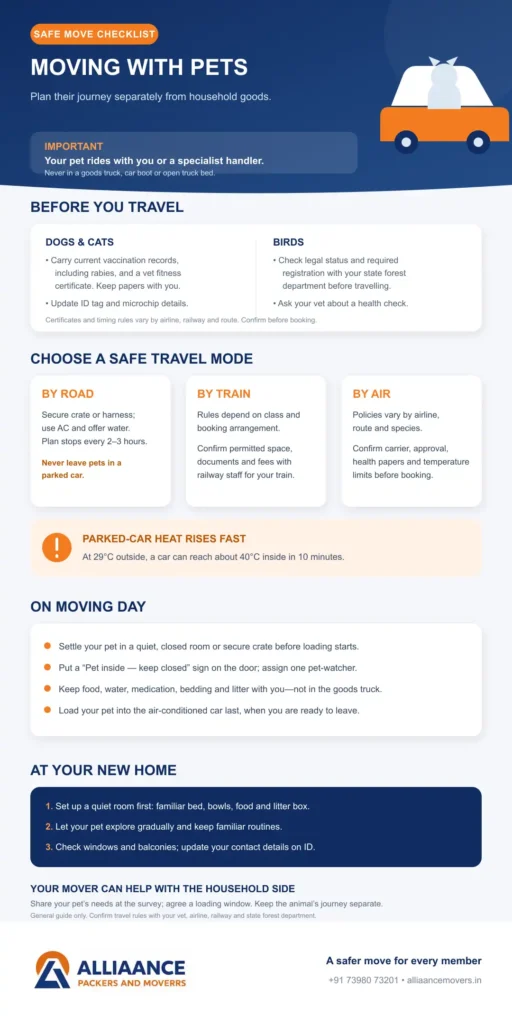
What Packers and Movers Will Not Help You With (and What They Can)
Understanding where a mover’s job ends is the first step to a safe pet move. The animal’s journey is yours to plan; the surrounding logistics are where a mover helps.
A household-goods truck is the wrong vehicle for a live animal
Most movers in other markets do not carry pets at all. In India, practice varies: some movers advertise pet relocation as a separate service using trained handlers and custom containers. If a mover offers it, ask exactly how it works: the vehicle, the ventilation, who handles the animal, and whether you travel alongside.
The goods truck itself is not a safe option. The cargo area of a moving truck has no ventilation and can quickly become deadly. Guidance from animal-welfare sources is never to transport a pet in an open truck bed, a car boot or the storage area of a moving van. Pets ride in the car with you, in a crate or on a pet seat belt, with the air conditioning on.
Alliaance Packers And Movers moves household goods. Your pet should travel with you or with a specialist handler, never on the goods truck.
What you must arrange yourself
| Task | Who does it |
| Vet check, vaccination record and fit-to-travel certificate | You, with your vet |
| Train or flight booking and airline approval | You |
| Travel crate or carrier of the right size | You |
| Updating the microchip and ID tag with your new address and phone number | You |
| Transporting the animal itself | You, or a specialist pet handler |
| Supervising the pet while the crew loads | A family member or sitter you assign |
| Bird registration and legal checks | You, with the state forest department |
| A pet bag with food, water, medication, bedding and litter for several days longer than the trip | You, kept with you and not in the truck |
What your mover can do around a pet move
- Pack and move pet furniture and supplies: empty cages, crates, cat trees, bedding, bowls and toys, as part of the normal household packing.
- Fit loading to your travel plan. Ask for a confirmed loading window at booking so you know when to leave with your pet.
- Plan an early start. Moving pets in the coolest part of the day is the safer choice in hot weather; an early-morning loading slot supports that.
- Know about the pet in advance. Mention at the pre-move survey that an animal lives in the home, so doors, access and timing can be planned around it.
Protect your pet on loading day
Moving day means open doors, strangers and noise, which is a recipe for stress and accidental escape. The single most effective step is to secure your pet before the first box moves.
- Place your pet in a closed room or crate before the crew arrives, and keep it there until you are ready to load it into your vehicle.
- Tape a sign to the door, such as ‘Pet inside — please keep closed’.
- Add water, bedding, a litter box for cats and a familiar item that smells like you.
- Assign one person to watch the pet, so that person is not also helping pack or coordinate the crew.
- For dogs, consider a trusted sitter or boarding for the day, since many dogs cope better away from the chaos.
- Update the microchip and ID tag details before moving day, when escapes spike.
- Put your pet into the car last, so it does not overheat while you finish loading.
How Alliaance Packers And Movers Fits Into a Move With Pets
Alliaance Packers And Movers has operated from Lucknow since 2013. Our part of a move with pets is the household side.
| What you need | What Alliaance provides |
| A clear picture of the job | A free physical or video pre-move survey, followed by a written fixed quote |
| Timing you can plan around | Loading dates and time windows confirmed at booking |
| Pet supplies packed safely | Standard packing of cages, crates, bedding and other pet items with the household goods |
| Visibility for your goods | GPS-tracked own vehicles on intercity moves |
| Somewhere for goods to wait | Secure storage at our Bijnor Road warehouse from ₹3,000 a month, if your dates do not line up |
Related guides:
- Peak Season vs Off-Season Moving: How Season Affects Your Bill
- How to Get an Accurate Moving Quote in India
- Transit Insurance for Packers and Movers: Cost, Coverage and Claims
- What Packing Materials Do Packers and Movers Use?
Documents You Need to Move With a Pet in India
Documents depend on how you travel, so carry the full set. A missing or stale certificate can stop a booking, and some state checkpoints do ask for papers on the road.
The core set for every dog and cat
- Vaccination records, including rabies, with current dates.
- A veterinary health certificate confirming the pet is fit to travel, issued close to the date of travel.
- Identification: a collar tag with your mobile number, plus microchip details if the pet is chipped.
- Your own ID proof, which the railway asks for when you book a pet.
What each mode of travel asks for
Mode | Certificate timing | Other requirements |
Train (Indian Railways) | Vet fitness-to-travel certificate within 24–48 hours of departure | Vaccination record; certificate stating breed, colour and gender; confirmed ticket; ID proof |
Health and rabies vaccination certificate, signed and stamped by a registered vet, not older than 7 days before departure | Pet passport or document with vaccination record; fit-to-fly certificate | |
Air (other guides) | Vet certificate within 7–10 days of travel | IATA-compliant carrier; some guides add microchip proof |
Road (car) | No formal national rule | Carry vaccination records and a vet certificate; some state checkpoints ask for them |
Extra papers for birds
Exotic birds are expected to be registered, with the owner declaring where the bird was bought; the state chief wildlife warden issues the ownership certificate, via the PARIVESH portal. Carry that certificate and your purchase proof. A veterinary health certificate for the bird is also advised.
None of these sources describes a separate transit permit for moving a registered exotic bird between states. Check with the state forest department before you travel. The next sections cover the legal position for birds in full.
Where the sources disagree
Pet-travel rules are not always consistent between guides. Check these points with the airline or railway directly:
- Microchip: some airline guides list a microchip as required, others do not mention it.
- Rabies timing: one guide lists a rabies shot at least 30 days before flying, which the airline pages we read do not state.
- A no-objection certificate from the Animal Welfare Board of India: one guide lists it as mandatory. We could not confirm that for domestic flights, so ask your airline.
- Train charges: sources cite different chargeable weights and describe both a parcel-office and an online booking route.
Keep the papers where you can reach them
Carry originals and phone photos with you, not in a carton on the goods truck. Keep the vet’s name and phone number, and a recent photo of your pet, with them in case of an emergency.
Choosing How to Travel: By Air, Train or Road
For most pets, First AC train travel with you in the same cabin is the most comfortable and least stressful option over a long distance. Car travel suits shorter journeys in familiar surroundings, and flights suit relocations or time-sensitive moves but need the most preparation.
1. By Air
Airline rules diverge more than any other mode, so confirm the policy for your airline and route before you book. Third-party guides sometimes contradict each other about a given airline, so rely on the airline’s own pages.
What one national airline publishes (summary)
| Rule | Detail |
| Species in the cabin | Only domesticated dogs and cats |
| Cabin weight | Up to 10 kg including the carrier |
| Pets per flight in the cabin | Two, each with an accompanying passenger |
| Seating | Economy only, aisle seats in the last row; two pets seated at least five rows apart |
| Minimum age | 8 weeks for the cabin |
| Advance approval | Request at least 48 hours before departure |
| Cargo | Combined pet and carrier weight over 32 kg is booked as cargo |
| Flat-faced breeds | Snub-nosed dogs and cats are not carried in the cargo hold; for the cabin, consult a vet |
| Pregnant pets | Not accepted; tell the airline if the pet gave birth in the last 48 hours |
| Sedation | Do not sedate before the pre-departure health assessment |
- Other airlines differ: one accepts dogs and cats from 3 months in the cabin or hold with booking at least 48 hours ahead; another carries only service dogs; another carries pets only as cargo.
- Your carrier must let the pet stand, turn and lie down comfortably, and meet IATA live-animal standards for size and ventilation.
- Approximate costs: a cabin pet about ₹3,000–5,000 per sector, and domestic cargo about ₹5,000–15,000 per sector.
- Some routes pause live-animal transport in peak summer or winter because of temperature limits, so confirm for your dates.
- Birds: the airline whose policy we read accepts only dogs and cats in the cabin. If you need to fly a bird, ask the airline about cargo, or choose road transport.
2. By Train (Indian Railways)
Indian Railways carries dogs and cats under two arrangements: with you in First Class AC, or in the brake van without you.
| Class or option | Pets allowed? |
| AC First Class or First Class: the entire 2-berth coupe or 4-berth cabin | Yes |
| AC 2-tier, AC 3-tier, AC Chair Car, Sleeper, Second Class | No |
| Dog box in the luggage-cum-brake van (SLR) | Yes, booked separately; under the guard’s supervision |
| Vande Bharat sleeper pet box | Reported as a fixed in-train enclosure with pre-booking; confirm with the railway |
Option 1: First AC coupe or cabin, with your pet
- You must book the entire compartment, so a single traveller books a full coupe or cabin.
- One dog goes on one PNR; with more than one dog, book an extra passenger so each dog has its own PNR.
- Cats and dogs are both permitted under this arrangement.
- Charges are at luggage rates; one guide cites a chargeable weight of 60 kg per dog in First AC, with an approximate cost of ₹300–2,000 depending on distance.
Option 2: the brake van, without you
- A dog travels in a dog box in the luggage-cum-brake van, charged at luggage rates; one guide cites a chargeable weight of 30 kg per dog.
- Official guidelines as quoted require the dog to be chained with a muzzle before boarding.
- Ventilation is limited and the brake van can get hot in Indian summers, so it is not ideal for anxious, elderly or sensitive breeds.
Booking and rules to know
- Booking: a 2026 guide says to book your own ticket first, then use the ‘Dogs/Cats Booking’ section of the IRCTC website under the Trains menu, or book at the station parcel office. Older rule summaries describe luggage-office booking only and no advance booking, and a 2023 report said online pet booking was being planned. Confirm which applies on your train.
- Documents: vaccination record and a fitness-to-travel certificate within 24–48 hours of departure; a certificate stating breed, colour and gender.
- Food and water: the railway does not provide food for animals, and the owner arranges water and food.
- Penalty: carrying a dog without proper booking is charged at six times the applicable luggage rate, with a minimum of ₹30.
- The parcel office issues a receipt; keep it with your other papers.
- Birds: the rules we found cover dogs and cats. Do not send a bird as an unmarked parcel; ask the railway what is permitted.
- Buses generally have no provision for pet travel.
3. By Road (Car)
Car travel is the most flexible option, and there is no formal national regulation governing it the way trains and flights are governed. That makes your own precautions the whole safety system.
- Secure your pet in a well-ventilated crate, or on a pet seat belt harness. Never let pets roam in the car.
- Make the crate large enough for the pet to stand, sit, lie down and turn around, and secure it so it cannot slide.
- Never let a dog travel with its head out of the window on highways, because of injury risk from debris and sudden stops.
- Plan rest stops every two to three hours, especially in summer, and carry fresh water and a portable bowl.
- Avoid a full meal just before a long drive, to reduce motion sickness.
- Carry vaccination records and a vet certificate if you cross state lines, since some checkpoints ask.
- Run the air conditioning, and move pets in the coolest part of the day.
Never leave a pet in a parked car. Veterinary association data cited in one guide shows how fast the inside heats:
| Outside temperature | Inside after 10 minutes | Inside after 30 minutes |
| 24°C | 34°C | 43°C |
| 29°C | 40°C | 48°C |
| 35°C | 46°C | 54°C |
Converted from the Fahrenheit figures cited. Indian summer temperatures are higher still. Cracking a window does not make a parked car safe.
Which mode suits which move
| Mode | Best for | Watch out for |
| Road | Shorter distances and familiar surroundings | Heat, rest stops, state checkpoints asking for papers |
| Train, First AC with you | Long distance; the most comfortable and least stressful for most pets | Must book the full coupe or cabin; booking route and charges vary |
| Train, brake van | When a First AC coupe is not available | Limited ventilation and heat; poor for anxious, elderly or sensitive pets |
| Air | Relocation or time-sensitive moves | Airline policies differ; temperature embargoes; flat-faced breeds barred from cargo at one airline |
| Bus | Not suitable | No provision for pets |
Species-Specific Guidelines: Dogs, Cats and Birds
Each species has its own risks. Dogs struggle most with heat and breed restrictions, cats with confinement and escape, and birds with the law and with temperature.
Dogs: Crates, Heat and Breed Restrictions
Before the move
- Get the vet check, vaccinations and fit-to-travel certificate in order.
- Introduce the crate two to three weeks ahead: leave it open with a blanket, feed meals inside it and practise short sessions with the door closed.
- Decide who will be with the dog on moving day, or arrange a sitter or boarding.
Heat and breed risks
- Flat-faced breeds, such as pugs and bulldogs, cannot pant efficiently. Seniors, puppies and overweight pets also regulate heat poorly.
- Watch for heavy, rapid panting that does not ease with rest, drooling and wobbliness. These signal heat stroke: cool your pet down and call a vet fast.
- At the airline whose policy we read, flat-faced dogs and cats are not carried in the hold.
- Do not sedate before the pre-flight health assessment, and talk to your vet about any travel medication.
On the journey
- Use a crate or a harness attached to the seat belt.
- Stop every two to three hours, keep the dog on a leash, and offer water.
- On the train, one dog goes on one PNR and the First AC coupe is booked entirely; in the brake van the dog is chained and muzzled in a dog box.
On arrival
- Set up the dog’s bed, bowls and toys in a cool, quiet room before unpacking.
- Update the collar tag and microchip with your new address and phone number.
Cats: Carriers, Litter and Calm Arrival
Before the move
- Leave the carrier open in a familiar room in the days before, with bedding inside.
- Keep the carrier, not the car, as the cat’s safe space.
In the car or train
- Cats should always be in a secured carrier, strapped to a seat with the seat belt or wedged on the floor so it cannot slide. Never let a cat ride loose.
- Position the carrier away from direct air-conditioning vents. Never leave a cat in a hot or parked car.
- Pack food, water, medication, blankets and litter for several days longer than the trip, plus a litter box and dishes that fit in the carrier.
- Offer water and a litter box on long drives, with stops every two to three hours.
- Avoid large meals immediately before departure.
- Guidance on rest stops differs. Some vets say let the cat out in the car to stretch and use the litter box, but do not open doors or windows while it is loose; others say keep the cat in the carrier at all times during stops. If you take a cat outside the car, use a harness and leash.
- If your cat is very sensitive, ask your vet about motion-sickness medication or a sedative; do not give anything on your own.
- On trains, cats are permitted in a First AC coupe or cabin booked entirely. On flights, snub-nosed cats are barred from the cargo hold at one airline.
On arrival
- Set up one room first with the litter box, food and water, keep the carrier door open and let the cat come out at its own pace; open up the rest of the home gradually.
- In a high-rise, do not open windows wide enough for a cat to squeeze through, and keep the cat off the balcony.
Birds: Check the Law First, Then Travel Carefully
Step 1: Is your bird legal to keep?
There is no single list of legal pets in India. Instead, laws set out a negative list of animals that cannot be kept. For birds, the position under the Wild Life (Protection) Act, 1972 is summarised below.
Type of bird | Legal position reported | Source |
Indigenous (native) Indian birds, such as rose-ringed and Alexandrine parakeets, munias and mynas | Capture and trade are banned; local birds are categorised as wild animals and are illegal to keep as pets. For rose-ringed parakeets, an animal-protection group reports penalties of a fine up to ₹1 lakh, jail up to 3 years, or both | |
Exotic (non-native) birds | May be kept as pets, but registration is expected, with the owner declaring where the bird was bought; the state chief wildlife warden issues an ownership certificate through the PARIVESH portal | |
CITES-listed exotic species, such as the African Grey Parrot | Listed under Schedule IV; registration of exotic live species is mandatory under rules notified in 2024; illegal possession is punishable |
- Budgerigars and zebra finches are named as exotic birds bred in captivity in India in a government reply to Parliament.
- Which exotic species must be registered depends on the current rules. Ask the state chief wildlife warden for the list and the process.
- If you live with a native species, moving the bird does not change the legal position. Speak to your state forest department or a wildlife rescue organisation before you travel, and do not move native birds between states on your own.
- Transporting caged birds as unmarked parcels by bus is a known pattern in wildlife-trafficking seizures, so keep your papers with you and the bird.
Step 2: Prepare the bird
- Visit an avian vet well ahead of a long trip: one guide suggests two to three months, so any supplements have time to take effect. Get a health certificate.
- Use a travel cage, not necessarily the home cage, which can be hard to secure. Get the bird used to it first.
Step 3: Travel safely
- Remove toys and swings so nothing swings or injures the bird on rough roads.
- Secure the cage with a seat belt so it cannot shift.
- Skip the water dish: it can spill and leave the bird soaked and chilled. Offer water at frequent stops instead.
- Cover part of the cage if the sun is too bright or the window view agitates the bird, but not the whole cage, because that cuts airflow.
- Keep the temperature moderate. In hot weather ensure ventilation and never leave the bird unattended in the car; in cold weather, pre-warm the car and cover the cage.
- Do not place the cage directly in front of a car vent.
- Many birds can chew their way out of a box, so monitor the bird. Fix a low perch where possible so the bird can step off during sudden stops.
- For short trips, avoid feeding before departure, since a full crop makes car sickness worse.
- Take the cage carrier with you at every stop.
- Line the cage floor so it is easy to clean.
Step 4: Settle in
On arrival, set up the bird’s familiar cage, food, water and toys in a quiet area and give it time to adjust.
Complete Moving-With-Pets Checklist
Four weeks or more before the move
- Book a vet check; confirm vaccinations, including rabies, are current
- Decide the travel mode: road, First AC train or flight
- For flights, confirm the airline carries your pet and request approval at least 48 hours ahead; check weather embargoes
- For trains, check the booking route and the First AC coupe or cabin; book your own ticket first
- Start crate or carrier training two to three weeks before
- Birds: confirm the legal status and registration; speak to the state forest department
- Find a vet at the new location and ask your current vet for a referral
One week before
- Time the vet certificate: 24–48 hours before a train; within 7 days before a flight at the airline whose policy we read
- Update the microchip and ID tag with your new address and phone
- Pack a pet bag: food, water, medication, bedding, litter, bowls, leash, vet papers
- Tell your mover that a pet lives in the home, and confirm the loading window
The day before
- Check the weather forecast and plan an early start
- Charge your phone and keep the vet’s number to hand
- Keep all papers in one folder, with phone photos
Moving day
- Place your pet in a closed room or crate before the crew arrives, with a sign on the door
- Assign one person to watch the pet
- Avoid a large meal before departure
- Load your pet into the car last, with the air conditioning on
On the journey
- Secure the crate or harness; nothing loose in the car
- Stop every two to three hours; offer water; keep dogs on a leash
- Never leave a pet in a parked car
- Carry papers where you can reach them for checkpoints and parcel offices
On arrival
- Set up one room with bed, bowls and litter box before unpacking
- Let the pet explore slowly and keep to normal routines
- Check windows and balconies in a high-rise
- Register with the new vet and update records
Get a Free Quote in 30 Seconds!
Tell us your move details and our team will call you back within 15 minutes — 7 days a week.
“Pay only 10% on delivery — after you are satisfied”
✅ No spam · No hidden charges · Call within 15 mins
🔒 Your information is 100% safe and never shared
⭐ 800+ families trust Alliaance Packers And Movers
📞 Prefer to call?
Frequently Asked Questions About Moving With Pets in India
A household-goods truck is not suitable for live animals, because the cargo area has no ventilation and can quickly become deadly. Some movers advertise pet relocation as a separate service with trained handlers and custom containers; ask how it works. Otherwise plan your pet’s travel separately.
Carry the vaccination record, including rabies, and a vet certificate stating the pet is fit to travel. Trains ask for it within 24–48 hours of departure; one national airline wants it not older than 7 days. Railways also ask for a certificate stating breed, colour and gender. Exotic birds need a registration certificate.
Yes, in a First AC or First Class coupe or cabin that you book entirely, or in a dog box in the brake van. Other classes do not allow pets. One dog goes on one PNR. Cats are also permitted in First AC.
It depends on the airline. One carries dogs and cats in the cabin up to 10 kg including the carrier, and in the hold, with approval requested 48 hours ahead; another carries only service dogs; another carries pets only as cargo. Flat-faced breeds are not carried in the hold at one airline.
As approximate figures from one 2026 guide: First AC pet luggage on the train ₹300–2,000 depending on distance, cabin pets on flights ₹3,000–5,000 per sector, and domestic cargo ₹5,000–15,000 per sector. Check current fees with the railway or airline.
It can be, with care. Move in the coolest part of the day, run the air conditioning, never leave a pet in a parked car, and watch for heat stroke signs such as heavy panting, drooling and wobbliness. Flat-faced breeds, seniors and puppies are at greater risk.
First confirm the bird is legal to keep. Indigenous Indian birds cannot be kept as pets, and exotic birds are expected to be registered with an ownership certificate. If the bird is legal, travel in a secured cage with toys removed, no water dish, a moderate temperature and frequent stops. Check with your state forest department before crossing state lines.
Not on your own. One airline asks owners not to sedate before the health assessment. If a pet is very sensitive, ask your vet about motion-sickness medication or a sedative.
Set up a quiet corner first with the bed, bowls, toys and litter box. Let pets explore slowly and keep to their normal routine. For cats, start with one room and open up the home gradually.
Ready to Move with a Verified Scam-Free Mover in Lucknow?
Every scam pattern in this guide has a verifiable counter at Alliaance Packers And Movers. Our payment structure, documentation practices, and transparent processes are designed to make fraud structurally impossible.