
How to Pack Fragile Items Like a Professional Mover
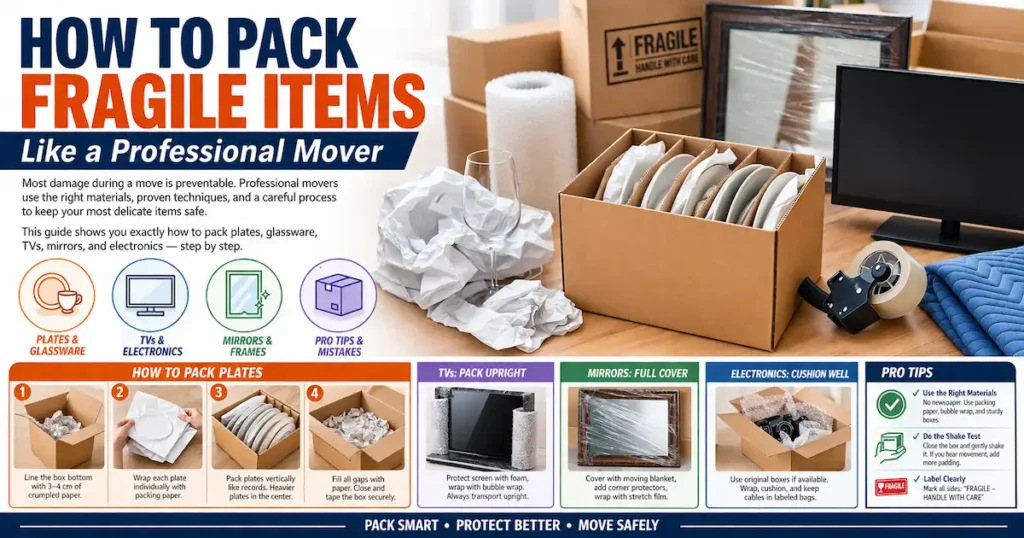
Most damage during a house move is not caused by the distance, the truck, or the road — it is caused by poor packing. A dish packed flat instead of on its edge breaks under the weight above it. A television laid flat instead of upright develops screen pressure cracks. A glass not wrapped individually chips where it touches the next one in the box. These are entirely preventable failures, and professional movers — especially experienced packers and movers in Lucknow — avoid all of them using specific, repeatable techniques.
This guide documents the exact methods professional movers use to pack the items most commonly damaged during relocation: crockery and glassware, televisions, mirrors and frames, and electronics. Every technique in this guide is verified practice used by trained packing crews — not guesswork.
Alliaance Packers And Movers has provided professional packing services in Lucknow since 2013. Our packing crew handles crockery, glassware, flat-screen TVs, mirrors, antiques, and electronics on every local and intercity move. The techniques in this guide are what our team uses on the job. If you would prefer professional packing rather than doing it yourself, call +91 7398073201 for a free pre-move survey.
Table of Contents
- Packing Materials Used by Professionals
- Packing Crockery, Plates & Glassware
- Packing Flat-Screen TVs Safely
- Packing Mirrors, Frames & Artwork
- Packing Electronics & Small Appliances
- Professional Loading Rules for Fragile Items
- Common Packing Mistakes to Avoid
- How Alliaance Packers and Movers Handle Fragile Items
- FAQs
Packing Materials: What Professionals Actually Use
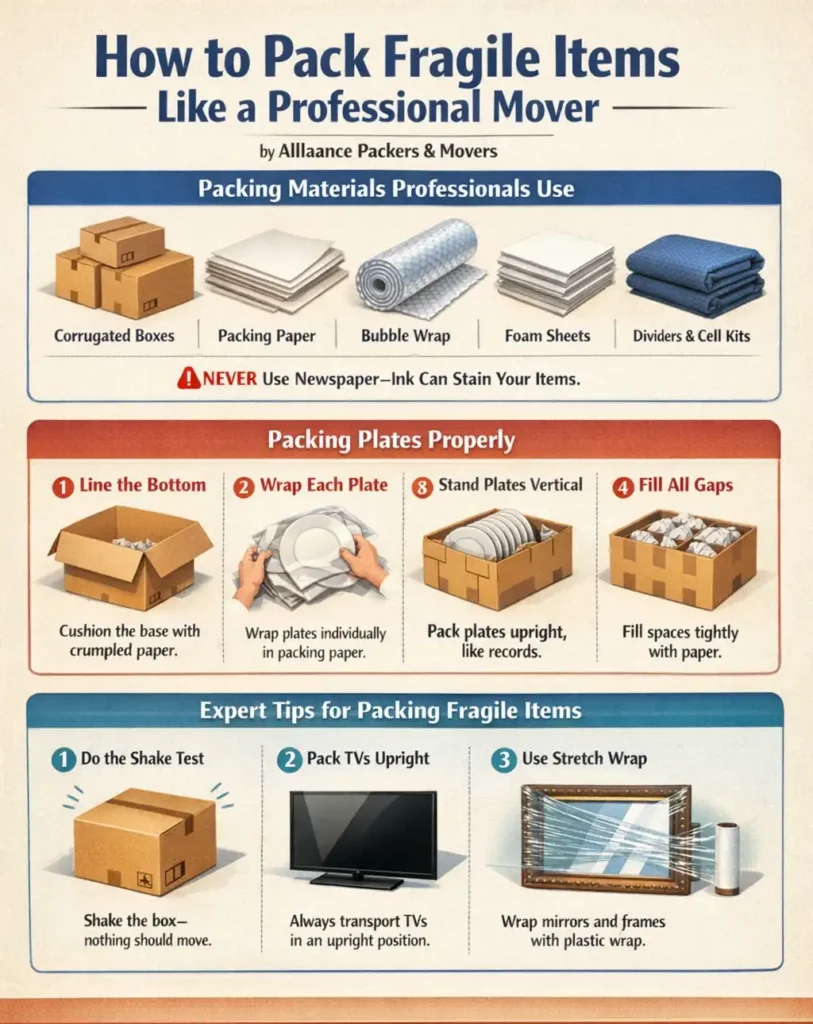
Before packing a single item, professionals assemble the right materials. Using inadequate materials — especially newspaper instead of packing paper — causes preventable damage.
Material | What It Does | When to Use It |
Corrugated carton boxes (small and medium) | Rigid outer shell. Smaller boxes limit weight and internal shifting. Small boxes (1.5–3 cu ft) are standard for crockery and heavy items. | All fragile items. Never use large boxes for heavy fragile goods. |
Packing paper (plain newsprint, unprinted) | First-layer wrap that prevents scratches and holds cushioning in place. Crumpled packing paper fills gaps and absorbs vibration. | All dishes, glassware, figurines. Fill interior of cups and vases. |
Bubble wrap | Second-layer protection against impact. Excellent for irregular shapes and items with extreme fragility. | All glassware, electronics, figurines, fragile decor |
Foam sheets | Flat sheet protection for surfaces. Good for stacking layers between plates or lining box bottoms. | Between plates in a box stack; lining TV box bottom |
Stretch film | Holds wrapping in place without tape touching the surface. Wraps irregularly shaped items and furniture with glass. | Mirrors, frames, TV screens where tape must not contact surface |
Furniture blankets / moving blankets | Heavy padding for large fragile items and furniture surfaces. | Mirrors, large paintings, furniture with glass panels |
Cardboard dividers / cell kits | Compartmentalise glasses and stemware so they cannot touch. | Wine glasses, champagne flutes, any stemware |
Packing tape | Seals boxes and secures wrapping. Applied to wrap, never directly to fragile surfaces. | All box sealing; securing bubble wrap on dishes |
⚠ Do NOT use newspaper as packing material. Newspaper ink transfers onto crockery, glassware, and fine china — and is difficult to clean off. Use plain packing paper (also called unprinted newsprint) instead. Professional movers never use newspaper.
How to Pack Crockery, Plates, and Glassware
The kitchen generates the most breakage in any move. Almost all of it is caused by one of three mistakes: plates packed flat instead of vertically, glasses not individually wrapped, or boxes left with empty space that allows shifting.
The single most important rule: plates go vertical, not flat
Pack plates on their edge — vertically, like vinyl records in a crate. This is the professional standard and it is not optional.
Why this matters: When plates are stacked flat, the plate at the bottom bears the full weight of every plate above it, plus the impact of every bump and vibration in the truck. When packed vertically on their edges, force is distributed along the stronger edge rather than pressing down on the flat surface. The difference between a broken plate and an intact one is often this single decision.
Step-by-step: how professionals pack plates
- Line the box bottom: Place 3–4 cm of crumpled packing paper at the base. This is the shock-absorbing foundation.
- Wrap each plate individually: Lay one plate in the centre of a sheet of packing paper. Fold corners over and secure with tape. For extra fragility, add a second layer of bubble wrap.
- Bundle and pack vertically: Stand wrapped plates upright in the box, on their edges — like records. Place heavier plates towards the centre; lighter or smaller plates to the sides.
- Fill every gap: Any space between plates allows movement. Fill with crumpled packing paper until nothing shifts when you press from the sides.
- Top layer padding: Before sealing, add another 3–4 cm of crumpled paper on top.
- Shake test: Gently lift and shake the sealed box. If you hear or feel any movement inside, open it and add more padding. A correctly packed box of plates makes no sound when shaken.
- Label: Write ‘FRAGILE’ and ‘THIS SIDE UP’ on multiple sides in bold marker. Add ‘CROCKERY’ so the box is handled correctly throughout the move.
How to pack glassware and stemware
- Fill the interior first: Crumple a piece of packing paper and stuff it inside each glass before wrapping. This absorbs vibration from the inside.
- Wrap from the base up: Place the glass on a corner of packing paper at an angle. Roll it diagonally, tucking the ends in as you go. Secure with tape.
- Add bubble wrap for stemware: The stem is the most fragile part. After the paper wrap, add a layer of bubble wrap specifically around the stem and bowl.
- Use cell dividers: Cardboard divider inserts (available at packing supply shops) create individual compartments — the standard professional solution for wine glasses and champagne flutes.
- Pack glasses upright (not on their sides): Upright position keeps pressure off the bowl and rim.
- Heavier items at box bottom: Pack heavier glass items (tumblers, mugs) below lighter ones (wine glasses, stemware).
Bowls, mugs, and serving dishes
- Bowls: Wrap individually and nest smaller bowls inside larger ones with packing paper between each layer. Pack on their edge like plates.
- Mugs: Stuff interior with socks, packing paper, or foam. Wrap handle separately — it is the highest breakage point. Do not let handles touch other items.
- Serving dishes and platters: Multiple layers of packing paper, then bubble wrap. Pack vertically with foam sheets between each.
💡 Keep box weight under 20 kg for boxes of crockery. A box of plates filled correctly becomes heavy quickly. Use a second box rather than overloading one — an overloaded box is more likely to be dropped.
How to Pack a Flat-Screen TV
Flat-screen TVs — LCD, LED, OLED — are among the most expensive fragile items in any home move and one of the most commonly damaged. Almost all TV damage during moves comes from two causes: laying the TV flat in the truck, and not using enough screen protection.
⚠ Never lay a flat-screen TV flat during transport. Flat-screen TVs are designed to support their own weight from the edges while upright. Laying the TV flat creates pressure in the centre of the screen and — combined with truck vibration — this causes internal stress fractures. Always transport TVs upright.
Step-by-step: how professionals pack a flat-screen TV
- Disconnect and photograph: Disconnect all cables. Take a photo of the rear connections before removing them. Label each cable with a sticker (‘HDMI 1’, ‘power’, etc.) so reconnection is straightforward.
- Remove the stand: Detach the stand or base. Wrap it separately in bubble wrap and label it.
- Use the original box if available: The manufacturer’s box is designed specifically for your TV and includes custom foam inserts. This is the best protection available. If original packing materials (foam) are missing, additional bubble wrap fills the gap.
- If no original box: Use a TV-specific moving box (available at hardware stores — sized to your screen diagonal). Measure your TV’s diagonal dimension before buying.
- Protect the screen first: Place a moving blanket or foam sheet flat, lay the TV face-down on it (screen facing the blanket). This protects the screen during wrapping.
- Wrap the screen: 2–3 layers of bubble wrap across the entire screen surface. Secure with tape to the wrap, NOT to the screen — tape on the screen surface leaves adhesive residue and can damage the display.
- Pad the corners: Foam corner protectors on each corner. Corners are the most impact-vulnerable point.
- Box the TV upright: Slide the TV into the box in an upright position. Fill any gaps on all sides with crumpled packing paper, foam, or additional bubble wrap. The TV should be snug with 5–7 cm padding on all sides.
- Label: ‘FRAGILE — SCREEN FACING [direction]’ and ‘UPRIGHT ONLY’ on multiple sides.
- In the truck: Position the boxed TV upright against a wall of the truck or between sturdy flat items. Secure with straps so it cannot fall.
✅ Alliaance Packers And Movers wraps all flat-screen TVs in moving blankets before boxing and transports them upright in our own GPS-tracked fleet. We bring our own TV packing materials on every job — no need to source separately. Call +91 7398073201 to include TV packing in your free pre-move survey.
How to Pack Mirrors, Frames, and Artwork
⚠ Mirrors and framed artwork must always be transported upright. Never pack them flat. When laid flat, a mirror or large frame bears the full weight of anything placed on it — a single item dropped on top can shatter the glass. Upright transport distributes force along the stronger edges.
Mirrors
- Mark an X on the glass surface with masking tape before wrapping. This does not prevent breakage, but it contains the shards if the glass does break — and prevents the frame from imploding inward.
- Wrap in foam sheets: 2 layers of foam sheet covering the entire surface.
- Add bubble wrap: 2 layers of bubble wrap over the foam. Secure with tape on the wrap, not on the frame.
- Use a mirror carton or flat picture box: These are available at moving supply shops. If no specialist box is available, use two pieces of cardboard larger than the mirror, one on each side, secured with tape, before wrapping.
- Pack and transport upright. Label ‘FRAGILE — DO NOT LAY FLAT’.
Picture frames and artwork
- Glass frames: Same X-tape technique on the glass. Foam wrap, then bubble wrap. Use corner protectors to shield the frame corners.
- Canvas paintings (no glass): Wrap in packing paper, then bubble wrap. Do not wrap too tightly — excessive pressure can dent the canvas.
- High-value artwork: Custom wooden crating is the professional standard. Foam-lined interior. Alliaance can advise on specialist crating for valuable pieces.
- All artwork: Transport upright. Label ‘FRAGILE — DO NOT LAY FLAT’.
How to Pack Electronics and Small Appliances
Item | How Professionals Pack It |
Laptop / notebook computer | Original box preferred — foam inserts are custom-fitted. If unavailable: wrap in bubble wrap, then place in a padded box with 5 cm foam on all sides. Remove battery if possible. Pack charger separately in a labelled bag. |
Desktop computer / CPU | Back up data before packing. Wrap in anti-static bubble wrap (static electricity can damage internal components on standard bubble wrap). Pack in a snug box with foam on all sides. Place upright — never on its side. |
Microwave / small oven | Remove turntable plate, wrap separately. Wrap unit in bubble wrap, then in a furniture blanket. Place in a medium box with crumpled paper filling all gaps. Pack power cord in a labelled bag taped to the side. |
Refrigerator | Empty and defrost completely at least 24 hours before moving. Wrap doors with stretch film to prevent them opening during transit. Transport upright — laying a refrigerator on its side can damage the compressor oil. Let stand upright for at least 2 hours before reconnecting after move. |
Washing machine | Remove water drum bolts (transit bolts) or insert transit bolts if you have them. These prevent the drum from swinging during transit. Transport upright. Tape the lid closed with moving tape. |
Camera / lenses | Bubble wrap each lens individually. Place camera body in a padded case or wrapped in foam. Pack cords and batteries separately in a labelled bag. |
💡 For all electronics: take a photo of cable connections before disconnecting. Label each cable with a sticker. Store cables in ziplock bags, label each bag, and tape to the back of the device box. This saves significant time during setup at the destination.
Professional Loading Rules for Fragile Items
Proper packing protects items from internal damage. Proper loading protects them from external impact. Professional movers follow a specific loading sequence that keeps fragile items safe throughout transit.
Rule | Why It Matters |
Heavy boxes at the bottom, fragile boxes on top | A heavy box on top of a fragile box can compress and crush it during transit or a sudden stop |
Never stack anything on top of boxes labelled FRAGILE | Even a light box can bounce on corners during braking |
Fragile boxes against the walls of the truck, not in the centre | Wall placement provides lateral support and prevents tipping |
Boxes with THIS SIDE UP must stay that way throughout the journey | Inverting a crockery box puts all the weight on the top layer — the lightest, most fragile items |
Mirrors, TV boxes, and artwork always upright — secured with straps | Upright transport is not optional for glass-faced items |
Fill empty space in the truck with blankets or furniture to prevent box shifting | An unsecured box can travel several feet on a sudden braking event — all internal padding is then irrelevant |
✅ Alliaance Packers And Movers uses our own trained crew for all loading on every move — no daily-wage labour. Loading sequence is supervised by a named crew supervisor. Fragile boxes are identified, loaded last, and positioned first for unloading. Call +91 7398073201 to discuss your specific fragile items at your free pre-move survey.
8 Packing Mistakes Professionals Never Make
Mistake | Why It Causes Damage | What to Do Instead |
Packing plates flat in a stack | Bottom plate bears full weight of every plate above. Even a small road bump can cause cracks. | Pack all plates vertically on their edges — like records in a crate |
Using newspaper as wrapping material | Ink transfers onto dishes and glassware, especially when paper gets slightly damp in transit | Use plain unprinted packing paper. It is inexpensive and clean. |
Leaving empty space in boxes | Items shift and collide during every bump and brake. Most crockery damage is caused by boxes with unfilled gaps. | Fill every gap with crumpled packing paper. Shake the box — if it moves, add more. |
Overpacking boxes above 20 kg | Overloaded boxes are more likely to be dropped. Heavy boxes also put pressure on their own contents. | Use multiple boxes. Keep all boxes under 20 kg. |
Laying a flat-screen TV flat | Creates centre-screen pressure and vibration stress on LCD/OLED panels. | Transport all flat-screen TVs upright, secured against a truck wall |
Applying tape directly to TV screen or picture frame | Tape adhesive damages screen surfaces and frame finishes when removed. | Apply tape to the bubble wrap or packing paper, not to the item surface |
Packing mirrors or large frames flat | A single item dropped on a flat-packed mirror shatters it. | All mirrors and framed artwork: upright only, labelled DO NOT LAY FLAT |
Not labelling boxes clearly | Fragile boxes treated as regular boxes — stacked under weight, inverted | Label every side: FRAGILE, THIS SIDE UP, and contents. Bright marker, large text. |
How Alliaance Packers And Movers Handles Fragile Items
Alliaance Packers And Movers has provided professional packing services in Lucknow since 2013. Every technique in this guide is standard practice for our packing crew — not aspirational advice.
What We Provide | For Fragile Items Specifically |
Free pre-move survey | We walk through your home before packing begins. Fragile items are identified and assigned the correct materials and technique during the survey — not improvised on moving day. |
All packing materials included | Corrugated cartons (new for every job), bubble wrap, foam sheets, stretch film, furniture blankets, edge protectors, cardboard dividers for glassware. No separate purchase required. |
Trained in-house packing crew | All packers are Alliaance employees, trained in professional packing techniques. No daily-wage outsourced labour on any packing job. |
Pre-move condition report | Signed by crew and customer before any item is touched. Documents the pre-move condition of all fragile items — the legal baseline for any post-move query. |
Specialist packing on request | High-value items (antiques, large mirrors, original artwork, piano) receive specialist packing materials and handling. Discuss at pre-move survey. |
GPS-tracked own fleet | All vehicles are Alliaance-owned. Fragile boxes are loaded last and positioned first for unloading, against truck walls, upright where required. |
Payment structure | 5% at booking · 85% at loading · 10% at delivery after you confirm all items arrived in satisfactory condition. |
Get a Free Quote in 30 Seconds!
Tell us your move details and our team will call you back within 15 minutes — 7 days a week.
“Pay only 10% on delivery — after you are satisfied”
✅ No spam · No hidden charges · Call within 15 mins
🔒 Your information is 100% safe and never shared
⭐ 800+ families trust Alliaance Packers And Movers
📞 Prefer to call?
Frequently Asked Questions
Professional movers pack plates vertically on their edges (not flat), wrap every item individually before placing it in a box, fill every gap in the box so nothing can shift, and use specific materials for each item type — foam sheets, corrugated cartons, bubble wrap, and cardboard dividers for glassware. The most common difference from amateur packing is the refusal to leave any empty space inside a box. If a box rattles when shaken, it is not packed correctly.
When plates are stacked flat, the bottom plate bears the full weight of every plate above it. Every bump and vibration in the truck adds to that pressure. Packed vertically on their edges — like vinyl records in a crate — the force distributes along the stronger edge rather than pressing down on the flat surface. The physics are simple: edges are structurally stronger than flat centres. This is the professional standard used by trained movers worldwide.
Use the original box and foam inserts if available — they are custom-designed for your TV. If not, use a TV-specific moving box sized to your screen diagonal. Wrap the screen in 2–3 layers of bubble wrap, tape to the wrap only (never to the screen surface). Pad corners with foam protectors. Box upright, fill all gaps. Label 'FRAGILE — UPRIGHT ONLY'. Always transport TVs upright — never flat. Flat transport puts pressure on the centre of the screen and can crack LCD and OLED panels.
For most items: plain packing paper (unprinted newsprint) as the first layer, bubble wrap as the second. Packing paper prevents scratches and holds padding in place; bubble wrap cushions against impact. For glassware and stemware, cardboard cell divider inserts are the professional standard — they create individual compartments so items cannot touch. Never use newspaper: the ink transfers onto dishes and glassware.
Yes, for some items. Clean clothing (T-shirts, socks stuffed inside cups, towels between plates) can work as supplementary padding and reduces the amount of packing material to purchase. Professional movers often use clean tea towels between plates as an additional layer. However, clothes alone — without a layer of packing paper — are not sufficient for glass items, electronics, or anything that could shatter on impact. Use proper packing paper and bubble wrap as the primary protection and clothes as additional fill.
For high-value or irreplaceable items — fine china, original artwork, antiques, large mirrors, expensive electronics — professional packing reduces risk significantly. Professional packers have the correct materials on-site, know which technique applies to each item, and complete a condition report before loading so any damage can be identified. Alliaance Packers And Movers offers partial packing — we can pack only your fragile items while you pack non-fragile goods yourself. Ask at your free pre-move survey: +91 7398073201.
Need professional packing for your Lucknow move?
Alliaance Packers And Movers brings all packing materials and sends a trained crew with a named supervisor. Fragile items assessed at a free pre-move survey. Written fixed quote. 5% advance only.