
How to Transport Plants During a Home Move in India

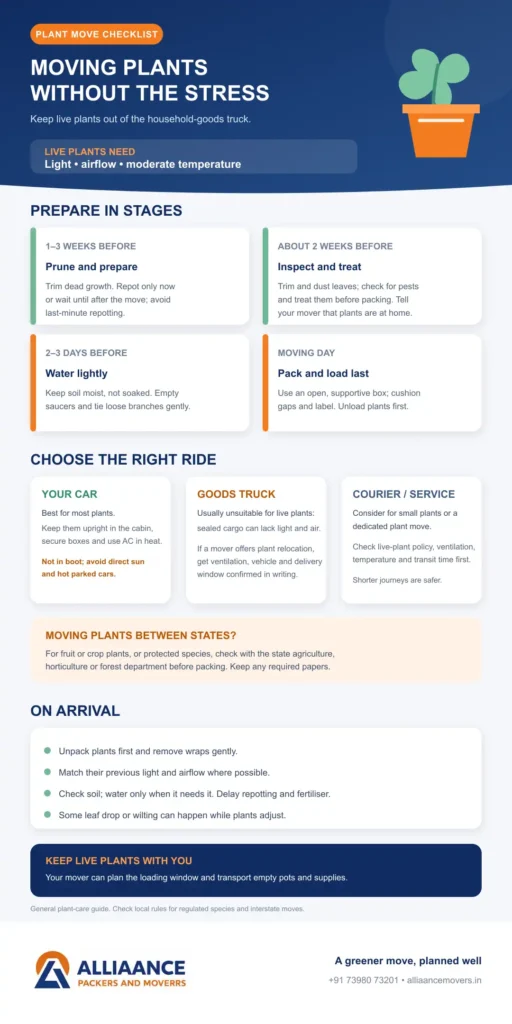
Boxes can sit in a hot truck for two days and arrive fine, but plants cannot. When planning a move with packers and movers Lucknow, remember that plants need light, air circulation and moderate temperatures to survive the journey. A long, sealed, dark trip in a goods truck can damage them.
That is why plants are among the items movers may hesitate to transport. This guide covers which plants are worth moving, legal checks in India, a preparation timeline, packing methods, transport options, and how to help plants settle into their new home. It also includes a complete checklist for moving plants safely.
Quick links to our services: Household Shifting | Intercity Relocation | Car Transport | Packing & Unpacking | Warehouse & Storage | Packers And Movers Lucknow |
Table of Contents
Quick Answers
Question | Short answer |
Will movers carry my plants? | Many movers elsewhere decline live plants, citing pests, regulation and the fact that plants rarely survive a sealed, dark truck. Some relocation firms in India advertise dedicated plant relocation. Ask your mover directly. |
Best way to transport them? | In your own car, inside the cabin, with the air conditioning on in summer. |
When to prune and water? | Prune one to three weeks ahead. Water lightly a few days before, so the soil is moist but not soaked. |
Any legal limits in India? | Domestic quarantine under the Destructive Insects and Pests Act restricts inter-state movement of nine named pests, and some native orchids, cycads and pitcher plants are specially protected. |
Is summer a bad time? | Yes. Avoid peak heat, move in the early morning, and skip repotting. |
What to expect on arrival? | Some leaf drop or wilting is normal in the first weeks. Match the old light, then water only when the soil needs it. |
Step 1: Decide Which Plants to Move and Which to Leave Behind
Moving is stressful for plants, and even healthy houseplants may sulk for weeks afterwards. The first decision is therefore which plants are worth the journey.
Plants worth moving
- Small potted plants are the easiest to move, since they can stay in their pots and travel in an open box.
- Hardy indoor plants cope best with heat. Snake plant, ZZ plant, aloe vera, jade plant and money plant are listed as coping well with Indian summers.
- Plants that are sentimental, rare or hard to replace deserve the best seat in your own car.
Plants better left behind
- Plants with a pest problem. Inspect for bugs and treat any issue before packing; do not carry an infestation to the new home.
- Very large or heavy plants and planters, which are hard to box, lift and secure in a car.
- Easily replaced, fast-growing or inexpensive plants.
- Plants likely to struggle with the journey or the new climate. The longer the trip and the hotter the season, the lower their odds.
How travel time and season change the decision
A two-hour local move in winter and a two-day interstate move in May are different decisions. Moving plants before or after the summer months is easier on them, and in some cases it may be best to find new homes for outdoor plants instead of risking a move. If your move falls in peak summer, take fewer plants.
Rehoming the plants you leave
Offer them to neighbours, friends, colleagues or your housing society’s garden group, or to a local nursery. Do this early, so that the plants are not left to wilt on moving day.
Quick decision table
| Plant type | Move it? | Why |
| Small potted houseplants | Yes | Easiest to move; can stay in their own pots |
| Hardy plants: snake plant, ZZ, aloe vera, jade, money plant | Yes | Cope with Indian summers |
| Sentimental, rare or hard-to-find plants | Yes, in your own car | Worth the care |
| Large, heavy planters and trees | Usually no | Hard to box and secure; consider rehoming |
| Plants with pests | Not until treated | Inspect and treat before packing |
| Fruit or crop plants such as banana, citrus, coffee, apple, potato | Check the rules first | Domestic quarantine covers specific pests and crops; see Step 2 |
| Orchids, cycads, pitcher plants and other protected species | Check the licence first | Protected under the Wild Life (Protection) Act; see Step 2 |
Step 2: Check the Rules Before You Move Plants Between States
Most household plants raise no legal question. A few do, so check before you pack.
Domestic plant quarantine in India
The Destructive Insects and Pests Act, 1914 provides for domestic quarantine, which regulates the inter-state movement of agricultural commodities. The Act empowers states to make laws to prevent the spread of dangerous insects within their jurisdiction; the first state law, a Madras Act of 1919, was an example, with one use being to prevent movement of banana from the Palani hills to stop banana bunchy top.
At national level, the domestic quarantine provision restricts the inter-state movement of nine invasive pests: flute scale, San Jose scale, coffee berry borer, codling moth, banana bunchy top and mosaic viruses, potato cyst nematode, potato wart and apple scab. Another example is the restriction on citrus planting material moving out of canker-affected states.
What this means for a household move
The sources we found describe quarantine in terms of crops and planting material. None of them says how the rules apply to a household moving ordinary ornamental pots, so treat that question as open rather than assume either way. If your plants include banana, citrus, coffee, apple or potato, or fruit trees, ask the state agriculture or horticulture department before crossing a state line. A property guide for India also notes that some states have quarantine rules and that permits may be needed.
Protected plants: a licence may be needed
The Wild Life (Protection) Act, 1972 gives special protection to certain plants. The original list of six specified plants in Schedule VI is: Beddome’s cycad (Cycas beddomei), Blue Vanda, Kuth (Saussurea lappa), Ladies slipper orchids (Paphiopedilum species), Pitcher plant (Nepenthes khasiana) and Red Vanda. Cultivating a specified plant requires a licence from the Chief Wild Life Warden or an officer authorised by the state (Section 17C). One summary says the schedule regulates cultivation, possession, sale and transport.
The Wild Life (Protection) Amendment Act, 2022, in force from 1 April 2023, reduced six schedules to four and placed protected plants in Schedule III. Sources differ on the current plant list, so check the up-to-date schedule. The Act prohibits picking, uprooting, acquiring or collecting specified plants from forest land or protected areas, so never move wild-collected plants. If you own a plant of one of these species, keep your licence or purchase papers and ask the state forest department before moving it.
Who to ask
If you have… | Ask… |
Fruit or crop plants (banana, citrus, coffee, apple, potato) | The state agriculture or horticulture department |
Orchids, cycads, pitcher plants or similar protected species | The state forest department (Chief Wild Life Warden’s office) |
Ordinary ornamental houseplants | Your mover and your housing society, and keep a nursery bill if you have one |
Related Guides:
Step 3: Pre-Move Preparation, Pruning, Pest Checks and Watering (Start 1 to 3 Weeks Ahead)
Sources give different lead times for each task, from one to three weeks for pruning and from one day to one week for watering. The timeline below shows the range and a sensible middle path.
Three weeks before: prune, and repot only if you must
Prune about two to three weeks before the move to remove dead or diseased growth and make plants more compact. That is also the time to move plants out of fragile pots into sturdy, shatter-proof plastic containers. Skip last-minute repotting: repot at least three weeks before the move, or wait until after it. Avoid repotting in peak summer heat, because it disturbs roots. Avoid fertilising in the two weeks before the move, since feeding encourages tender new growth that suffers most in transit.
One to two weeks before: clean, inspect and treat pests
Trim dead leaves and dust the foliage about two weeks before moving. Inspect each plant for insects and treat any problem before packing. In summer, spider mites and mealybugs are common; in the monsoon, fungus is common and neem oil is described as an effective organic fungicide.
Three days to one week before: water sensibly
Sources differ on exactly when to water, but they agree on the principle: moist, not soaked.
| Advice | Timing | Source |
| Water thoroughly about one week before, not the night before | 1 week | |
| Water lightly 2–3 days before to keep the soil moist but not saturated | 2–3 days | |
| Water your plants three days before, without overwatering | 3 days | |
| Dampen the soil a day or two before, but avoid soaking | 1–2 days |
Heavy, waterlogged pots are harder to carry, while dry soil can leave plants stressed during travel. Empty any standing water from saucers. In an Indian summer, most potted plants need deep watering every day or two, so do not let pots dry out while you wait for moving day.
The day before: tidy up and gather supplies
Secure loose branches with soft plant ties or twine. Collect boxes, newspaper or towels, and bubble wrap. Decide where each plant will travel in the vehicle.
Indian weather: heat and monsoon
- Summer: move pots into the coolest, most shaded spot, mulch the soil surface to reduce water loss, and water early, before 8 am if possible.
- Monsoon: it runs from June to September, and excess water, poor drainage and fungal growth threaten potted plants; do not water as often as in summer. Check drainage before you pack.
Preparation timeline at a glance
| When | What to do | Source |
| 3 weeks before | Prune; repot only now, or wait until after the move; stop fertilising 2 weeks ahead | |
| 2 weeks before | Trim and dust leaves; inspect for pests and treat | |
| 1 week before | Water thoroughly if you follow the one-week approach | |
| 2–3 days before | Water lightly; soil moist, not soaked | |
| Day before | Tie loose branches, empty saucers, gather boxes and padding | |
| Moving day | Pack plants last, load them into your own vehicle last |
Step 4: How to Pack Plants for a Safe Move
Choose the right container
- Use a box slightly taller than the plant, so that leaves are not bent.
- Small plants can stay in their pots in an open box.
- Tall plants travel better in an open box that supports the pot and leaves room around the leaves; for a very tall plant, a wardrobe box with the plant tied to the hanging bar can work.
- Swap fragile ceramic pots for shatter-proof plastic. If you keep ceramic or terracotta pots, wrap them in bubble wrap.
Keep the soil in place
Press a double layer of newspaper against the soil surface and tape it to the outside of the pot, which keeps the root zone intact and stops soil shifting. Another guide suggests wrapping the soil in damp paper towels and securing it with plastic wrap. If you place plastic pots in a box, tape or cover the drainage holes with a bag to avoid leaks.
Cushion the plants and fill the gaps
- Put heavier plants at the bottom and lighter ones on top.
- Fill empty spaces with packing paper or bubble wrap so nothing shifts. A box that is too big lets plants slide around.
- Group similar plants together and pack extra newspaper between pots.
Protect leaves, stems and spiky plants
- Secure loose branches with soft ties or twine.
- Use bubble wrap or tissue for delicate leaves, but remember bubble wrap can trap moisture.
- Wrap prickly plants such as cactus in bubble wrap, then set them in a box.
- A property guide for India suggests burlap or breathable fabric, which protects plants while allowing air circulation.
Label and mark the boxes
Label each box with its contents, and note if a plant needs specific care on the journey. Keep a list of what is in each box.
Packing materials checklist
Material | Use |
Sturdy boxes in several sizes | Containing pots; box slightly taller than the plant |
Newspaper, towels or packing paper | Covering soil and padding gaps |
Bubble wrap or tissue | Delicate leaves, terracotta pots, cactus |
Soft plant ties or twine | Securing loose branches |
Tape, plastic bags or wrap | Holding newspaper in place, covering drainage holes |
Labels and marker | Contents and care notes |
Step 5: How to Transport Houseplants During House Shifting in India
The right vehicle matters more than anything else in the move. Plants need light, air and moderate temperatures, and the transport you choose either gives them that or does not.
Option 1: your own car, inside the cabin (best for most plants)
- Keep plants inside the cabin, not in the boot, where air circulates better. Place them upright on the back seat or the floor, and use seat belts to secure large boxes.
- Pack plants last and unload them first at the new home.
- In summer, keep plants out of direct sun and use air conditioning.
- Do not leave the car parked in hot sun for long: the inside of a closed car heats up fast and bakes plants. If you stop in the heat, crack the windows for ventilation.
Option 2: the goods truck (usually not advised)
Movers elsewhere commonly refuse live plants, for three reasons: pests can travel with plants, there can be regulatory restrictions, and plants typically do not survive being sealed in a dark truck without light, air or water. In some markets insurers also typically do not cover live plants during a move. A property guide for India suggests asking movers about customised services for plants and about climate-appropriate vehicles and insurance cover. If a mover does agree to carry plants, get the vehicle type, ventilation and liability in writing.
Option 3: courier or dedicated plant relocation
Online nurseries in India ship plants across the country by courier, with typical delivery of two to five business days in ventilation-friendly packaging with moisture-retention material. Others use strong corrugated boxes and tie plants to the box so they do not move. One shipping guide cautions that most plants survive only two to three days inside a dark box. Couriering therefore suits small plants over short distances, and you should check the courier’s policy on live plants first.
Some relocation firms in India list dedicated plant relocation. One describes planning from photos, adjusting the watering schedule 48 hours before pickup, ventilated crates, vertical strap loading, and pan-India routes that take 3 to 7 days. Use it as a checklist of what to ask: how are plants crated, how is ventilation handled, is the vehicle temperature-controlled, and what is the delivery window?
Time of day and weather
- Move in the early morning, or on an overcast day or in the evening, to avoid dehydration.
- Avoid peak summer heat where you can.
- Protect plants from rain, heat and dust.
Trains, buses and flights
We did not find sources on carrying plants on Indian trains, buses or flights. Check the carrier’s policy before you plan around one.
How long can plants stay packed?
As little as possible. Plants deprived of light during transport need to be taken out as soon as you arrive. On a multi-day drive, a sensible precaution is to bring plants indoors for the night and give them light, and to avoid the one-way sealed-box journeys that plants handle poorly.
Comparing the options
| Method | Best for | Watch out for |
| Your own car, in the cabin | Most plants, especially rare or sentimental ones | Heat in a parked car; luggage space |
| Goods truck | Empty pots and planters, not live plants | Movers often refuse live plants; no light, air or water; insurance often excludes plants |
| Courier from a nursery-style service | Small plants over short distances | Two to three days in a dark box is the limit for most plants |
| Dedicated plant relocation | Many or valuable plants | Ask about crating, ventilation, temperature control and delivery window |
Step 6: Post-Move Care, Unpacking and Settling Plants at the New Home
Unpack plants first
Get plants settled first, and remove wraps and covers gently. Place them in suitable locations with adequate sunlight and ventilation.
Match the old light before anything else
A shift in light is often the first cause of decline: a plant that moves from bright indirect light to low indirect light can drop leaves and grow less consistently. Place plants where they get conditions similar to what they had before, to reduce light shock.
Check the soil before you water
Water as needed, considering the conditions during the move. One guide advises letting the plant settle before giving it a big drink, since watering during the move can dislodge roots. Check the soil with a finger and water when it feels dry, rather than by habit.
Expect some stress
Yellowing, drooping or dropped leaves in the first weeks are normal. Plant recovery is not abrupt, so resist the urge to fuss; constant handling slows recovery. If something looks wrong, change one thing at a time and see whether it helps.
Do not repot or fertilise straight away
Give plants time to recover before repotting. Avoid repotting in peak summer, because it disturbs roots. Leave fertiliser until the plant is clearly growing again, since feeding encourages tender growth that suffers in stress.
Summer and monsoon after you arrive
- Summer: keep pots in the coolest, shaded part of the balcony or home, and keep indoor plants away from direct air-conditioning airflow.
- Monsoon: water less often, since ambient moisture often covers a plant’s needs, and watch for fungus.
How Alliaance Packers And Movers Handles Plants
Alliaance Packers And Movers has operated from Lucknow since 2013. We move household goods with GPS-tracked own vehicles. Plants are living cargo, so they need a different plan from cartons.
What we handle on every move
What you need | What Alliaance provides |
A clear picture of the job | A free physical or video pre-move survey, followed by a written fixed quote |
Packing materials | Cartons, bubble wrap, stretch film and furniture blankets, included in the written quote |
Timing you can plan around | Loading dates and time windows confirmed at booking |
Visibility for your goods | GPS-tracked own vehicles on intercity moves |
Cover for your goods | Transit insurance: basic (about 1.5% of declared value) or all-inclusive (up to 3%), with the certificate issued before the truck departs |
How plants fit into your survey and quote
Tell us at the pre-move survey how many plants you have, their sizes, and whether any are in heavy or glazed pots. That lets the crew and timing be planned around them. Ask for any plant-related handling to be written into the quote, and ask whether live plants are covered by the insurance, because in some markets they typically are not.
What we recommend you carry yourself
Rare, sentimental and delicate plants should travel with you in your own car, because plants need light, air and a moderate temperature that a sealed goods truck cannot give.
Heavy planters, empty pots and gardening tools
Empty pots, planters and gardening tools can travel with the household goods. Wrap fragile pots and put sharp tools in protective cases or wrap them securely.
Timing the loading window around plants
Ask for an early-morning loading slot, so plants can be packed last and loaded into your car before the heat builds.
Contact Alliaance Packers And Movers | Details |
Phone / WhatsApp | +91 9580367912 | +91 7398073201 |
WhatsApp Chat | https://wa.me/917398073201 |
Available | Monday to Sunday, 8 AM to 10 PM |
Office | Plot No. 16, Royal City, Bijnor Road, Lucknow 226002 |
💡 Related guides: How to Get an Accurate Moving Quote in India (alliaancemovers.in/blog/how-to-get-accurate-moving-quote-india/), Peak Season vs Off-Season Moving (alliaancemovers.in/blog/best-time-to-move-india-season/) and Moving With Pets in India (alliaancemovers.in/blog/moving-with-pets-india/).
Complete Plant-Moving Checklist
Four weeks before
- List every plant and decide which to move, rehome or leave
- Identify fruit or crop plants and protected species; ask the state agriculture, horticulture or forest department if needed
- Check whether your mover will carry plants, and in which vehicle
Three weeks before
- Prune dead or diseased growth and compact the plant
- Repot only now, into sturdy plastic pots, or wait until after the move
- Stop fertilising
Two weeks before
- Trim and dust leaves; inspect for pests and treat them
- Tell your mover about plants at the survey; get any plant handling and insurance position in writing
- Gather boxes, newspaper, bubble wrap, soft ties and labels
One week before
- Check monsoon drainage or summer shading
- Water thoroughly if following the one-week approach
Two to three days before
- Water lightly; soil moist but not soaked
- Empty saucers
Moving day
- Tie loose branches; press newspaper over the soil and tape it
- Pack plants in boxes slightly taller than the plant, with gaps filled
- Pack plants last and load them into your own car last, inside the cabin
- Start early; keep plants out of direct sun; use air conditioning in summer
On the journey
- Secure boxes upright; use seat belts for large ones
- Never leave plants in a hot, parked car; crack the windows at stops
On arrival
- Unpack plants first; remove wraps gently
- Place in conditions close to the old light
- Check the soil, then water if dry
- Do not repot or fertilise yet; expect some leaf drop
Get a Free Quote in 30 Seconds!
Tell us your move details and our team will call you back within 15 minutes — 7 days a week.
“Pay only 10% on delivery — after you are satisfied”
✅ No spam · No hidden charges · Call within 15 mins
🔒 Your information is 100% safe and never shared
⭐ 800+ families trust Alliaance Packers And Movers
📞 Prefer to call?
Frequently Asked Questions About Moving Plants During House Shifting in India
Movers elsewhere commonly refuse live plants, because of pests, regulation and the fact that plants rarely survive a sealed, dark truck. Some relocation firms in India advertise dedicated plant relocation. Ask your mover whether it carries plants, in which vehicle, and what insurance covers.
Often yes, but two checks apply. Domestic quarantine under the Destructive Insects and Pests Act restricts the inter-state movement of nine named pests, so check with the state agriculture or horticulture department if you are moving banana, citrus, coffee, apple or potato plants. Certain protected plants, including some orchids, cycads and pitcher plants, need a licence to cultivate.
Prune and treat for pests, water lightly a few days earlier, press newspaper over the soil, put each plant in a box slightly taller than the plant, fill gaps with paper or bubble wrap, and secure loose branches with soft ties. Swap fragile pots for plastic.
Prune one to three weeks ahead. Sources vary on watering from one day to one week before; the common advice is to keep the soil moist but not soaked.
It is harder. Avoid peak heat where possible, move in the early morning or on an overcast day, keep plants out of direct sun, use air conditioning in the car, and avoid repotting. Never leave plants in a parked car.
Online nurseries in India ship plants by courier in two to five business days, but one shipping guide says most plants survive only two to three days in a dark box. Couriering suits small plants over short distances. Check the courier’s policy on live plants first.
Repot at least three weeks before the move, or wait until after it. Avoid repotting in peak summer, because it disturbs roots.
Unpack them first and match the old light. Water only when the soil is dry. Expect some yellowing or dropped leaves, and resist fussing, since constant handling slows recovery.
The Wild Life (Protection) Act lists specified plants including Beddome’s cycad, Blue Vanda, Kuth, ladies slipper orchids, the Khasi pitcher plant and Red Vanda; cultivating them requires a licence. After the 2022 amendment, protected plants sit in Schedule III, and sources differ on the current list, so check the up-to-date schedule.
Planning a House Move? Let’s Plan Your Plants Too
Moving your household to a new home? Alliaance Packers And Movers in Lucknow can help you plan your relocation with a pre-move survey, packing arrangements, and a written moving quote. Tell us how many plants you have, their sizes, and whether you need special handling for heavy planters or fragile pots. Before booking, confirm whether live plants can travel in the moving vehicle and what insurance coverage applies.
Request your moving quote today and plan your household relocation with greater clarity.