
Transit Insurance for Packers and Movers: Cost, Coverage and Claims

Most moves go smoothly, but accidents, fires, sudden stops, and crushed cartons can damage household belongings during relocation. When hiring packers and movers Lucknow, it is important to understand who pays for damaged goods, how much compensation may be available, and what documents are required to file a claim.
Transit insurance is financial protection for goods while they are in transit, and people relocating household belongings through packers and movers can buy it. It is also the part of a quote that is explained most loosely. Movers say ‘everything is covered’, and customers find the gaps only at claim time.
Table of Contents
- 1. Transit Insurance Charges
- 2. Transit Insurance Cost in India
- 3. Transit Insurance Premium Table
- 4. Coverage and Exclusions
- 5. Insurance on Moving Quotes
- 6. Common Insurance Gaps
- 7. Questions to Ask Before Buying
- 8. How to File an Insurance Claim
- 9. Spotting Fake Insurance Offers
- 10. Alliaance Packers And Movers Insurance Policy
- FAQs
Question | Short answer |
What does it cost? | Sources put premiums at roughly 1.5% to 3% of the declared value of your goods |
How is the premium worked out? | Declared value multiplied by a rate that reflects the goods, distance and route, packing and cover type |
What is covered? | Depends on the clause: all-risk (subject to exclusions) or named perils such as fire and overturning |
What is usually excluded? | Wear and tear, improper packing, inherent vice, delay and wilful misconduct |
Biggest hidden gap? | The declared value is the ceiling on what you can recover |
How to claim? | Note damage at delivery, tell the insurer at once, let the surveyor assess, submit documents |
How to spot a fake? | Check the insurer on the IRDAI list, get the policy document, and verify the policy number directly with the insurer |
How Transit Insurance Charges Are Calculated
The premium is not a flat fee. It is a rate applied to the value of the goods you declare. Understanding the pieces tells you what to check on a quote.
The basic formula: declared value multiplied by a rate
Once an insurer arrives at a rate based on the risk, it applies that rate to the total value of the goods, and the premium follows. In short: premium = declared value × rate. The sum insured is the maximum value of cargo the policy recognises during transit.
Example | Declared value | Rate | Premium |
Household goods | ₹4,00,000 | 1.5% | ₹6,000 |
Household goods | ₹4,00,000 | 3% | ₹12,000 |
Household goods declared too low | ₹2,00,000 (actual value ₹4,00,000) | 3% | ₹6,000, but payout is capped by the declared amount |
This is arithmetic using the rates reported in the sources, not a quote.
Declared value: what you tell the insurer your goods are worth
Goods should be declared and listed before dispatch. One published mover quotation asks the client to record proper values on the inventory sheet, and another says values are declared individually at the time of packing, per the inventory. A higher declared value means a higher premium, and it also raises the amount you can claim.
What moves the rate: goods, distance, route and packing
- Type of goods: fragile or high-end electronics attract higher premiums, while utensils, plastic or metal items and garments attract lower ones.
- Distance and terrain: Delhi to Pune, Kolkata to Shimla and Bhopal to Srinagar cannot be charged at the same rate.
- Packing, mode of conveyance, distance and past claims experience are among the factors insurers list.
Type of cover: all-risk or basic
Insurers describe two broad types, all-risk and basic risk. In movers’ terms, basic cover protects goods only while they are being transported, whereas all-risk covers packing, loading, transit, unloading and unpacking. Expect the all-risk option to cost more.
Single-transit or open policy
A single-transit policy covers one specific shipment, and an annual open policy suits customers with multiple shipments. A one-off household move is the single-transit case.
High-value items: agreed-value cover
Antiques, paintings, sculpture and other high-value goods can be insured on an agreed-value basis, where an authorised valuer sets the value and the premium follows. The premium on such items is generally high, underwriters insist on suitable packing, and the valuation may be needed if you claim.
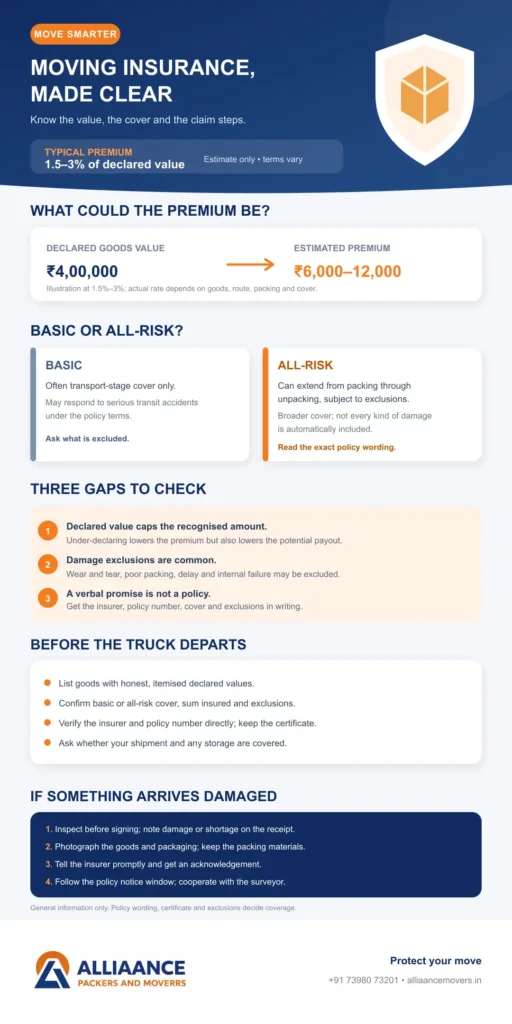
How Much Does Transit Insurance Cost in India?
There is no single national price. The sources agree on a range, and that range is wide enough to matter.
The typical range: 1.5% to 3% of declared value
One marketplace answer puts the extra premium at often 1.5% to 3% of the declared worth of your items. An insurer’s underwriting executive says that most transporters charge three per cent of the total value.
What was reported | Rate |
Most transporters, household goods | 3% of total value |
Household goods in a reported customer case | 3% of household goods value |
Bike in the same case | 1.5% |
One mover’s published quotation: household goods | 3.00% of declared value |
Same quotation: car | 1.50% of declared value |
Another mover’s published rate contract: household goods | 1.50% of declared value |
Marketplace guidance, general range | 1.5% to 3% |
Why rates differ between movers
The sources do not explain why one mover lists 1.5% and another 3% for household goods. A likely reason is a difference in cover type, since basic and all-risk cover protect different things. Do not compare the percentages alone. Ask what each rate actually buys.
What usually sits outside the headline price
Quotes usually exclude GST, floor or staircase charges, premium packing materials and insurance, so insurance is often an add-on. Check whether the move price you were given includes it, and if so which type.
Alliaance Packers And Movers insurance rates
Alliaance Packers And Movers offers transit insurance on two levels: basic cover at about 1.5% of declared goods value, covering the transport phase, and all-inclusive cover at up to 3%, covering packing, loading, transit, unloading and storage. The original certificate is issued before the truck departs.
Is the premium worth it?
Set the premium against the exposure. On ₹4,00,000 of declared goods, 3% is ₹12,000. Without insurance, you rely on the mover’s own liability. One marketplace answer gives an example of basic carrier liability worked out by weight, such as ₹50 to ₹100 per kg, so a ₹50,000 television weighing 10 kg could fetch far less than its value. Under the law, a carrier’s liability is also capped by a formula tied to freight, not to the value of your goods.
Transit Insurance Premium Table: What You Pay at Different Declared Values
The table applies the two rates reported most often, 1.5% and 3%, to a range of declared values. Use it to estimate, then confirm the actual rate and cover type in writing.
Declared value of goods | Premium at 1.5% | Premium at 3% |
₹50,000 | ₹750 | ₹1,500 |
₹1,00,000 | ₹1,500 | ₹3,000 |
₹2,00,000 | ₹3,000 | ₹6,000 |
₹3,00,000 | ₹4,500 | ₹9,000 |
₹5,00,000 | ₹7,500 | ₹15,000 |
₹10,00,000 | ₹15,000 | ₹30,000 |
Figures are simple arithmetic (declared value × rate). Actual premiums depend on the insurer, goods, distance, packing and cover type.
Item moved | Rate reported |
Household goods | 1.5% to 3% of declared value |
Bike | 1.5% |
Car | 1.5% |
Antiques, paintings, sculpture, high-value goods | Agreed-value policy; premium set after valuation and generally high |
Related guides:
What Transit Insurance Covers and What It Excludes
Cover depends on which clause the policy is written under and on the insurer’s wording. The same word, ‘insurance’, can mean very different things.
Three clause levels for goods moving within India
Goods sent by rail or road within India fall under Inland Transit clauses A, B and C.
- Clause A (all risks): covers all risks of loss or damage, subject to exclusions.
- Clause B (named perils): covers physical loss or damage caused by listed perils.
- Clause C: the narrowest; covers fire and lightning.
What named-perils cover typically includes
Clause B wordings list perils such as fire or explosion, lightning, breakage of bridges and overturning of the carrying vehicle. A guide to transit insurance also lists collision and derailment among major named perils. The exact list differs by insurer and clause version, so read yours.
Standard exclusions in transit policies
- Wilful misconduct of the insured
- Ordinary leakage or loss in weight, and wear and tear
- Insufficient or improper packing
- Inherent vice, meaning loss from the nature of the goods themselves
- Delay, even where the delay is caused by an insured risk
- War, riot and strike, which can be covered by an extension
What basic cover means for household goods in practice
One marketplace answer says basic transit cover typically responds only to serious accidents during transport, such as a truck fire, collision or overturn. It lists items basic cover typically does not cover: furniture scratches or minor dents, items packed by the customer, paint marks or cosmetic damage, and internal failure of TVs, refrigerators or washing machines . A television that arrives undamaged outside but stops working may be refused for lack of external impact damage.
What all-risk adds, and what it still excludes
All-risk cover extends protection across packing, loading, transit, unloading and unpacking. Even then, movers typically have to pack the items themselves, minor wear and tear is often excluded, and furniture scratches may be covered only if the damage is serious.
Typically covered (depends on clause) | Typically excluded or limited |
Fire and explosion | Wear and tear, ordinary loss in weight |
Lightning | Insufficient or improper packin |
Overturning of the carrying vehicle | Inherent vice |
Collision or derailment, under some wordings | Delay, even if caused by an insured risk |
Packing through unpacking, under all-risk | Wilful misconduct of the insured |
Total loss in an accident, even under basic cover | Cosmetic damage, minor scratches, internal failure, under basic cover |
How to Read Insurance on a Moving Quote
Insurance on a quote is usually one line. That line carries a lot of meaning, and reading it carefully is the cheapest protection you can buy.
Where insurance appears and what it looks like
A typical quotation lists transit risk coverage as a percentage of the total declared value and asks the client to record proper values on the inventory sheet. That is the cue to ask for the insurer’s name, the cover type and the sum insured.
Key terms decoded
Term on the quote | What it means | What to ask |
Declared value | The value you state for your goods, which sets premium and payout ceiling | Is it itemised, and is my total declared value recorded in writing? |
Sum insured | The maximum value recognised during transit | What is the sum insured on my certificate? |
Transit risk coverage at x% | Premium = x% of declared value | Which cover type does this rate buy: basic or all-risk? |
Carrier liability | The carrier’s legal liability, capped at ten times freight and not above declared value | Is this insurance, or only the mover’s liability? |
Basic | Transport phase only | Does it exclude packing, loading and unloading? |
All-risk | Packing through unpacking | What are the written exclusions? |
Weak and strong insurance wording on a quote
Element | Weak quote | Strong quote |
Insurance line | ‘Insurance included’ or ‘everything covered’ | Cover type, rate, declared value and insurer named |
Policy document | Not mentioned | Certificate or policy issued before loading |
Inventory | Not linked | Inventory with declared values attached |
Exclusions | Not listed | Listed in writing |
Claims | Not explained | Who files, timelines and documents explained |
Check the maths on the line
If the quote says 3% of declared value and your goods are ₹4,00,000, the premium should be ₹12,000. If the quote shows a different number, or a premium with no declared value behind it, ask why. A premium is a rate times a value, so both should be on the page.=
Insurance Gaps Most People Miss
The declared value is the ceiling
The sum insured is the most a policy recognises during transit, and one mover’s terms say it will not be liable for more than the value declared in the inventory. If you under-declare to save premium, you cap your own recovery.
The carrier’s legal liability is capped by a formula, not by your loss
The Carriage by Road Act, 2007, in force since 20 July 2010, regulates common carriers; the term is defined to include contractors, agents and brokers carrying on that business. Every consignor must execute a goods forwarding note including a declaration of the value of the consignment. Under the 2011 Rules, liability for total loss is limited to ten times the freight paid or payable, and cannot exceed the value declared in that note. Liability is calculated on the actual freight collected or due, or 90% of total charges excluding taxes shown on the goods receipt, whichever is higher. Liability for loss of documents sent with a consignment is capped at ₹500.
As an illustration of the formula only: on ₹20,000 of freight, ten times is ₹2,00,000. If your household is worth more, that cap, not your loss, sets the ceiling, and a lower declared value lowers it further. Whether and how this applies to a particular mover is a legal question; speak to a lawyer if you need advice on a specific case.
Basic cover is not all-risk
Basic cover typically responds to serious accidents, not scratches, dents, cosmetic damage or internal failure. Many customers buy basic cover believing it covers everything.
Who packs matters
Insufficient packing is a standard exclusion, and in the marketplace guidance, items packed by the customer are typically not covered. One mover’s published terms say its risk charge does not apply to goods it did not pack, although it arranges cover for total loss in transit. If you pack fragile items yourself, ask what that does to your cover.
Delay is not covered
Loss or damage caused by delay is excluded, even if the delay is caused by an insured risk. Late delivery is a service issue, not an insurance claim.
High-value items need their own arrangement
Antiques, paintings and sculpture are best insured on an agreed-value basis after professional valuation, which may be required if you claim. Do not hide such items inside a general household declaration.
No policy document, or a shared shipment with no paperwork
In one reported case, a customer paid a separate premium for insurance on a shared shipment, and when another customer’s goods were damaged and the policy documents were requested, the mover could not produce them; the mover said the paperwork was included in the receipt, and the customer could not claim when his own goods were damaged. Insist on the policy or certificate in your hands.
Cover start, cover end and storage
Policies define when cover starts and ends. One insurer’s inland clause provides for road-only transit cover to run until seven days after arrival, subject to its terms. One mover’s published terms exclude storage in transit unless declared before dispatch. If your goods will wait in a warehouse, say so and ask whether storage is covered.
What to Ask Before You Pay for Transit Insurance
Vague answers are the problem, so ask specific questions and get the answers in writing.
Who is the insurer, and can I see the policy or certificate before loading?
Ask for the insurer’s name and a copy of the policy or certificate, and secure an official policy document. Genuine policies come with official documents, so a missing document is a warning sign.
Is this basic or all-risk cover?
Basic cover applies only during transportation, while all-risk covers packing, loading, transit, unloading and unpacking. Ask which one the quoted rate buys, and request declared-value cover, not basic carrier liability.
What declared value is recorded, and is it itemised?
Ask for an itemised list of insured items and the declared value of each. Goods should be declared and listed before dispatch.
What exactly is excluded?
Ask for the exclusions in writing, covering at minimum scratches and dents, internal failure of appliances, items packed by you, pre-existing damage and delay. Capture photos and videos of valuables before the move.
Is my consignment covered under a certificate with my details?
Ask whether your goods are covered under a certificate that names your consignment, especially on a part-load or shared truck, and ask for the consignment note or lorry receipt, since it is needed at claim time.
How do I claim, and how fast?
Ask how soon damage must be reported, who files the claim, which documents are required, and how long settlement takes.
How to File a Transit Insurance Claim, Step by Step
The first hours after delivery matter most. The steps below combine guidance from insurers and industry guides.
Step 1: Inspect before you sign
Check the goods when they are delivered. Ask for open delivery and have damage or shortage recorded on the lorry receipt or delivery document. Do not give a clean acknowledgement for visibly damaged packaging. One report warns that damage cannot be claimed once the papers are signed without remarks.
Step 2: Document the damage at once
Photograph everything, including packaging, and keep the damaged goods and packing for the surveyor to see.
Step 3: Notify the insurer immediately
Tell the insurer as soon as you find damage]. One guide says to notify within 24 to 48 hours, which is a guideline, not a rule, so check the notice period in your own policy. If you bought through a broker or agent, inform them too, and collect a formal acknowledgement of your claim.
Step 4: Lodge a written claim with the mover or carrier as well
Insurers expect a monetary claim to be lodged with the carrier within the time limit, to protect their recovery rights, and ask for a damage or shortage certificate from the carrier. Keep a copy.
Step 5: Let the surveyor assess the loss
After you intimate the claim, the insurer appoints a surveyor to assess the cause and extent of loss, and the survey report is central to the outcome. On receipt of the loss assessment report, the insurer processes the claim.
Step 6: Submit documents and follow up
Send the documents the insurer asks for, keep copies, and follow the claim status. Many insurers allow claims to be lodged online. If a claim is declined, ask for the reason in writing and the policy clause relied on.
Document | Why it is needed |
Claim form | Records dispatch, destination, date of damage and whether a claim was made on the carrier |
Original policy or certificate | Main proof of cover |
Lorry receipt or consignment note, with damage remarks | Transport document; remarks support the claim |
Itemised inventory with declared values | Shows what was insured and for how much |
Original purchase bills for expensive items | Supports value |
Photos and videos before the move, and after delivery | Show condition before and after |
Survey report | Central to the outcome |
Damage or shortage certificate from the carrier, and proof of claim on the carrier | Protects recovery rights |
Many claims fail for lack of documentation, and an item not listed in the inventory may be declined.
When | What to do |
At delivery | Inspect, note damage on the receipt, do not sign clean |
Same day | Photograph, keep packaging, tell the insurer |
Within about 24–48 hours (check your policy) | Complete the intimation and obtain acknowledgement |
After intimation | Surveyor visits; survey and loss assessment |
After assessment | Insurer processes the claim |
How to Spot a Fake Moving Insurance Offer
Fake or hollow insurance is a real risk in this market. One reported case shows a customer paying a separate premium and then being unable to claim because no documents could be produced. These checks take a few minutes.
An insurer you cannot find on the IRDAI list
IRDAI regulates and licenses insurers in India. Check the insurer on the IRDAI website under the list of registered insurers, in the general insurance category; one insurer’s guide says an insurer not listed there is not authorised to sell insurance in the country.
No policy document or certificate
Genuine policies always come with official policy documents, and if the document is missing, that is a warning sign. Do not accept ‘it is included in the receipt’ as a substitute.
A policy number that will not verify
Check the unique identification number of the plan on the document, then verify the policy number through the insurer’s own customer service channel. Insurers’ own guides add that you can verify on the official website using the policy number, and that a policy the website does not recognise may be fake.
Carrier liability sold as insurance
Many movers offer basic carrier liability, which provides little compensation. If the ‘insurance’ is only the mover’s own liability, it is not declared-value cover. Ask which one you are buying.
A premium with no declared-value inventory behind it
Goods should be declared and listed before dispatch. A premium charged with no itemised list or declared value cannot be calculated properly, and you should never pay insurance premium blindly.
‘Everything is covered’, with no exclusions in writing
It is a myth that all transit insurance covers all damage. If the answer to every question is ‘don’t worry’, ask for the exclusions in writing.
If you suspect that you have bought a fake policy, report it to IRDAI and file a complaint on its portal. IRDAI introduced its Insurance Fraud Monitoring Framework Guidelines in 2024 to strengthen defences against fraud.
How Alliaance Packers And Movers Handles Transit Insurance
Alliaance Packers And Movers has operated from Lucknow since 2013. Our approach to insurance follows the checks in this guide.
What you should expect | How Alliaance handles it |
A choice of cover | Basic at about 1.5% of declared value (transport phase) or all-inclusive at up to 3% (packing, loading, transit, unloading and storage) |
Paperwork in your hands | The original insurance certificate is issued before the truck departs, naming the insurer, policy number, coverage scope, declared value and claim process |
A price you can read | A written fixed quote after a free physical or video pre-move survey, with GST shown on the invoice (GSTIN and SAC code; GSTIN verifiable at gst.gov.in) |
Staged payment | 5% at booking, 85% at loading and 10% at delivery after safe arrival |
Intercity visibility | GPS-tracked own vehicles on intercity moves |
Storage if dates slip | Secure storage at our Bijnor Road warehouse from ₹3,000 a month; tell us if goods will be stored so the cover is arranged for it |
When you ask any mover for a quote, including us, ask for the cover type, the declared value and the certificate in writing before you pay.
Your transit insurance checklist
Before you book
- Decide which items are high-value or fragile, and whether any need agreed-value cover
- Photograph and video valuables, and list them with purchase bills
- Decide who will pack fragile items, knowing packing by the customer may not be covered
When you get quotes
- Ask for the insurer’s name, cover type (basic or all-risk), rate and sum insured
- Ask for exclusions in writing
- Confirm whether the rate is included in the move price or extra
- Confirm whether storage and any waiting period are covered
Before the truck loads
- Itemised inventory with honest declared values signed and copied
- Policy or certificate in your hands; insurer verified on the IRDAI list; policy number verified with the insurer
- Consignment note or lorry receipt copy obtained
At delivery
- Inspect goods before signing; ask for open delivery
- Record damage and shortage on the receipt; do not sign clean
- Photograph everything and keep the packing
If something is damaged
- Tell the insurer immediately and get an acknowledgement
- Lodge a written claim with the mover or carrier
- Cooperate with the surveyor; submit all documents; track the claim
Get a Free Quote in 30 Seconds!
Tell us your move details and our team will call you back within 15 minutes — 7 days a week.
“Pay only 10% on delivery — after you are satisfied”
✅ No spam · No hidden charges · Call within 15 mins
🔒 Your information is 100% safe and never shared
⭐ 800+ families trust Alliaance Packers And Movers
📞 Prefer to call?
Frequently Asked Questions About Transit Insurance for Packers and Movers
Sources put it at roughly 1.5% to 3% of the declared value of your goods. An insurer executive says most transporters charge 3%, and published mover documents show 1.5% for household goods in one case and 3% for household goods with 1.5% for a car in another. On ₹4,00,000 of goods, that is ₹6,000 to ₹12,000.
We did not find a source saying household transit insurance is mandatory. Quotes usually treat insurance as an extra. Separately, a carrier’s legal liability under the Carriage by Road Rules is capped at ten times freight and cannot exceed the declared value, so most customers with valuable goods choose insurance.
It depends on the clause. All-risk cover protects against all risks subject to exclusions; named-perils cover protects against listed perils such as fire, lightning and overturning of the vehicle. For household moves, all-risk covers packing through unpacking, whereas basic covers only transportation.
Basic cover typically does not. Furniture scratches, minor dents, cosmetic damage and internal failure of TVs, refrigerators or washing machines are usually outside it. Even all-risk typically excludes minor wear and tear.
Declared value is the value you state for your goods. The premium is calculated on it, and the sum insured is the most the policy recognises during transit. If you under-declare, you lower the premium but cap what you can recover.
Inspect at delivery and note damage on the receipt without signing clean, photograph the damage, tell the insurer immediately, lodge a claim with the carrier, let the insurer’s surveyor assess, and submit the claim form, policy, lorry receipt, inventory, bills, photos and survey report. One guide says to notify within 24 to 48 hours, so check your own policy’s notice period.
Check that the insurer appears on the IRDAI list of registered insurers, insist on the policy document, check the plan’s unique identification number, and verify the policy number directly with the insurer. Treat a missing policy document as a warning sign.
Often not. Under the Rules, liability for total loss is limited to ten times the freight, not above the declared value, and liability for documents is capped at ₹500. Marketplace guidance gives an example of basic carrier liability worked out by weight, which can be far below the value of an item. Insurance on a declared-value basis is the stronger protection.