
How to Pack a Refrigerator for Moving: Step-by-Step Guide
The refrigerator is one of the heaviest, most complex appliances in any home — and one of the most commonly damaged during moving. Average refrigerators weigh between 45 and 136 kg, with some double-door models reaching up to 181 kg. They contain a pressurised refrigerant system, compressor oil, and internal glass shelving — all of which require specific handling before, during, and after a move.
Most refrigerator damage during moving is not caused by the journey itself. It is caused by skipping the defrost period, failing to remove and separately pack internal shelves, transporting the unit at the wrong angle, or plugging it back in too soon. Every one of these errors is preventable with the right preparation — something experienced packers and movers in Lucknow always prioritise during appliance relocation.
This step-by-step guide covers everything you need to know: tools and materials, the 8-step process from disconnection to loading, what NOT to do, and exactly how long to wait before plugging the fridge in at your new home.
About Alliaance Packers And Movers: We have handled refrigerators as part of household shifting in Lucknow since 2013. Our crew brings the correct equipment — appliance dolly, EPE foam, moving blankets, stretch film, and ratchet straps — on every job. For a free pre-move survey, call +91 7398073201.
Table of Contents
Can You Move a Refrigerator by Yourself?
No. Refrigerators should never be moved alone. The weight (45–181 kg), the height, and the awkward shape make solo refrigerator moving a significant injury risk. You need at least one other person, an appliance dolly, and cargo straps as a minimum requirement.
Even if you are simply moving the refrigerator away from the wall or to another room within the same home, assistance is still recommended. The risk of the appliance tipping, crushing a foot, or damaging a wall or doorframe is real at any scale of movement.
Situation | Minimum Requirement |
Moving within the same room | At least 1 assistant + furniture sliders |
Moving through doorways or corridors | 2 people + appliance dolly + cargo straps + floor protection (cardboard) |
Moving to a truck (loading) | 2–3 people + appliance dolly + ramp + ratchet straps in truck |
Large double-door refrigerator (100+ kg) | 3–4 people; consider professional movers |
⚠ Do not attempt to move a refrigerator alone. The combination of its weight, height, and shape makes it extremely likely to tip, causing injury to you or damage to the appliance. Always work with at least one other person.
Tools and Materials You Will Need
Gathering everything before you start prevents mid-process delays and reduces injury risk. Here is the complete list:
| Tool / Material | Purpose | Notes |
| Measuring tape | Check fridge dimensions vs doorways and corridors before moving | Measure height, width, and depth. Check all doorways on the path. |
| Appliance dolly (hand truck) | The primary equipment for moving the refrigerator | Standard dollies hold ~45 kg. Appliance dollies hold 270–360 kg with a reinforced frame for cargo straps. Always use an appliance dolly, not a standard dolly. |
| Ratchet straps / cargo straps | Secure the fridge to the dolly during movement; secure in truck | Minimum 2 straps. Large fridges need 3. |
| Moving blankets / furniture pads | Protect exterior from scratches, dents, and dings | Wrap the entire exterior before loading onto the dolly. |
| Stretch film / plastic wrap | Hold moving blankets in place; provide moisture protection | Applied over the blanket layer, not directly on the fridge surface. |
| Cardboard or hardboard sheets | Protect floors along the moving path | Lay along the entire route from kitchen to truck. |
| Furniture sliders | Protect floors when sliding fridge away from wall | Placed under all four feet before pulling fridge out. |
| Cooler with ice | Store perishable food during the move | Prepare this 24–48 hours before the move. |
| Dry towels (4–6) | Absorb defrost water from the floor and drainage pan | Place under and around the fridge during defrosting. |
| Screwdriver | Remove refrigerator doors if needed for narrow doorways | Check owner’s manual for door removal instructions. |
| Bungee cords or tape (non-adhesive) | Keep refrigerator doors closed during the move | Do not tape directly onto the fridge’s painted or plastic surface. |
| Silica gel packets | Absorb residual interior moisture during transport or storage | Place inside main compartment and freezer before closing. |
Preparation: What to Do 24–48 Hours Before Moving
Refrigerator moving preparation begins at least 24 hours before the move — not on the morning of. Skipping this preparation is the single most common cause of refrigerator damage and leaking during transit.
Step 1: Measure the Path and Plan the Route
Before touching the refrigerator, measure its height, width, and depth. Then measure every doorway, corridor, and turn on the path from the kitchen to the truck. If the fridge is too wide or too tall for a doorway, consult the owner’s manual — most modern refrigerators allow door removal to reduce width.
- Measure: height, width, depth of the refrigerator
- Measure: width and height of every doorway and stairwell on the path
- Lay cardboard or hardboard sheets along the entire route to protect floors before moving day
- If the fridge will not fit through any doorway — check owner’s manual for door removal instructions
Step 2: Empty the Refrigerator — 24 to 48 Hours Before
Empty the refrigerator and freezer completely. Perishable food you plan to keep goes into a cooler with ice. Food you cannot consume should be given away or discarded. Do not leave any items inside — moving a full refrigerator is heavier, and contents can shift and damage internal components during transport.
⚠ Do NOT use the refrigerator interior as extra storage space for the move. Do not place clothes, linen, or household items inside the fridge during transport. The internal floor and shelves are not designed to bear the load of external items during movement and can crack or deform.
Step 3: Unplug and Defrost — Minimum 24 Hours Before
Unplug the refrigerator at least 24 hours before moving. This is the most important preparation step. You cannot move a running or cold refrigerator — it will leak defrost water during transit, damaging other goods in the truck.
- Unplug the unit from the wall.
- If the refrigerator has a water dispenser or automatic ice maker, disconnect the water line from the back of the unit. Consult the owner’s manual for ice maker disconnection — some models have specialized shut-down procedures.
- Leave the freezer door open to allow ice to melt completely. Place 4–6 dry towels underneath and around the base to absorb defrost water.
- Some models have a drainage pan at the bottom rear. Check and empty this pan — it fills with defrost water and will spill if not cleared before moving.
- Allow the full 24 hours. Partial defrost means ice remains in the system. This ice melts during transit and leaks through the truck, potentially damaging other goods.
💡 Start the defrost process the evening before moving day. This gives the freezer the full night to melt completely without requiring you to wake early.
Step 4: Clean the Interior Thoroughly
Once defrosted and unplugged, clean the entire interior — walls, drawers, shelves, and freezer compartment. Use a mild cleaning solution and soft cloth. Remove any stuck-on food residue and dried spills. Allow the interior to air dry completely with the doors open.
This step is critical for storage or long-distance moves. A damp, food-residue interior in a sealed appliance develops mold and persistent odour within 24–48 hours. Cleaning before closing the doors prevents this entirely.
💡 After cleaning and drying, place 2–3 large silica gel packets inside the main compartment and 1–2 inside the freezer. These absorb any residual moisture during transit or storage — preventing mold growth even on long intercity moves.
Step 5: Remove, Wrap, and Pack Shelves and Drawers Separately
Remove all removable shelves, glass panels, and pull-out drawers from the refrigerator. These are almost always made of glass or brittle plastic and will shift, crack, or shatter against each other during transport if left inside.
- Wrap each glass shelf individually in packing paper, then bubble wrap. Secure with tape to the wrap.
- Wrap plastic drawers in packing paper. These are less fragile but will rattle and scratch if left loose inside the unit.
- Pack wrapped shelves and drawers in a dedicated carton box with adequate EPE foam padding. Label: ‘FRIDGE SHELVES — FRAGILE — GLASS’.
- If any shelves must remain inside, secure them firmly with strips of cardboard and tape across the front opening so they cannot slide during movement.
Step 6: Secure the Power Cord
Coil the power cord neatly and tape it securely to the back or side of the refrigerator. A dangling cord is a tripping hazard during loading and can be run over or damaged during transport. Do not tape the cord across a door or hinge area.
How to Wrap and Pack the Refrigerator Exterior
Before the refrigerator is moved from its position, the exterior must be fully protected. This prevents scratches, dents, and abrasion on the painted or stainless steel finish during movement through doorways, down stairs, and inside the truck.Step 7: Secure the Doors
With the power cord coiled and taped, the refrigerator and freezer doors must be secured shut before any movement. Use bungee cords or a length of non-adhesive moving tape wrapped around the entire unit. ⚠ Do not apply adhesive tape directly to the refrigerator’s painted surface, plastic trim, or stainless steel finish. Tape adhesive damages these surfaces when removed. Wrap tape around the exterior over the blanket layer only — never directly on the appliance. Stretch film wrapped around the outside of the unit (after blankets are applied) is the best method — it holds the doors closed without any adhesive contact with the surface.Step 8: Wrap the Entire Exterior
With doors secured, wrap the entire exterior in moving blankets or furniture pads. These protect the finish from scratches and dents during contact with doorframes, truck walls, and other goods in transit.- Start at the top and work downward, ensuring all sides are covered — front, back, both sides, and all four corners.
- Apply stretch film (plastic wrap) over the blanket layer, wrapping the entire unit from top to bottom and then around the middle. This holds the blankets firmly in place and adds a waterproof outer layer.
- Apply EPE foam edge protectors to all four vertical corners before the blanket layer if available — these protect the most impact-vulnerable points on any doorframe contact.
How to Move and Load the Refrigerator Safely: Steps 9 to 12
Step 9: Slide the Refrigerator Away from the Wall
With at least one assistant, tilt the refrigerator very slightly to one side and slide furniture pads or sliders underneath all four feet. Repeat on the other side. This protects the floor as you pull the fridge forward.
Pull the fridge forward slowly and carefully until it is fully clear of the wall. Do not rush this step — refrigerators can tip if pulled too quickly, particularly tall single-door models.
Step 10: Load onto the Appliance Dolly
Always use an appliance dolly, not a standard hand truck. Standard moving dollies are typically rated for around 45 kg. Appliance dollies are rated for 270–360 kg and have a reinforced frame with attachment points for cargo straps.
- Position the appliance dolly beside the base of the refrigerator.
- With one person steadying the fridge from the front, carefully tilt the refrigerator slightly to one side and slide the flat base plate of the dolly underneath. Do NOT tilt the fridge forward onto the dolly — always load it from the side.
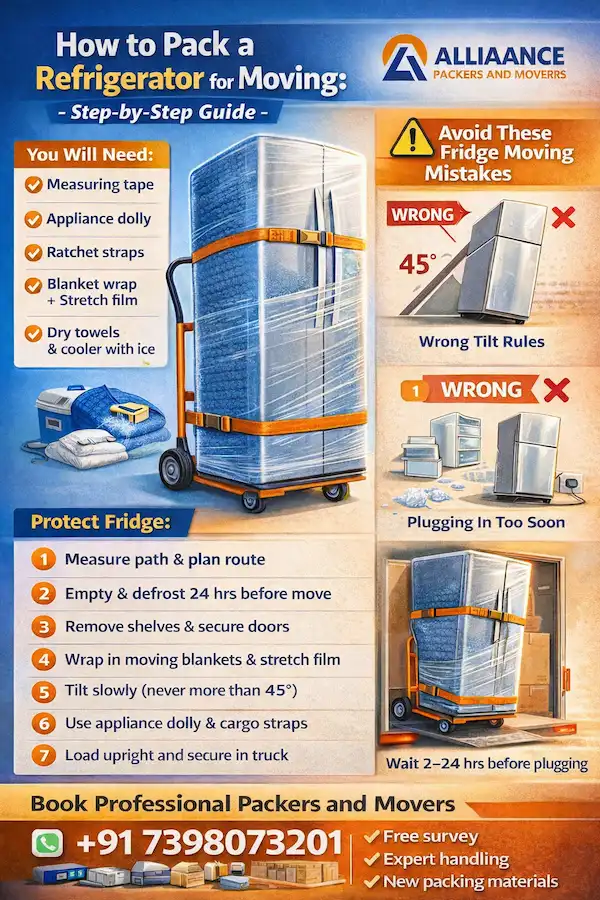
- Attach at least two cargo straps or ratchet straps around the refrigerator and the dolly frame. Cinch firmly but not so tightly that the straps deform the appliance body.
- Tip the dolly back to no more than 45 degrees from vertical. This is the maximum safe transport angle. Beyond 45 degrees, the compressor oil can begin moving into the cooling lines.
⚠ Never tilt the refrigerator more than 45 degrees from vertical during transport on the dolly. Beyond this angle, compressor oil enters the cooling lines and the compressor may fail when the unit is restarted.
Step 11: Move Through the Path
With the fridge secured on the dolly at no more than 45 degrees, roll it slowly and deliberately along the prepared cardboard-protected floor path.
- Use your assistant as a spotter when navigating corners, doorways, and narrow corridors
- Go around corners slowly — allow the spotter to guide from the front
- On stairs: one person controls the dolly from the upper position; the assistant guides from below, supporting the weight one step at a time. Never rush staircase movement.
- Keep the fridge upright whenever possible. Minimise any tilting beyond what the dolly requires.
Step 12: Load into the Moving Truck
Use a loading ramp to roll the refrigerator up into the truck. Pull the dolly up the ramp backwards — do not push from below with the refrigerator above you.
- Position the refrigerator upright against the truck wall for the journey — NOT lying flat
- Attach ratchet straps from the refrigerator to the truck’s tie-down rails on both sides. The fridge should not be able to shift in any direction
- Secure smaller, flat items around the base of the refrigerator to stabilise it further during the journey
⚠ Refrigerators must always be transported in an upright position. Never lay a refrigerator on its front or back during transport — this puts excessive weight on engine components and causes permanent damage. If the refrigerator must be laid down (only as a last resort), lay it on its side only — never front or back.
If the Refrigerator Must Be Laid on Its Side: What to Know
In rare situations — very low trucks, tight stairwells, or unavoidable space constraints — a refrigerator may need to be laid on its side. This is not recommended, but if it is unavoidable, the following rules apply:
- Lay the refrigerator on its side only — never on its front or back. The front and back positions put weight directly on the most vulnerable components.
- Check the owner’s manual for which side is safer. Generally, lay the refrigerator on the side opposite where the compressor lines exit the compressor unit.
- Keep the time it spends on its side as short as absolutely possible.
- After standing it back upright, wait before plugging in (see the next section).
The reason for all of these precautions is the compressor oil. When the refrigerator is laid on its side, this oil flows out of the compressor and into the cooling lines. If the unit is then switched on while the oil is in the lines rather than in the compressor, the compressor runs dry and can fail permanently — a repair that costs more than many used refrigerators.
How Long to Wait Before Plugging In the Refrigerator at Your New Home
This is the most frequently asked question after a refrigerator move — and one where incorrect guidance causes real damage. The waiting period depends on how the refrigerator was transported.
How the Fridge Was Transported | How Long to Wait Before Plugging In | Why |
Upright throughout (recommended) | 2–4 hours minimum as a general precaution. If transported upright over a short distance, plugging in after settling is considered safe by most guidelines. | Oil and refrigerant remain correctly positioned when upright. Short settling time allows any vibration-related displacement to settle. |
Briefly tilted at 45 degrees or less (normal dolly use) | 2–4 hours | Brief tilting during loading is unavoidable. 2–4 hours is sufficient for oil to return to the compressor. |
Laid on its side for less than 1 hour | Wait the same length of time it was on its side (minimum 1 hour upright) | Oil moves slowly. Matching wait time to lay time ensures it returns before startup. |
Laid on its side for several hours | Minimum 8 hours — Whirlpool’s own guidance. Many experts recommend 24 hours for certainty. | Oil takes time to drain back to compressor. Compressor runs dry if oil is still in the lines. |
Laid on its side for more than a day | 24 hours minimum after returning to upright | Full oil settlement and refrigerant stabilisation required. |
Why this waiting period is critical: The compressor relies on oil for lubrication. When the refrigerator is tilted or laid down, this oil flows from the compressor into the refrigerant cooling lines. If the unit is switched on while oil is still in the lines, the compressor runs without lubrication and can fail permanently — an expensive repair or a complete replacement. Waiting allows the oil to drain back to the compressor under gravity before startup.
After the waiting period: plugging in correctly
- Check that the refrigerator is level front-to-back and side-to-side at its new position. Use adjustable levelling feet or wheels to correct any tilt. An unlevel refrigerator causes door sealing problems and uneven cooling.
- Inspect the exterior and interior for any damage that occurred during transport before plugging in.
- Plug in and set to the manufacturer’s recommended temperature.
- Allow 2–4 hours for the refrigerator to reach its target temperature before loading food. Do not place warm food inside immediately.
- If the refrigerator makes unusual noises after startup, unplug it and wait an additional 2–4 hours before trying again. If the problem persists, contact a technician.
💡 Always consult your refrigerator’s owner’s manual for model-specific guidance. Some models have specific waiting time recommendations that may differ from general guidelines. The manual is the most reliable source for your specific unit.
Common Refrigerator Moving Mistakes to Avoid
Mistake | Why It Causes Damage | What to Do Instead |
Not defrosting 24 hours before moving | Ice in the freezer melts during transit and leaks water into the truck, damaging other goods and the fridge floor | Unplug at least 24 hours before moving day. Place towels around the base to catch melt water. |
Leaving shelves and glass drawers inside | Internal items shift and rattle during transport. Glass shelves crack or shatter against each other. | Remove all shelves and drawers. Wrap individually in packing paper and bubble wrap. Pack in a separate labelled carton. |
Moving the refrigerator alone | Injury risk from tipping is serious given weight (45–181 kg) and height | Always have at least one assistant. Two or three for large models. |
Tilting beyond 45 degrees on the dolly | Compressor oil flows into cooling lines | Keep dolly tilt to maximum 45 degrees. Transport upright in the truck. |
Transporting on its front or back | Puts weight on compressor and engine components. Causes permanent damage. | Only side-down if absolutely unavoidable. Never front or back. |
Plugging in immediately after moving | Compressor oil may still be in the lines. Compressor runs dry and fails. | Wait 2–4 hours if upright throughout. Wait 8–24 hours if laid on its side. |
Filling the fridge interior with clothes for the move | Internal floor and shelves are not designed to bear external load during movement. Can crack. | Fridge interior must be empty during transport. |
Taping directly to the fridge surface | Adhesive residue damages paint, plastic trim, and stainless steel finishes | Tape over the moving blanket layer only. Use stretch film to hold blankets in place. |
Using a standard dolly instead of appliance dolly | Standard dollies rated for ~45 kg — not sufficient for a 100–181 kg appliance | Rent or borrow an appliance dolly rated for 270–360 kg. |
Not levelling the fridge at new location | Unlevel position causes door seal problems, uneven cooling, and compressor strain | Use the fridge’s levelling feet or wheels to ensure it is level on all axes after placement. |
How Alliaance Packers And Movers Handles Your Refrigerator
Alliaance Packers And Movers has handled refrigerators as part of household shifting in Lucknow since 2013. Every refrigerator move follows a defined process with the correct equipment — nothing is improvised.
| What Alliaance Provides | Detail |
| Free pre-move survey | Our crew visits your Lucknow address before booking. We check the refrigerator’s dimensions against your doorways, staircases, and path to the truck. If door removal is required, we identify it at the survey — not on moving day. |
| Defrost guidance | We advise exactly when to unplug and defrost based on your move date. Written confirmation given at survey. |
| Appliance dolly | Alliaance crew brings an appliance-rated dolly on every job — not a standard hand truck. Rated for safe refrigerator movement with integrated strap points. |
| EPE foam + moving blankets | All refrigerator exterior surfaces wrapped in EPE foam edge protectors and moving blankets before any movement. Stretch film applied over blankets. |
| Cargo straps in truck | Refrigerator secured to truck interior using ratchet straps on both sides. Upright position maintained throughout transit. |
| Shelves packed separately | Our crew removes, individually wraps, and boxes all glass shelves and plastic drawers before moving the unit. Labelled carton packed with EPE foam. |
| Plugging-in advice | We advise the correct waiting period based on how the refrigerator was transported — and leave written instructions if needed. |
| Payment structure | 5% at booking · 85% at loading · 10% at delivery after you confirm safe arrival |
Get a Free Quote in 30 Seconds!
Tell us your move details and our team will call you back within 15 minutes — 7 days a week.
“Pay only 10% on delivery — after you are satisfied”
✅ No spam · No hidden charges · Call within 15 mins
🔒 Your information is 100% safe and never shared
⭐ 800+ families trust Alliaance Packers And Movers
📞 Prefer to call?
Frequently Asked Questions
Unplug your refrigerator at least 24 hours before moving. This allows the freezer to defrost completely. Moving a refrigerator that has not fully defrosted causes ice to melt during transit — the resulting water can damage other goods in the truck and the refrigerator's interior. Place dry towels around the base before unplugging to absorb defrost water. For models with automatic ice makers, also disconnect the water line as per the owner's manual.
If the refrigerator was transported upright throughout the move, wait a minimum of 2–4 hours before plugging in. If it was laid on its side at any point, wait at least 8 hours — many experts recommend 24 hours for certainty. The reason: compressor oil flows into the cooling lines when the unit is tilted or laid down. If the compressor is started while oil is still in the lines rather than in the compressor, it runs without lubrication and can fail permanently. Always check your owner's manual for model-specific guidance.
No. The refrigerator must be empty during transport. The internal floor and shelving are not designed to bear the weight of external items during movement — they can crack or deform under load. The refrigerator is already one of the heaviest items in any move. Adding internal load increases injury risk during handling and damage risk to the appliance interior.
Yes. Always remove all glass shelves, glass panels, and plastic drawers. These shift and rattle during transport — glass shelves can shatter against each other even on a short local move. Wrap each piece individually in packing paper then bubble wrap. Pack in a separate labelled carton with EPE foam padding. If any shelves must stay inside, secure them with cardboard strips across the opening so they cannot move.
Only as a last resort, never on its front or back. If the refrigerator must be laid down, place it on its side only. Check the owner's manual for which side is safer — lay it on the side opposite where the compressor lines exit the unit. Keep the time it spends on its side as short as possible. After returning it to upright, wait the same amount of time it was on its side before plugging in (minimum 8 hours; 24 hours for certainty if it was on its side for several hours).
No more than 45 degrees from vertical. This is the maximum safe angle during dolly transport. Beyond 45 degrees, the compressor oil begins moving into the cooling lines. Always keep the refrigerator as close to upright as possible on the dolly. In the moving truck, the refrigerator must be positioned fully upright and secured with ratchet straps — never transported at an angle or laid flat.
Yes — particularly for large, heavy models (double-door, side-by-side, French door refrigerators above 80 kg); for intercity moves where the refrigerator will be in transit for 1–3 days; for homes with narrow doorways, stairs, or difficult access; and whenever you do not have access to an appliance dolly, ratchet straps, and at least 2 helpers. Professional movers bring the correct equipment, know the correct techniques, and carry insurance coverage if damage occurs. The cost of replacing a compressor is often higher than professional packing charges for the appliance.
Move Your Refrigerator Safely — Avoid Costly Damage
Get expert packing and safe handling for your fridge. Book a free survey with Alliaance Packers and Movers today and ensure damage-free shifting with professional tools and trained crew.