
Single Layer vs Multi-Layer Packing: Which Do You Need?
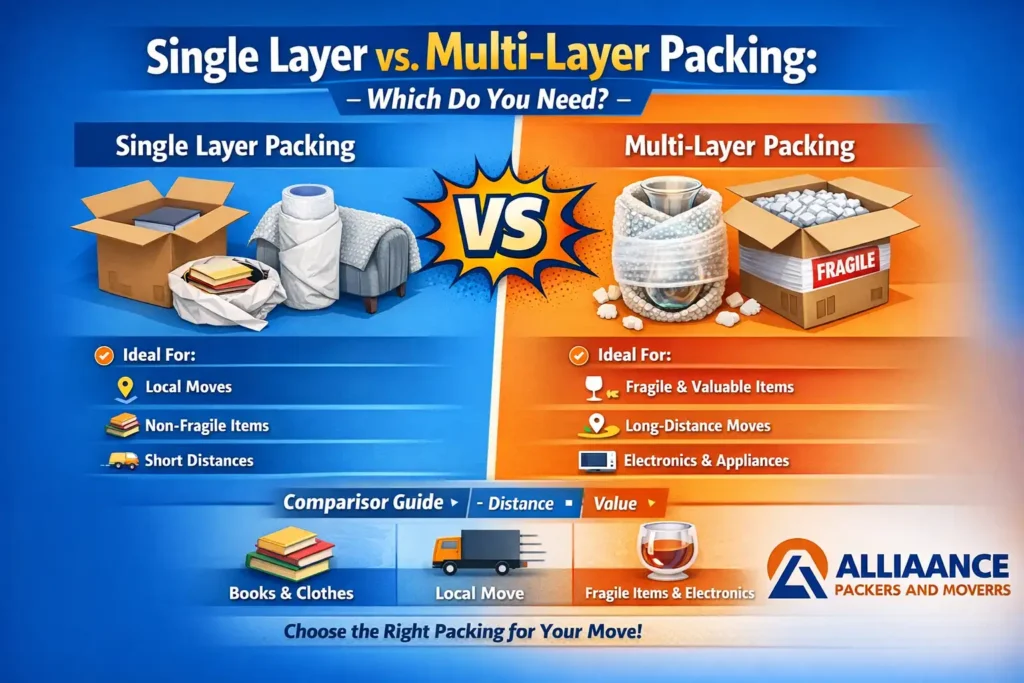
Every item in your home needs packing before it moves — but not every item needs the same packing. This is one of the most misunderstood parts of hiring professional packers and movers in Lucknow. Some customers expect everything to be wrapped three times over, especially when working with packers and movers in Lucknow for local shifting. Others assume a single layer of bubble wrap will do for everything. Both assumptions cost money or cause damage.
Single-layer packing is adequate for a specific category of items: non-fragile, low-value goods being moved locally over short distances. Multi-layer packing is the professional standard for fragile goods, electronics, high-value items, and any move where goods travel more than a few kilometres.
The decision between single and multi-layer packing is not arbitrary — it is determined by the item’s fragility, the distance of the move, the handling it will undergo, and whether replacement is expensive or impossible. This guide explains the difference clearly, shows which approach applies to each category of item, and tells you what Alliaance Packers And Movers uses on every job.
About Alliaance Packers And Movers: Operating in Lucknow since 2013, we use verified packing techniques on every local and intercity move. All packing materials are new for every job. For a free pre-move survey and written quote, call +91 7398073201.
Table of Contents
What Is Single-Layer Packing?
Single-layer packing means one protective material is applied to an item before it is boxed or loaded. This is the most basic form of protection used during a move.
What it looks like in practice
- A carton box with items placed inside without individual wrapping — filled with crumpled paper to prevent shifting
- A single layer of packing paper wrapped around non-fragile kitchen items like steel utensils, tins, or plastic containers
- A moving blanket draped over a sofa without stretch film — adequate for a very short in-building move
- Books or folded clothes stacked in a standard corrugated carton with no individual item wrapping
When single-layer packing is adequate
Item | Why Single Layer Works | Condition Where It Applies |
Books and documents | Dense, sturdy, low breakage risk. Weight is the main concern, not fragility. | Local move, short distance, no moisture risk |
Clothes and linen | Soft, flexible, self-cushioning. Cannot scratch or shatter. | Any distance — clothes do not need multi-layer protection |
Plastic containers and steel utensils | Hard surfaces, no breakage risk under normal handling. | Local move. For intercity, sealed in box with no gaps. |
Soft toys and cushions | No fragility. Serve as cushioning material themselves inside boxes. | Any distance |
Flat-packed furniture parts (MDF/wood) | Rigid and resistant to moderate impact when well-stacked. | Local only; edges need corner protection |
⚠ Single-layer packing is frequently misapplied to items that need multi-layer protection. The most common error: one sheet of bubble wrap around a glass item, without packing paper first, without filling box gaps, and without a rigid carton. This is not multi-layer — and it is not adequate for fragile goods.
What Is Multi-Layer Packing?
Multi-layer packing means two or more distinct protective materials are applied in sequence to a single item, each serving a different protective function. Professional packers use this system for all fragile, high-value, or intercity-bound goods.
The standard professional multi-layer sequence
- Layer 1 — Surface protection: Plain packing paper (unprinted newsprint) is wrapped directly against the item’s surface. It prevents scratches, does not transfer ink, and snugly conforms to the item’s shape. For hollow items like cups and glasses, crumpled packing paper is stuffed inside first to absorb internal vibration.
- Layer 2 — Cushioning: Bubble wrap is applied over the packing paper with the air bubbles facing inward against the item. The sealed air capsules absorb shocks and vibrations that packing paper alone cannot handle. For particularly fragile items such as glassware and fine china, two layers of bubble wrap are used.
- Layer 3 — Rigid containment: The wrapped item is placed inside a corrugated carton box — either 5-ply or 7-ply depending on weight and fragility. The box provides the rigid outer shell that the wrapping alone cannot deliver. Cardboard dividers separate individual items within the box.
- Layer 4 — Void filling: All gaps inside the carton are filled with crumpled packing paper, EPE foam pieces, or packing peanuts until nothing moves when the box is shaken. This prevents internal shifting which is one of the leading causes of breakage during transit.
- Layer 5 (intercity/long-distance): The sealed carton is wrapped in stretch film as the outermost layer, creating a waterproof moisture barrier for multi-day transit through variable weather.
For specific high-risk items, additional specialist layers are used
Item | Multi-Layer Sequence Used Professionally |
Glass items (crockery, showpieces) | Packing paper → bubble wrap (1–2 layers) → corrugated divider box → void fill → FRAGILE label |
LED/LCD flat-screen TV | Moving blanket → bubble wrap (2–3 layers) → thermocol corner protectors → TV-specific corrugated box → EPE foam gap fill → upright only |
Mirror / large glass panel | X-tape on glass face → EPE foam sheets → bubble wrap (2 layers) → wooden crate or specialist flat carton → UPRIGHT ONLY label |
Electronics (laptop, PC) | Soft cloth → anti-static foam → bubble wrap → snug corrugated box → EPE foam void fill |
Antiques / original artwork | Packing paper → bubble wrap → EPE foam → corrugated sheets → custom wooden crate → tamper seal |
Refrigerator | EPE foam sheets on all panels → furniture blanket → stretch film to lock doors |
The key principle is that each layer addresses a different threat: packing paper protects surfaces, bubble wrap cushions impact, rigid boxes contain the item, void fill prevents internal movement, and stretch film blocks moisture. No single layer addresses all these threats. This is why multi-layer packing exists.
💡 The shake test: After a box is sealed, gently lift and shake it. If you hear or feel any movement inside, the box is not correctly packed. Open it and add more void fill until nothing shifts. A correctly packed fragile box makes no sound when shaken.
Single Layer vs Multi-Layer Packing: Full Comparison
Factor | Single-Layer Packing | Multi-Layer Packing |
Item types suited | Books, clothes, steel/plastic items, non-breakables | Crockery, glassware, electronics, mirrors, artwork, appliances, high-value items |
Number of protective materials | 1 (typically a carton or one wrapping material) | 2–5 distinct materials in sequence, each serving a different function |
Cost | Lower — fewer materials, less packing time | Higher — more materials and more packing labour time per item |
Protection level | Adequate for non-fragile goods with low breakage risk | Required for fragile goods, electronics, or items where replacement is expensive |
Move type | Local moves (same city, short distance) | Intercity, long-distance, and any move with fragile goods regardless of distance |
Shock absorption | Minimal — relies on box walls and crumpled fill only | Layered — packing paper (surface) + bubble wrap (cushioning) + box (rigid) + void fill (no shift) |
Moisture protection | None by default | Stretch film outer layer provides moisture barrier — essential for monsoon moves or intercity transit |
Handling cycle risk | Low — few loading/unloading events | High on shared trucks — multiple handling cycles. Multi-layer compensates. |
Space and weight | Compact and lighter — wrapping is thin | Adds bulk and weight — each layer adds volume to the packed item |
When it fails | Used on fragile items — no cushioning, item shatters on first impact | Fails only when applied incorrectly — voids not filled, wrong material order, or tape on item surface |
Does Move Distance Change Which Packing You Need?
Yes — significantly. The distance of a move directly determines how many handling cycles your goods undergo, how long they are in transit, what weather conditions they may encounter, and how much vibration and road impact they accumulate. Each of these factors increases the risk of damage, and multi-layer packing compensates for each one.
Local moves (same city)
For a local move within the same city — a 10 to 25 km trip, same-day completion — single-layer packing is acceptable for non-fragile goods. The goods are in the truck for a few hours, loading and unloading happens once at each end, and there is no extended vibration exposure. Basic carton packing with proper void filling is sufficient for books, clothes, and kitchen non-breakables.
However, even on local moves, fragile items — crockery, glassware, electronics, mirrors — still require multi-layer packing. Distance does not reduce the risk of breakage from impact during loading or unloading. A plate packs identically whether the move is 5 km or 500 km.
Intercity and long-distance moves
For any intercity move — Lucknow to Delhi, Lucknow to Mumbai — multi-layer packing is the non-negotiable standard for all item types, including those that might be single-layer packed on a local move. Several specific factors make this necessary:
- Extended vibration: A truck covering 500–1,400 km over 1–5 days exposes goods to sustained road vibration that accumulates damage in inadequately wrapped items over time
- Multiple handling cycles: Shared trucks (part-load) involve multiple loading and unloading events across different customers’ stops — each event is a damage opportunity
- Weather exposure: Intercity moves may encounter rain, high humidity, or temperature variation. Stretch film outer wrapping on all cartons provides moisture protection that is absent in single-layer packing
- No same-day verification: On a local move, you see your goods arrive the same day. On an intercity move, goods travel for 1–5 days without you. If packing fails, there is no immediate intervention
| Move Type | Non-Fragile Items | Fragile Items | Furniture | Electronics |
| Local (same city, <25 km) | Single layer adequate | Multi-layer required | Blanket + stretch film | Multi-layer required |
| Short intercity (25–200 km) | Multi-layer recommended | Multi-layer required | Blanket + stretch film + EPE foam | Multi-layer required |
| Long-distance (200–500 km) | Multi-layer required | Multi-layer + void fill + stretch film outer | Full protection + crate if glass | Multi-layer + original or specialist box |
| Very long-distance (500+ km) | Multi-layer + stretch film outer on all cartons | Multi-layer + double-boxing + wooden crate for valuables | Full protection + wooden crate for glass tops | Multi-layer + anti-static + specialist box |
Which Packing Does Each Item Actually Need?
Rather than deciding by guesswork, the correct packing level for each item is determined by three factors: breakability, replacement cost, and move distance. Here is the practical decision for the most common household item categories:
Item Category | Single Layer? | Multi-Layer? | Reason |
Books and files | Yes — for local and intercity | Not required | Dense, low breakage risk. Small boxes, proper void fill. |
Clothes, linen, curtains | Yes — for all distances | Not required | Flexible, self-cushioning. Wardrobe box or carton adequate. |
Steel and plastic kitchen items | Yes — local. Carton with void fill | Recommended for intercity | Durable surface, but lightweight items can shift and dent on long trips |
Crockery and dinnerware | No | Yes — always | Glass-ceramic materials shatter under minimal impact. Paper + bubble wrap + dividers + void fill mandatory. |
Glassware and stemware | No | Yes — always | Extremely fragile. Two layers bubble wrap, cardboard cell dividers, hollow interior stuffed with paper. |
Flat-screen TV | No | Yes — always | Screen surface cracks from sustained vibration if improperly packed. Blanket + 2–3 layers bubble wrap + thermocol corners + TV box + upright transport. |
Refrigerator | No | Yes — always | EPE foam on all exterior panels prevents dents. Stretch film locks doors. Always transported upright. |
Washing machine | No | Yes — always | EPE foam on exterior, transit bolts reinstated, stretch film on lid. Always upright. |
Mirrors | No | Yes — always | X-tape on glass, EPE foam, bubble wrap, specialist flat carton or wooden crate. Upright only — never flat. |
Artwork and antiques | No | Yes — highest standard | Packing paper, bubble wrap, EPE foam, corrugated sheets, custom wooden crate. Loaded last, unloaded first. |
Laptops and computers | No | Yes — always | Soft cloth, anti-static foam, bubble wrap, snug carton with foam fill. Original box preferred. |
Wooden furniture | Blanket for local moves | Blanket + stretch film + EPE foam corners for intercity | Scratch protection is primary risk. Corners especially vulnerable on staircase carries. |
Sofa and upholstered items | Blanket for local | Blanket + stretch film for intercity | Upholstery stain and snag protection during multi-day transit. |
Bike / two-wheeler | No | Yes — always | Painted surfaces bubble-wrapped, foam sheets on metal panels, corrugated around body, stretch film outer. |
Double-Boxing: When Multi-Layer Packing Goes One Step Further
Double-boxing is an advanced version of multi-layer packing used for high-value, extremely fragile, or irreplaceable items. The item is packed completely inside a smaller box using full multi-layer technique — packing paper, bubble wrap, void fill, sealed. This smaller packed box is then placed inside a larger corrugated carton with additional cushioning (packing peanuts, EPE foam, or crumpled paper) between the two boxes. The outer box provides a second rigid shell.
Why double-boxing works
When a box is dropped or struck externally, the outer box absorbs and distributes the impact force. By the time that force reaches the inner box, it has been significantly reduced. The cushioning layer between the two boxes — typically 5–7 cm on all sides — acts as a secondary shock-absorber.
When double-boxing is used
- Glassware and fine china on long-distance intercity moves
- Electronics including laptops, cameras, gaming consoles — whenever the original factory box is not available
- High-value showpieces, crystal, and antique ceramics
- Medical devices, instruments, and precision tools
⚠ Packing peanuts are NOT effective when used alone — they must always be combined with a wrapped item inside. Heavy items will crush packing peanuts under their own weight during transit, eliminating all cushioning. Always wrap the item first, then surround with packing peanuts in the outer box.
Anti-static consideration for electronics
Standard bubble wrap can generate static electricity when in contact with electronic components. For sensitive electronics — motherboards, processors, hard drives, graphics cards — anti-static foam or anti-static bubble wrap must be used as the first layer. Regular bubble wrap is then applied over the anti-static layer. This sequence protects the item from both electrostatic discharge and physical impact. Using only standard bubble wrap directly on circuit boards is a known cause of electronics damage during moves.
What Alliaance Packers And Movers Uses: Single and Multi-Layer in Practice
Alliaance Packers And Movers has provided packing and shifting services in Lucknow since 2013. We do not apply a single packing standard to everything. Every item is assessed at the pre-move survey and packed using the correct technique for its fragility, value, and the distance being moved.
Move Type | Standard Alliaance Packing Approach |
Local Lucknow move (non-fragile items) | Single-layer: new 3-ply corrugated cartons with proper void fill. No wasted wrapping on non-fragile goods. |
Local Lucknow move (fragile items: crockery, glass) | Multi-layer mandatory regardless of distance: packing paper + bubble wrap + corrugated dividers + void fill + FRAGILE label. |
Intercity move (all items) | Multi-layer on all categories including non-fragile cartons, which receive stretch film outer layer for moisture protection. Fragile items get full sequence. |
Flat-screen TVs | Always multi-layer: moving blanket + 2–3 layers bubble wrap + thermocol corners + TV-specific corrugated box + EPE foam gap fill. Always upright. |
Mirrors and large glass | Always multi-layer: X-tape + EPE foam + bubble wrap (2 layers) + specialist flat carton or custom wooden crate + UPRIGHT ONLY. |
Electronics | Always multi-layer: anti-static foam + bubble wrap + snug corrugated box + EPE foam void fill. Original box used if available. |
High-value antiques / artwork | Double-boxing or custom wooden crate standard. Loaded last, unloaded first on all moves. Discussed at pre-move survey. |
Refrigerators and washing machines | EPE foam on all panels + furniture blanket + stretch film to lock doors/lid. Always upright. |
All materials — new carton boxes, bubble wrap, packing paper, EPE foam, stretch film, furniture blankets — are included in the written fixed quote. No separate material charges on moving day. Packing approach confirmed at free pre-move survey.
Get a Free Quote in 30 Seconds!
Tell us your move details and our team will call you back within 15 minutes — 7 days a week.
“Pay only 10% on delivery — after you are satisfied”
✅ No spam · No hidden charges · Call within 15 mins
🔒 Your information is 100% safe and never shared
⭐ 800+ families trust Alliaance Packers And Movers
📞 Prefer to call?
Frequently Asked Questions
Single-layer packing uses one protective material — typically a corrugated carton box or one sheet of packing paper. It is adequate for non-fragile goods like books, clothes, and steel items on local moves. Multi-layer packing uses two or more distinct materials in sequence: packing paper for surface protection, bubble wrap for shock absorption, a rigid carton for containment, void fill to prevent shifting, and stretch film for moisture protection on intercity moves. Multi-layer packing is the professional standard for all fragile, electronic, and high-value items.
For non-fragile items on a short local move — books, clothes, plastic items — single-layer carton packing with proper void fill is adequate. However, even on a local move, fragile items such as crockery, glassware, electronics, and mirrors always require multi-layer packing. Distance does not reduce impact risk during loading and unloading — a plate breaks identically on a 5 km move and a 500 km move if improperly packed.
Professional multi-layer packing for crockery:
(1) crumpled packing paper stuffed inside hollow items such as cups.
(2) each item individually wrapped in packing paper.
(3) bubble wrap applied over the paper with bubbles inward.
(4) items placed in a 5-ply corrugated carton with cardboard dividers separating each piece.
(5) all gaps filled with crumpled paper or EPE foam until nothing shifts when the box is shaken.
(6) FRAGILE and THIS SIDE UP labelled on multiple sides. All plates are packed vertically — never flat.
Double-boxing is used for high-value, extremely fragile, or irreplaceable items — fine china, glassware, and electronics on long-distance moves when the original factory box is unavailable. The item is packed completely with multi-layer technique inside a smaller box, which is then placed inside a larger carton with 5–7 cm of cushioning (EPE foam, packing peanuts) on all sides between the two boxes. The outer box absorbs and distributes impact before it reaches the inner box.
Sensitive electronic components — motherboards, processors, hard drives, graphics cards — should always have anti-static foam as the first layer, not standard bubble wrap. Standard bubble wrap can generate static electricity in contact with circuit boards, causing electrostatic discharge damage that is invisible externally but destroys internal components. Anti-static foam or anti-static bubble wrap is applied first, with standard bubble wrap over it for external impact protection. For consumer electronics (laptops, TVs, cameras), the original factory box with its custom foam inserts is always the preferred packing.
Yes, for fragile and high-value items. The cost of multi-layer packing for a household move typically adds ₹3,000–8,000 to the total quote compared to basic single-layer packing, depending on the volume of fragile goods. The cost of replacing a cracked LED television screen starts at ₹8,000–20,000. A full crockery set costs ₹5,000–25,000+. A large mirror replacement costs ₹3,000–10,000+. The insurance value of correct packing always exceeds the material cost, particularly on intercity moves where goods cannot be inspected during transit.
Choose the Right Packing — Save Your Belongings!
All materials — new carton boxes, bubble wrap, packing paper, EPE foam, stretch film, furniture blankets — are included in the written fixed quote. No separate material charges on moving day. Packing approach confirmed at free pre-move survey.