
Why Are Packers and Movers Charges Higher on Weekends and Month-End?

You received a quote of ₹18,000 for your move, booked a Saturday near the end of the month, and ended up paying ₹25,500. Nothing changed about the move—not the house, goods, or route. The only difference was the date. When comparing packers and movers Lucknow, understanding how moving dates affect demand can help you avoid unexpected expenses and plan a more cost-effective relocation.
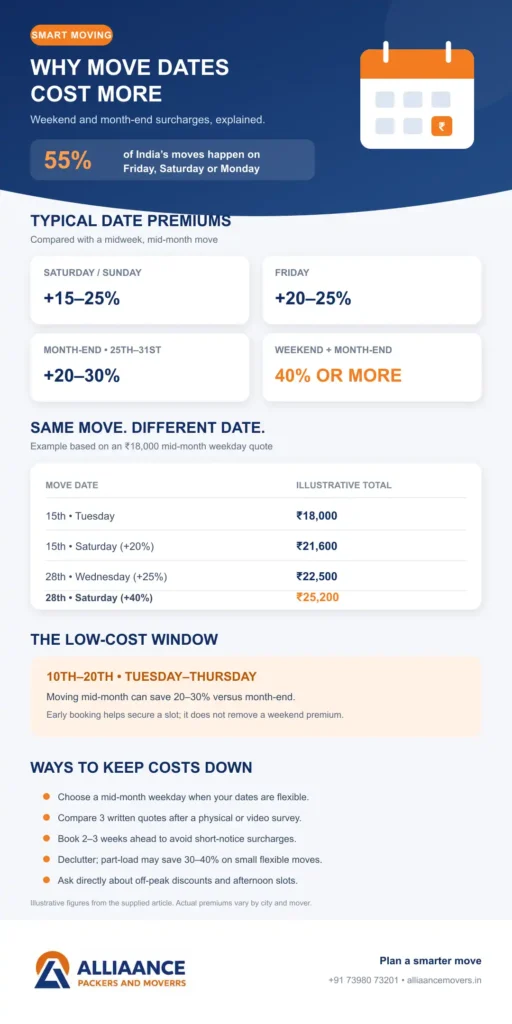
This is not a pricing anomaly. It is a predictable, documented consequence of how demand concentrates in the Indian relocation market. Research shows that 55% of all relocations in India occur on Friday, Saturday, or Monday, creating massive demand spikes that drive up packers and movers charges significantly. Add month-end lease cycles and the picture becomes clear: the date of your move can add 20 to 40 per cent to the cost of a move that is otherwise identical.
This guide explains exactly why this happens, what the real numbers look like, and how to use this knowledge to save money on your next move.
Timing Factor | Premium Range |
Weekend (Saturday/Sunday) vs weekday | 15–25% higher |
Friday specifically vs midweek | 20–25% higher (highest weekend day) |
Month-end (25th–31st) vs mid-month | 20–30% higher |
Combined weekend + month-end | Up to 40% higher or more |
Peak transfer season (March–June) | Slots fill 3–4 weeks ahead; rates at top of range |
Festive season (Diwali/Dussehra, Oct–Nov) | 15–25% higher |
Monsoon season (July–September) | 15–20% LOWER than peak; best rates of the year |
Mid-month weekday (Tue–Thu, 10th–20th) | Lowest demand; most available slots; best rates |
Table of Contents
- Why Weekend Charges Are Higher
- Why Month-End Charges Are Higher
- How to Save on Relocation
- How Alliaance Helps You Save on Moving
- FAQs
Why Weekend Charges Are Higher
Weekend pricing in the Indian packers and movers market is not arbitrary. It is the logical result of supply and demand compression into a two-day window, combined with several structural factors that make weekends genuinely more expensive to operate.
55 Per Cent of India’s Moves Happen on Friday, Saturday, or Monday
The single most important fact about weekend pricing: research shows that 55% of all relocations in India occur on Friday, Saturday, or Monday. This means more than half the national volume of moves is concentrated in a three-day window. Every mover, every truck, and every packing crew is being pulled in the same direction at the same time. With supply fixed in the short term, demand concentration drives prices up.
When six customers want the same truck and crew on Saturday, and the mover only has one available, the price goes to the customer who is willing to pay most. The other five either pay the premium or reschedule. This is not price gouging — it is basic scarcity pricing.
Friday: The Most Expensive Day of the Week
Among the peak weekend days, Friday is the highest-priced. Friday moves cost 20 to 25% more due to weekend preparation demands and limited availability. The reason: customers moving on Friday want to be settled before the weekend, and many use Saturday as an unpacking day. This creates particularly concentrated Friday morning demand that exhausts mover availability early.
Workers Demand Weekend Differential Pay
Packing and moving is physical labour. Labour charges in India for packers and movers are typically ₹400 to ₹500 per person per day on weekday rates. On weekends, workers — like workers in most industries — expect a differential for giving up their day off. This is a cost that the mover passes through. A 2BHK move requiring 4 workers carries ₹1,600–2,000 in base daily labour. A weekend differential of 25% on labour alone adds ₹400–500 in real cost before any other premium.
Truck Availability Drops Because Drivers Also Have Weekend Constraints
Professional long-distance truck drivers and local tempo operators have their own preferences and family obligations. Weekend availability in India’s commercial transport market is structurally lower than weekday availability — particularly for the experienced, reliable operators who have the best safety records. The best operators tend to be booked first; what remains for last-minute weekend bookings is a thinner pool of available vehicles and crews.
Society Access Hours Are Restricted on Weekends in Many Buildings
Premium gated housing societies — particularly in Noida, Gurugram, Mumbai, Pune, and Bangalore — restrict moving vehicle access on weekend mornings and evenings to reduce disruption to residents. When the permitted moving window on a Saturday is 10 AM to 2 PM instead of 8 AM to 7 PM, a move that would take 6 hours during weekday access has to be compressed or split. Compression means overtime charges. Splitting means a second trip.
Move Complexity Increases at Peak Times: Traffic and Access
Weekend traffic patterns in Indian cities are different from weekday patterns. Market areas, mall districts, and residential zones all see higher vehicle density on weekends, particularly Saturday mornings. A move in Mumbai’s Andheri or Delhi’s Greater Kailash on a Saturday morning takes meaningfully longer than the same move on a Tuesday morning. Longer handling time = more labour hours = higher cost, even before the weekend rate premium.
No Discount for Same-Week Cancellations on Weekend Slots
When a mover books a Saturday slot, they hold a truck and crew for you. If you cancel at short notice, they cannot easily fill that slot during the remaining working week. This creates a risk premium that is factored into weekend rates: the mover is effectively insuring against a higher-probability short-notice cancellation by pricing the slot higher in the first place.
Corporate and Institutional Demand Clusters on Weekends
Corporate offices overwhelmingly prefer weekend moves for office relocations, because a weekend move means zero working-hour disruption. This adds a layer of institutional demand — often well-funded and non-price-sensitive — on top of the existing household demand on Saturdays. When corporate and household demand compete for the same pool of movers on a Saturday, prices rise to clear the market.
Parts of the Moving Supply Chain Are Closed on Sundays
Some support services that movers rely on — transit insurance endorsement, documentation for interstate moves, lift booking confirmations at societies — have limited availability on Sundays. Sunday moves therefore carry a higher operational friction cost for the mover, which is reflected in the pricing.
The Demand Multiplier Effect on Already-Expensive Month-End Weekends
The most expensive possible moving date is a weekend that also falls at the end of the month. When month-end coincides with a Saturday or Sunday, both premium factors compound. This is the combined weekend + month-end scenario where prices can rise 40% or more above a midweek, mid-month baseline. a base service cost of ₹15,000 becomes ₹18,000 with the weekend premium (+₹3,000) and ₹22,500 when the month-end rush is added (+₹4,500 on top of the weekend-adjusted figure).
Why ‘Just Booking Early’ Does Not Fix Weekend Pricing
A common misconception: ‘if I book 3 weeks ahead, I will get the normal rate on a Saturday.’ This is not how weekend pricing works. The premium is not for last-minute booking — it is for the day itself. You can book a Saturday slot 4 weeks in advance and still pay 15 to 25% more than a Wednesday slot booked the same day. Booking early does ensure you get a slot — but it does not remove the weekend rate premium.
Day of Week | Demand Level | Typical Rate vs Wednesday |
Monday | 🔴 High (weekend spill; people who moved Sun want to set up) | 10–15% higher |
Tuesday | 🟢 Low | Baseline — cheapest weekday |
Wednesday | 🟢 Low | Baseline — cheapest weekday |
Thursday | 🟡 Medium | 3–5% higher |
Friday | 🔴 Very High | 20–25% higher (highest single-day premium) |
Saturday | 🔴 Very High | 15–25% higher |
Sunday | 🟡 Medium-High | 10–20% higher (lower than Saturday; access restrictions in many societies) |
Why Month-End Charges Are Higher
Month-end moving premiums in India are driven by a specific structural reality: most rental leases in India operate on calendar-month cycles. When leases expire simultaneously, moving demand concentrates into the same 7–10 day window every month, with the intensity highest in the 25th–31st band.
India’s Rental Market Runs on Calendar-Month Lease Cycles
The foundation of month-end pricing: rental agreements in India, across virtually all cities and property types, are structured on calendar months. When a tenant signs a lease, it starts on the 1st and ends on the 28th–31st. When a large number of tenants in a city are all ending leases simultaneously, a very large number of households are all moving within the same week. In Mumbai, the month-end rush window is specifically documented as the 28th–5th, when thousands of leases expire simultaneously.
The 25th–31st Band: The Most Expensive Week of Any Month
Within the month-end window, the 25th–31st represents peak demand concentration. Demand spikes every 28th–5th in Mumbai (and equivalently at the end of the month in every major Indian city), when thousands of leases expire simultaneously, adding 20 to 30% to any moving bill.
The specific mechanics: a tenant who must vacate by the 31st needs to move before that date. If they plan a weekend move for the 28th or 29th, they get the combined month-end + weekend premium. The premium compounds the later in the month they move.
Government and Corporate Transfer Orders Cluster in the 1st–31st March–June Window
Government transfer orders in India are routinely issued in the March–June window, when the fiscal year ends and departmental transfers are processed. A large volume of government employees — bank staff, central government employees, defence personnel, PSU officers — all receive transfer orders in approximately the same period. When they need to move by a deadline, they are competing for the same moving resources.
Mover Capacity Does Not Scale with Demand
Moving companies cannot double their fleet or crew in the last week of every month. Trucks require drivers. Drivers need rest periods. Packing materials need to be in stock. The physical supply of professional moving services has a ceiling that does not move with demand. When 30% of a month’s moving volume concentrates into the last 20% of the month’s days, the price must clear the market.
Fuel and Overtime Costs Rise During High-Density Periods
During month-end peaks, movers often run multiple moves back-to-back, with less rest time between jobs. Drivers work longer hours. Packing crews work across multiple days with reduced breaks. Fuel costs do not change, but the operational intensity does — and the overtime and crew fatigue costs are real. These cost increases flow into the pricing.
Labour Availability Tightens Dramatically at Month-End
Experienced packing crew members know that month-end is busy. Some take advantage of the moment to push for higher daily rates. Others are already committed to another mover. The pool of experienced, available packing crew is meaningfully smaller in the last week of the month than in the second week. Labour charges (₹400–500 per person per day on normal days) can drift higher during peak periods when all movers are competing for the same crew.
Goods Lifts and Parking Bays in High-Rise Buildings Are Booked Out
In cities with high concentrations of gated high-rise societies — Gurugram, Noida, Mumbai, Pune, Bangalore — the freight lifts and society parking bays used by moving trucks are booked out days or weeks in advance during month-end. A mover who cannot get a freight lift slot may need to use manual staircase carry for a 15th-floor delivery, which adds staircase charges and time. These operational constraints at month-end push effective costs up even for customers who secured a slot.
The New Address Possession Cluster
Many possession dates in India are set for the 1st of the month. A buyer who gets possession on 1 March needs to move before or shortly after that date. This creates a cluster of moves in the last week of February and the first days of March — month-end on one side and month-start on the other. Both ends of this cluster see elevated demand.
Peer Pressure and Herd Behaviour Amplify the Cluster
There is also a behavioural element to month-end concentration. Because so many people move at month-end, movers become visibly scarce in that window — which prompts people who have flexibility to book early to lock in a slot. This early booking by flexible customers actually intensifies the remaining scarcity for less-flexible customers. The concentration feeds on itself.
The Festive Season Overlay: October–November Diwali Premium
Diwali and Dussehra are considered auspicious times to enter a new home in many Indian traditions. This cultural overlay adds a festive season demand layer on top of the usual month-end cycle. Prices between October and November rise by approximately 15 to 25% over regular months due to this festive-season demand. A month-end Diwali date can combine three premium factors simultaneously: month-end, festive season, and weekend.
Real-Money Example: How Dates Change Your Bill
Scenario | Base Move Cost | Date Premium | Total |
Mid-month (15th), Tuesday move | ₹18,000 | None (baseline) | ₹18,000 |
Mid-month (15th), Saturday move | ₹18,000 | Saturday: +20% (+₹3,600) | ₹21,600 |
Month-end (28th), Wednesday move | ₹18,000 | Month-end: +25% (+₹4,500) | ₹22,500 |
Month-end (28th), Saturday move | ₹18,000 | Weekend + month-end: +40% (+₹7,200) | ₹25,200 |
Festive season month-end Saturday | ₹18,000 | Weekend + month-end + festive: +50%+ possible | ₹27,000+ |
💡 The single highest-risk scenario: a Saturday that falls on the 28th–31st during Diwali season. If your lease ends near Diwali, book 3–4 weeks ahead regardless of date flexibility.
How to Save Money on Your Relocation
The premium on weekend and month-end moves is real and documented. But it is also largely avoidable if you have any flexibility on dates. The following strategies, based on verified pricing data, can save 20 to 40% on the total cost of your move.
Book Mid-Month (10th–20th): The Single Most Effective Cost-Saver
The most affordable dates in any month are the 10th to the 20th. Demand in this window is at its monthly low across India. Moving on the 15th versus the 28th can save 20 to 30% on an otherwise identical move. If your lease end or possession date has any flexibility — even a week either direction — pushing from month-end to mid-month is the highest-value single decision you can make.
Choose Tuesday, Wednesday, or Thursday
Among the days of the week, Tuesday to Thursday consistently offer the lowest rates across India. Weekend demand is at its lowest midweek. Crew availability is highest. Traffic conditions are better in most Indian cities on Tuesday mornings than Saturday mornings. A Tuesday 15th move is the gold standard for the lowest possible demand-based pricing.
Book October–February for the Cheapest Annual Window
October to February is the cheapest period of the year for packers and movers across India — off-peak demand, no summer heat surcharge, post-Diwali festive premium over, and no monsoon risk. July to September (monsoon season) is also a low-demand period with rates 15 to 20% below peak — but monsoon moves carry waterlogging risks in certain cities and require extra packing precautions.
Book 2–3 Weeks Ahead to Avoid Last-Minute Premiums
While early booking does not remove the weekend or month-end premium, it does ensure you actually get a slot — and it gives you time to negotiate. Last-minute bookings (48 hours or less) during peak windows often attract a short-notice surcharge on top of the peak premium. Booking 2 to 3 weeks ahead for month-end moves and 1 to 2 weeks for mid-month moves is the standard recommendation.
Negotiate Early Morning or Late Evening Slots
Professional movers typically run 2 moves per day: a morning slot (loading 8 AM, typically done by 2 PM) and an afternoon/evening slot (loading 2 PM, done by 8–9 PM). The afternoon slot is often slightly cheaper than the morning slot on peak days because it is less preferred — customers do not want to unload into their new home late at night. On a peak Saturday, taking a 2 PM loading slot can sometimes negotiate a small reduction.
Request Off-Peak Discounts Explicitly
When getting quotes on mid-month weekday dates, ask the mover directly whether they offer a mid-week or off-peak discount. Professional movers know their demand curve and often have informal discounts for customers who explicitly choose low-demand dates and acknowledge that flexibility. The ask costs nothing; the discount is available more often than customers realise.
Get at Least 3 Written Quotes After a Survey
Moving-date premiums vary between operators. Some charge a strict 25% weekend premium across the board; others are more flexible. Getting 3 written quotes — all after physical or video surveys — gives you visibility into the market. Compare the all-in total (including GST, packing materials, staircase, insurance) not the headline number. A lower headline number with an undisclosed weekend premium added on moving day is not a saving.
Avoid the Month-End Window by Negotiating Your Lease End Date
The most effective month-end savings strategy is simply not ending your lease at month-end. If you are renewing or exiting a rental, negotiate a lease end date of the 15th to 20th instead of the 30th or 31st. Many landlords in India are open to this: a mid-month vacating date disrupts them less than a 31st-of-December last-day rush. The date negotiation happens before the move is booked, and it can save 25% on the move.
Declutter Before the Move: Reduce Volume, Reduce Cost
Every item you move contributes to truck size, crew time, and packing materials cost. A declutter before the move — selling, donating, or disposing of items you no longer need — directly reduces moving cost. For moves where a 2BHK truck would otherwise be needed, enough decluttering can bring the job into the 1BHK truck range, saving on vehicle size and crew. Decluttering is the one cost-saving strategy that works regardless of what date you move on.
Use Part-Load for Small Moves with Flexible Timelines
If you are moving a 1BHK or smaller household with a flexible delivery timeline (7 to 15 days is acceptable), part-load (shared truck) saves 30 to 40% compared to a dedicated truck, regardless of the move date. The day-of-week premium still applies, but at 60–70% of the dedicated rate, your total remains significantly lower. Part-load is the right choice for budget-priority small moves.
Check for Referral and Return-Customer Pricing
Some movers offer preferential rates to returning customers and customers referred by existing clients. If you have used a professional mover before, ask about return-customer pricing before accepting the standard rate. This is not a published discount — it is negotiated, and it requires you to ask.
The Complete Moving Date Savings Checklist
Strategy | Savings Potential | When to Apply |
Move mid-month (10th–20th) instead of 25th–31st | 20–30% vs month-end | Any move with date flexibility |
Move Tuesday–Thursday instead of Friday–Sunday | 15–25% vs weekend | Any move with date flexibility |
Move October–February instead of peak seasons | 10–20% vs peak periods | Annual planning window |
Negotiate lease end to mid-month | 25% vs month-end rate | Before signing / renewing rental agreement |
Book 2–3 weeks in advance | Avoids short-notice surcharge of 5–10% | All moves; especially month-end and peak |
Part-load for 1BHK with flexible timeline | 30–40% vs dedicated truck | 1BHK/studio; flexible delivery window |
Declutter before the move | 10–25% (smaller truck/crew) | Any move; most impact on large households |
Prevents 10–30% overpayment | All moves; non-negotiable | |
Ask for mid-week/off-peak discount explicitly | 5–10% negotiated reduction | Mid-month weekday bookings |
Take afternoon slot on peak-day if unavoidable | 3–8% vs morning premium slot | When date is fixed but time is flexible |
How Alliaance Packers And Movers Can Help You Move Smarter and Save More
Understanding surge pricing is useful. Having a moving company that gives you transparent, written pricing — and helps you plan around peak windows rather than profit from them — is more useful.
Transparent, Fixed Quotes After a Physical or Video Survey
Every Alliaance quote is issued in writing after a free pre-move survey at your Lucknow address. The quote names every included item: packing materials, labour, loading, transport, unloading, and 18% GST. The surveyed price is the final price. Weekend and date-based pricing is disclosed at quotation stage — not revealed on moving day.
Honest Peak Pricing Disclosure Before Any Advance Is Paid
If your preferred date is a weekend or falls in the 25th–31st window, Alliaance tells you that at the survey stage, explains the exact premium, and presents the alternative dates and their savings. You make an informed decision before any advance is paid. There are no moving-day surcharge surprises.
Mid-Month and Weekday Slot Recommendations
If your move has any date flexibility, we will suggest the optimal date from a pricing and operational standpoint. A Tuesday 15th move is simpler to execute — better traffic, easier society access, more crew availability — and costs less. We recommend it not just because it saves you money but because it produces a better move.
Early Booking Confirmation and Written Delivery Windows
Alliaance confirms bookings with written documentation: the moving date, loading time window, delivery window (for intercity moves), vehicle registration, and crew count. Your slot is held, in writing, from the moment the advance is paid. There are no last-minute availability surprises.
Correct Payment Structure: Never Pay Large Advances
The correct payment structure for any professional mover: maximum 5 to 10% at booking, 80 to 85% after goods are fully loaded, and 10 to 15% at delivery after you confirm safe arrival. Alliaance follows this structure on all moves. Do not pay a large advance for any move — including peak-date moves where you feel pressure to ‘lock in a slot’.
GPS-Tracked Fleet and Delivery Commitment in Writing
Alliaance operates GPS-tracked own vehicles for intercity moves. The delivery window is committed in writing at booking. For local moves, loading time and completion window are confirmed at booking. Operational commitments are in writing — not verbal assurances.
| What Alliaance Provides | Detail |
| Free pre-move survey | Physical or video survey; written fixed quote after |
| Transparent peak-date pricing | Weekend and month-end premiums disclosed at quotation stage |
| Mid-month / weekday slot recommendations | Date optimisation advice at survey stage; explicit savings communicated |
| Written booking confirmation | Moving date, loading window, delivery window, vehicle registration |
| GST-compliant invoice | GSTIN, SAC code, CGST+SGST or IGST correctly formatted |
| Transit insurance options | Basic (1.5%) or all-inclusive (3%); original certificate before truck departs |
| Correct payment structure | 5–10% booking advance only; 80–85% at loading; 10–15% at delivery |
| GPS-tracked fleet | Own vehicles; tracking available during intercity transit |
Get a Free Quote in 30 Seconds!
Tell us your move details and our team will call you back within 15 minutes — 7 days a week.
“Pay only 10% on delivery — after you are satisfied”
✅ No spam · No hidden charges · Call within 15 mins
🔒 Your information is 100% safe and never shared
⭐ 800+ families trust Alliaance Packers And Movers
📞 Prefer to call?
Frequently Asked Questions
Weekend charges are 15 to 25% higher than midweek rates across India, with Friday specifically commanding 20 to 25% more due to weekend preparation demand. Saturday is typically the second most expensive day. Sunday is slightly cheaper than Saturday in many cities due to society access restrictions that create operational complications. The lowest rates of the week are Tuesday and Wednesday.
Month-end charges are higher because most Indian rental agreements run on calendar-month cycles, causing lease expiries to cluster in the 25th–31st window every month. In Mumbai alone, the month-end rush window (28th–5th) sees thousands of leases expire simultaneously, adding 20 to 30% to moving costs (assureshift.in). The same dynamic applies across all major Indian cities.
The cheapest combination: a mid-month date (10th–20th) on a Tuesday, Wednesday, or Thursday, during October to February. Monsoon months (July–September) also offer 15 to 20% lower rates than peak season, though they carry waterlogging risk in some cities. The most expensive combination: a Saturday or Sunday that falls in the 25th–31st window during peak transfer season (March–June) or the Diwali festive period (October–November).
Partially. The weekend premium is a market rate, not an arbitrary markup, and it reflects genuine supply constraints. What you can negotiate on a weekend: the packing grade (standard vs premium), the truck type (dedicated vs part-load for small moves), and whether reassembly and unpacking are included. What you cannot negotiate away: the GST, the transit insurance (though you can choose the basic instead of the comprehensive option), or the core weekend supply-demand premium.
No. The weekend premium applies to the day itself, not to when you booked it. A Saturday move booked 4 weeks in advance costs 15 to 25% more than a Wednesday move booked the same day. What early booking does do: it ensures you get a slot (weekend slots book out first), it gives you negotiating time, and it avoids any short-notice surcharge. But it does not remove the day-of-week rate premium.
Significant. Assureshift.in documents a specific example: a base move cost of ₹15,000 becomes ₹18,000 with the weekend premium (+₹3,000), and ₹22,500 when the month-end rush is added further (+₹4,500 on top of the weekend-adjusted figure). This represents a 50% increase over the base midweek mid-month cost. Across India, dynamic pricing models during peak demand windows increase costs by 25 to 40% (assureshift.in).
Monsoon (July–September) is the lowest-demand period for packers and movers, with rates 15 to 20% below peak (intercitypackermover.com). It can be a good window for cost savings. The caveats: certain cities have waterlogging risks that affect truck routing (Gurugram’s Sohna Road, Mumbai’s lower-lying areas, Chennai during northeast monsoon in October–December). If you move during monsoon, confirm the truck has a waterproof cargo cover and that all cartons have stretch film outer wrap.