
How to Declutter Before Moving: What to Keep, Donate, Sell, or Discard
Every move in India, from a 1BHK in Gomti Nagar to a 4BHK villa in any major city, carries the same hidden cost: the price of moving things you do not need. Professional movers calculate their rates based on the volume and weight of your belongings. Every unnecessary item in the truck costs real money in packing materials, labour time, and transport charges. And when you arrive at your new home surrounded by boxes full of things you never use, unpacking becomes chaos rather than a fresh start.
Decluttering before moving is not just a feel-good exercise. It is a practical, cost-saving decision, especially when hiring packers and movers in Lucknow for local or intercity relocation. Getting rid of clutter can eliminate, on average, 40 per cent of your regular housework. Fewer belongings to move means a smaller truck, lower charges, shorter packing time, and faster settling-in at the new home.
This guide covers every step of the decluttering process before a move — the proven methods that make decisions easier, the room-by-room checklist, and exactly what to do with items once you have decided to let them go.
About Alliaance Packers And Movers: We have provided packing and shifting services in Lucknow since 2013. Call +91 7398073201 or WhatsApp https://wa.me/917398073201 for a free pre-move survey.
Table of Contents
- Why Decluttering Before Moving Is Worth the Effort
- When to Start Decluttering Before a Move
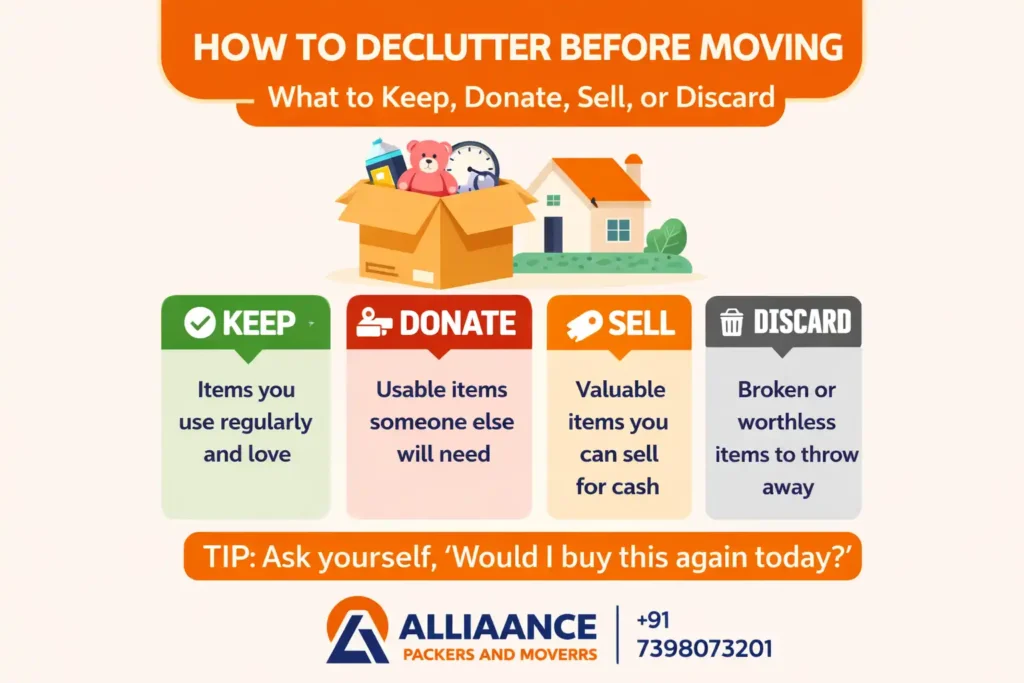
- The Decluttering System: Four Categories for Every Item
- 5 Proven Rules to Make Decluttering Decisions Faster
- Room-by-Room Decluttering Checklist
- What to Do With Items Once Sorted: Donate, Sell, or Discard
- Decluttering for Your New Home: What the New Space Tells You
- How Alliaance Packers And Movers Helps You Move Right
- FAQs
Why Decluttering Before Moving Is Worth the Effort
Most people understand that decluttering is a good idea in theory. What they underestimate is the direct, measurable impact it has on their moving experience and moving bill.
Benefit | How It Works |
Lower moving cost | Professional packers and movers calculate charges based on the volume or weight of goods. Fewer items = smaller truck requirement = lower shifting charges. Every room’s worth of items removed can meaningfully reduce your final bill. |
Less packing time | With fewer belongings to wrap, box, and label, packing takes significantly less time — whether you are doing it yourself or using professional packers. |
Faster unpacking and settling in | Moving into a new home with only the items you actually need means boxes get emptied faster. You settle into a functional home on Day 1 rather than sorting through unknown boxes for weeks. |
Reduced stress | A decluttered space reduces visual distraction and decision fatigue throughout the move. A cleaner, more organised environment contributes to overall mental well-being. |
Possible extra income | Items you no longer need can be sold on platforms like OLX, Facebook Marketplace, or at a second-hand sale. This can directly offset a portion of your moving costs. |
A genuine fresh start | Filling your new home with broken, outdated, or unused possessions means carrying old clutter into a new space. Decluttering lets you define what your new home looks and feels like. |
💡 Before moving, walk through each room and ask one simple question for each item: ‘If I had to buy this again today, would I still buy it?’ If the answer is no, it probably should not go into a box.
When to Start Decluttering Before a Move
Professional organiser Maija Diethelm, with more than a decade of organising experience, states: ‘We always have way more stuff than we even imagine. That just allows the process to be a lot less intense and stressful’ when you start early enough. The general guidance is:
| Home Size / Situation | Recommended Start Time |
| 1 BHK apartment | At least 4–6 weeks before moving date |
| 2–3 BHK family home | At least 6–8 weeks before moving date |
| Large home (4BHK+) or long residence | 2–6 months or more before moving date |
| Very long-term residence with significant accumulation | Up to 12 months before moving date |
Start 1–3 months before moving for most households. This gives you time to assess items thoughtfully, list things for sale (which can take time to find a buyer), schedule donation pickups, and avoid the rushed decision-making that leads to either taking things you should not, or throwing away things you should keep.
⚠ One of the top mistakes people make when decluttering before moving is not starting early enough. Procrastination leads to rushed decisions, missed opportunities to sell or donate properly, and the default of ‘just packing everything’ to deal with it later — which means paying to move things you did not need.
The Decluttering System: Four Categories for Every Item
Before you open a single drawer, set up your sorting system. Get four boxes, bags, or designated areas and label each clearly. Every single item in your home must go into one of these four categories. There is no fifth category. There is no ‘maybe’ pile.
⚠ Establishing a ‘maybe pile’ is a mistake. As Mary Kay Buysse, co-executive director of the National Association of Senior and Specialty Move Managers, explains: ‘Always, the maybe pile is the biggest pile — and all you’re doing is putting off a hard decision.’
Category | What Goes Here | Action Required |
KEEP | Items you use regularly, need, or hold genuine emotional value. Only what you use, need, or love. | Pack for the move. Label boxes clearly with room and contents. |
DONATE | Items in good condition that you no longer need or use. Usable by someone else. | Move to car for drop-off immediately, or schedule a charity pickup for the earliest available date. |
SELL | Items in good to very good condition with enough resale value to justify the time and effort. | List online (OLX, Facebook Marketplace), or set aside for a second-hand sale before moving day. |
DISCARD / TRASH | Items that are broken, damaged, expired, or not accepted by donation centres. | Dispose of responsibly. Check for recycling options, junk removal, or electronic waste drop-offs for applicable items. |
The Full Dump Method
When tackling any area — a bookshelf, a wardrobe, a kitchen cabinet — use the full dump method: empty the entire area completely before assessing anything. Spread items out so you can see everything. Then pick up each item and make a decision. This prevents the common habit of skimming over things and convincing yourself that items you saw every day are being used.
After you sort: get the discard piles out of the house immediately
Once you finish an area, act on the non-Keep piles straight away. Move donate boxes into your car for drop-off. Take trash bags out. Set sale items in a designated area. Removing items quickly prevents second-guessing and literally clears the space, so you are not tripping over old things while trying to pack the things you are keeping.
5 Proven Rules to Make Decluttering Decisions Faster
The hardest part of decluttering is not sorting — it is making decisions quickly without endlessly second-guessing. These established rules remove the paralysis from the process.
Rule 1: The One-Year Rule
If you have not used an item in the past 12 months, it is a strong candidate for donation or sale. For clothing specifically: if you have not worn it in a year, it is time to let it go. Apply this rule across wardrobes, kitchen gadgets, tools, books, and decor. Exceptions: genuinely seasonal items used annually, and items of authentic sentimental value.
Rule 2: The 90/90 Rule
Developed by Joshua Fields Millburn and Ryan Nicodemus (The Minimalists), the 90/90 rule asks two questions about any item: Have I used this in the last 90 days? Will I use it in the next 90 days? If the answer to both is no, it is a declutter candidate. This rule works particularly well for appliances, tools, electronics, and clothing. For seasonal items, extend the window to 180 days. The 90/90 rule removes the emotion from the decision and focuses purely on practical use.
Rule 3: The KonMari Method (Spark Joy)
Developed by professional organiser Marie Kondo, the KonMari method asks a single question as you hold each item: Does this spark joy? If yes, keep it. If not, thank it and let it go. Unlike room-by-room sorting, the KonMari method works by category. Start with clothes, then books, then papers, then miscellaneous items, and finally sentimental items. Leave sentimental items last — they are the hardest decisions and should be made when your decision-making is at its sharpest.
Rule 4: The 12-12-12 Rule
For days when decluttering feels overwhelming or you are running low on motivation, the 12-12-12 rule provides a manageable structure: find 12 items to throw away, 12 items to donate, and 12 items to pack and keep. Repeat as many rounds as time allows. This method is particularly useful for getting children involved, giving them autonomy over their own belongings while keeping the process moving.
Rule 5: The ‘Cost to Move’ Test
For large or heavy items you are unsure about, calculate whether the item is worth its moving cost. As Ali Wenzke, author of The Art of Happy Moving, advises: ‘Get rid of any heavy and large items that you don’t love. Consider how much it will cost you to pack it, move it, and unpack it in your new place.’ If the item would cost more to move than to replace at the new home — and you do not deeply love it — it should not be in the truck.
Room-by-Room Decluttering Checklist
Work through one complete room before starting the next. Professional organiser Nicole Gabai, founder of B. Organized: ‘The benefit of tackling one room at a time is that you can better evaluate completion. You can clearly look around that one room and double-check that you have gotten rid of everything you possibly can from that one room before moving on to the next.’ Do not start with photographs, collections, or mementos — sentimental items are the hardest decisions and should come last.
KITCHEN
Start here: The kitchen holds the most expired, duplicate, and rarely used items in most homes. Be ruthless.
DISCARD:
- Expired food: dry goods, canned items, spices more than 2–3 years old, condiments past best-before date
- Expired medications from the medicine cabinet
- Broken or cracked crockery, glassware, and cookware
- Stained plastic containers, containers without matching lids
- Small appliances or gadgets not used in the past year
DONATE:
- Duplicate utensils and cookware (if you have 3 pasta pots, consider donating one)
- Dishes that do not match or do not fit your new kitchen setup
- Working appliances you never use
- Excess water bottles, mugs, or glasses beyond what your household uses
KEEP:
- Everything used regularly. Daily-use utensils, cookware, and appliances that work and are used.
- Items specific to your cooking style. Do not let the ‘I might need this’ instinct take over.
💡 For Indian households: extra pressure cookers, mixers with unused attachments, and inherited utensils that have never been used are the most common kitchen clutter. Ask honestly: when was the last time this was used?
BEDROOM
DISCARD / DONATE — Clothes and accessories:
- Clothes not worn in the past year: donate if in good condition, discard if worn out
- Clothes that do not fit (either direction) — the ‘I’ll fit into these again’ pile rarely gets used
- Broken or damaged jewellery
- Children’s outgrown clothing: donate to families, building staff, or charitable organisations
- Extra winter coats if moving to a warmer city
- Shoes not worn in the past year
DISCARD / DONATE — Linens and household:
- Worn-out, stained, or mismatched towels and bedsheets
- Old pillows and pillowcases beyond their useful life
- Bedding specific to a climate you are leaving
KEEP:
- Daily-use clothing in good condition
- Seasonal items you will actually use
- Bedding appropriate for the new home’s climate and bed sizes
LIVING ROOM
- Discard: old magazines, unread books (donate to a library, school, or community org instead)
- Discard: unnecessary decor, knick-knacks, and display items that add no value
- Discard: obsolete media formats — VHS tapes, cassettes, CDs/DVDs you no longer play
- Donate: working electronics you no longer use (speakers, old tablets, gaming accessories)
- Donate: furniture that will not fit the new home’s floor plan or rooms
- Donate or sell: large items (sofas, bookshelves, side tables) that will not fit or do not match the new space
- Keep: measure your new home first. Only move furniture that has confirmed space in the new layout.
💡 Measure your new home’s rooms before deciding which furniture to move. Sellers of homes and agents can provide a floor plan. Moving large furniture that will not fit creates real problems on moving day and extra cost.
BATHROOM
- Discard: expired toiletries, perfumes, and cosmetics (most cosmetics have 1–3 year shelf lives)
- Discard: expired medications — do not move them to the new home’s medicine cabinet
- Discard: half-used products you will not finish
- Discard: old towels with discolouration or that are beyond useful life
- Keep: all active daily-use products that are not expired
HOME OFFICE / STUDY
- Keep: important documents — birth certificates, passports, Aadhaar, PAN, property papers, insurance
- Discard / shred: old bills and bank statements older than required retention period
- Discard / shred: old pay stubs, resumes, and paper clutter with no current value
- Donate: books you have not read in years and will not read. Donate to a library, school, or community space.
- Donate: working office equipment you do not need
- Discard: broken electronics and old cables for devices you no longer own
⚠ Shred (do not just bin) sensitive documents: old bank statements, pay slips, financial correspondence, and anything with your name, account numbers, or personal data.
CHILDREN’S ROOM
- Involve children in the decluttering process. The 12-12-12 Rule works well with children.
- Donate: outgrown toys in good condition to other families, schools, or NGOs
- Donate: games and puzzles with all pieces, books they have outgrown
- Discard: broken toys, games with missing pieces, worn-out stuffed toys
- Keep: current favourite toys, books appropriate for their age, and learning materials in active use
STOREROOM / GARAGE / BALCONY
Start here first: storage areas and garages are the best rooms to begin decluttering. Items here are rarely used, which makes decisions easier, and clearing these spaces builds momentum and decision-making confidence for the harder rooms.
- Discard: broken equipment and tools that have not been repaired
- Donate: tools and equipment you no longer use but are in working order
- Donate: seasonal items specific to the old city’s climate (if moving to a warmer or significantly different climate)
- Discard: garden equipment if moving to a flat or community with managed grounds
- Discard: old appliances stored ‘just in case’ that have not been used in years
- IMPORTANT: Do NOT pack these into the moving truck — flammable items (paint, thinner, kerosene), aerosol cans, and hazardous chemicals. These are non-transportable and safety hazards.
What to Do With Items Once Sorted: Donate, Sell, or Discard
Donating items in India
Donating is the fastest way to move items out of the house with minimal effort. Organisations that typically accept household goods in good condition include local charitable trusts and NGOs, schools and community centres (books, stationery, furniture), temples and religious organisations (utensils, clothes), building staff and domestic helpers (clothes, utensils, working appliances), and second-hand shops in your area.
- Call or contact the organisation in advance — confirm what they accept and their drop-off or pickup process
- Only donate items that are genuinely in good, usable condition
- Collect receipts from registered charitable organisations — eligible for tax deductions under Section 80G
Selling items before moving
Selling is worth the effort for higher-value items. Price items realistically: garage sale pricing is typically about 10% of original retail value to encourage buyers. Set a cut-off date for sales: any items that do not sell by a week before moving day should be donated rather than moved.
- List on OLX (olx.in) for furniture, appliances, and electronics
- Facebook Marketplace and local Facebook community groups for quick local sales
- WhatsApp groups of building residents or colony groups for immediate local buyers
- Plan a second-hand sale if you have a high volume of items
💡 Set a clear sale deadline. If an item has not sold by one week before moving day, donate it rather than moving it. Trying to sell everything can backfire — you cannot let a difficult sale decision result in things going into the moving truck by default.
Discarding responsibly
Items in genuinely poor condition that cannot be donated or sold should be discarded responsibly. Do not default to the dustbin for everything.
- Electronics and e-waste: contact local e-waste collection drives, authorised recycling centres, or check with your municipality for e-waste drop-off. Do not put electronics in regular household rubbish.
- Hazardous items (paint, chemicals, batteries): contact your local municipal authority for safe disposal. These cannot go in regular bin or into the moving truck.
- Broken large furniture: some municipalities have bulk item collection schedules. Or arrange with a local junk removal service.
- Old clothing too worn to donate: many textile recycling bins accept worn clothing for fabric recycling
Sentimental items: a special approach
Sentimental items are the hardest decisions in the entire decluttering process. Jennifer Dwight, a professional organiser: ‘You’re not throwing away the memory, you’re just gifting or donating the item.’ A few approaches that help:
- Photograph sentimental items before donating them. You keep the memory; someone else gets use from the item.
- Digitise: old photographs, children’s school artwork, and documents can be scanned and stored digitally. The physical item can then be released.
- Limit: keep one box of genuinely meaningful sentimental items per person. Not one box per room.
- Ask before assuming: before packing items that you plan to hand down (‘my children or grandchildren might want this’), ask them first. Preferences have changed across generations.
Decluttering for Your New Home: What the New Space Tells You
Decluttering for a move is different from general decluttering because you have a specific destination. Your new home is a filter. Items that do not fit the new home’s space, climate, or layout should not be in the truck — regardless of how useful they were at the old home.
Situation | What to Declutter |
Moving to a smaller home (downsizing) | Measure every room in the new home. Only move furniture that has a confirmed place. Over-large sofas, beds, wardrobes, and dining tables that will not fit should be sold or donated before the move. |
Moving to a warmer city | Heavy winter curtains, thick quilts, heavy woollens, and room heaters may not be needed. Donate or sell rather than move. |
Moving to a colder city | AC units designed for older rooms, thin cotton summer curtains, lightweight fans may become less relevant. Assess based on new home’s climate. |
Moving from house to apartment / flat | Gardening tools, hoses, lawn equipment, and outdoor furniture become redundant if the new home has no personal outdoor space. |
Moving to a managed society (RWA-maintained grounds) | Sold or donated: shovels, rakes, hoses, and lawn maintenance equipment that the society provides centrally. |
Moving to a furnished home | Assess every furniture piece against what is already in the new home. Duplicate items should be sold or donated, not warehoused. |
⚠ Do not move furniture ‘just in case’ it fits. Measure before moving day. Large furniture that does not fit creates a serious problem on moving day: it blocks entry, damages walls and doorframes during failed entry attempts, and may need to be taken back out at extra cost.
How Alliaance Packers And Movers Helps You Move Right
Alliaance Packers And Movers has provided packing and shifting services in Lucknow since 2013. A well-decluttered home is the best thing you can do before we arrive — it makes the pre-move survey more accurate, the packing faster, and the final bill lower.
What Alliaance Provides | Detail |
Free pre-move survey | We assess the volume and type of goods before providing a written fixed quote. A decluttered home produces a more accurate survey and a lower quote. |
Professional packing | Room-by-room packing to professional standard. All packing materials included in the written quote. |
Advice on what not to move | Our team will flag non-transportable items (flammable, hazardous, plants, perishables) during the pre-move survey. |
GPS-tracked own fleet | All intercity moves on our own GPS-monitored vehicles. |
Bijnor Road warehouse | Secure short-term and long-term storage for items you are not yet ready to sell or donate. Plot No. 16, Royal City, Bijnor Road, Lucknow 226002. Storage from ₹3,000/month. |
Payment structure | 5% at booking · 85% at loading · 10% at delivery after confirmed safe arrival |
Get a Free Quote in 30 Seconds!
Tell us your move details and our team will call you back within 15 minutes — 7 days a week.
“Pay only 10% on delivery — after you are satisfied”
✅ No spam · No hidden charges · Call within 15 mins
🔒 Your information is 100% safe and never shared
⭐ 800+ families trust Alliaance Packers And Movers
📞 Prefer to call?
Frequently Asked Questions
For most 2–3 bedroom homes, start at least 6–8 weeks before your moving date. Larger homes or households that have accumulated significant belongings over a long period may need 2–6 months, or even up to 12 months for very large residences. Professional organiser Maija Diethelm advises: 'We always have way more stuff than we even imagine.' Starting early reduces stress, gives you time to sell items properly, schedule donation pickups, and make thoughtful decisions rather than rushed ones.
Start with the garage, storeroom, balcony, and guest room — not with photographs, collections, or sentimental items. These low-emotion areas contain mostly rarely used items, making decisions easier. Building this decision-making momentum means that by the time you reach important rooms (bedroom, living room) and eventually sentimental items, you are better at making quick, confident decisions. Professional organiser Nicole Gabai recommends: complete one entire room before moving to the next.
The one-year rule states that if you have not used an item in the past 12 months, it is a strong candidate for donation or sale. For clothing: if not worn in the past year, let it go. For kitchen gadgets, tools, or appliances: if not used in a year, they are unlikely to be used in the next year either. Exceptions apply to genuinely seasonal items (used once a year at a specific time) and items of authentic sentimental importance.
The 90/90 rule was developed by Joshua Fields Millburn and Ryan Nicodemus (The Minimalists). For any item, ask two questions: Have I used this in the last 90 days? Will I use it in the next 90 days? If the answer to both questions is no, it is a candidate for donation or sale. This rule removes emotional bias from the decision and focuses on practical use. For seasonal items, extend the window to 180 days.
Professional packers and movers calculate their charges based on the volume and weight of your belongings. The more items in the truck, the larger the vehicle required and the more labour hours needed for packing, loading, and unloading. Every unnecessary item adds directly to your final bill — in packing materials, labour time, and transport charges. Fewer items also means fewer boxes, less packing tape, and faster unpacking at the new home.
Do not move: flammable items (paint, thinner, kerosene, aerosol cans) — these are non-transportable by professional movers and safety hazards. Expired medications and cosmetics. Expired pantry items that will not be consumed before moving day. Items that will not fit the new home (measure furniture before moving day). Items that cost more to move than to replace at the new home. Items for a climate or lifestyle that no longer applies (lawn equipment if moving to a flat, heavy winter items if moving to a warm city).
Ready to Move Smart & Save Big on Your Shifting Cost?
Stop paying to move things you don’t need. Declutter the right way before your move and reduce packing time, truck size, and overall charges. Let Alliaance Packers and Movers handle your relocation with expert planning, safe packing, and reliable transport.
Related Guides:
- How to Pack Mirrors and Glass Panels Safely for Transport
- How to Label Moving Boxes Like a Professional for Easy Unpacking
- Moving Checklist India: Complete Room-by-Room Guide Before Shifting
- What to Do 4 Weeks Before Moving: Pre-Move Countdown for Lucknow Residents
- Address Change Checklist After Moving in India: All Documents to Update