
How to Pack Mirrors and Glass Panels Safely for Transport
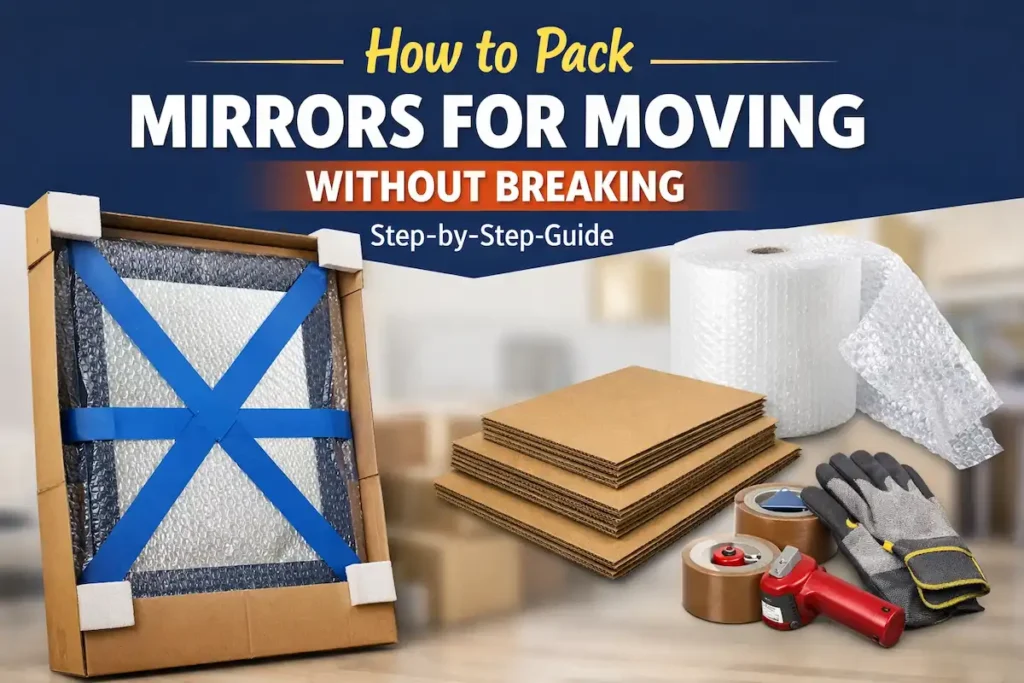
Mirrors and glass panels are among the most difficult items in any household move. They are fragile, they shatter into dangerous shards, they cannot bear any pressure when laid flat, and they are structurally strongest only at their edges. A large wall mirror weighing 20–30 kg with an ornate frame, a glass tabletop, or a full-length mirrored wardrobe door — each requires a specific packing sequence that is different from every other item in the home.
The consequences of getting it wrong go beyond replacement cost. Shattered mirror or glass in a moving truck creates a safety hazard for everyone handling goods at the destination. Shards embed in packing materials, cut through cardboard, and are almost impossible to fully locate and clear. Reliable packers and movers in Lucknow ensure proper multi-layer protection to prevent such risks.
This guide covers the complete, verified professional packing sequence for wall mirrors, glass tabletops, large glass panels, and mirrored furniture components — with specific guidance for frameless mirrors, antique frames, and gilded finishes.
About Alliaance Packers And Movers: We have packed and transported mirrors, glass tabletops, and large glass panels as part of household shifting in Lucknow since 2013. Our crew brings mirror boxes, cardboard sheets, corner protectors, and the correct multi-layer wrapping sequence on every job. Call +91 7398073201 for a free pre-move survey.
Table of Contents
- Safety Before You Start: Handling Glass
- Packing Materials You Will Need
- How to Pack a Mirror for Moving: Complete Step-by-Step
- How to Pack Different Types of Mirrors and Glass
- How to Pack a Glass Tabletop for Moving
- How to Load and Transport Mirrors and Glass in the Moving Truck
- Common Mirror and Glass Packing Mistakes to Avoid
- How Alliaance Packers And Movers Handles Mirrors and Glass
- FAQs
Safety Before You Start: Handling Glass
Mirror and glass handling carries genuine injury risk at every stage — lifting from the wall, carrying through doorways, loading into the truck. Before any packing begins, the safety requirements are non-negotiable.
Always wear thick gloves
Wear thick work gloves throughout every stage of handling. Glass and mirror edges are sharp even when intact. If the item breaks during handling, bare hands are in direct contact with shards. Gloves do not eliminate injury risk from breaking glass but significantly reduce it.
Always use two people for any mirror over 60 cm
No mirror larger than approximately 60 cm (2 feet) in any dimension should be handled alone. Two people are required: one on each side, maintaining steady balanced support throughout. The risks of solo handling are tipping, which applies uneven pressure on the glass and cracks it, and dropping, which shatters it. Stand directly opposite your helper and move together in the same direction at the same pace.
Work on a padded surface
When setting the mirror down to wrap it, always place it on a padded surface — a bed, a thick blanket on the floor, a padded table. Never place a mirror directly on a hard floor or hard surface. The glass is most vulnerable at the moment of contact with any hard surface.
⚠ If a mirror or glass panel breaks during packing or transit, do NOT pick up shards with bare hands. Wear thick gloves. Use a broom and dustpan for small fragments. Wrap large shards in cardboard or thick paper before disposal. Document the damage photographically for insurance purposes before clearing the breakage.
Packing Materials You Will Need
| Material | Purpose | Key Notes |
| Painter’s tape or masking tape | Applied in X pattern across the glass face before wrapping | Does NOT prevent breaking, but holds glass fragments together if the mirror shatters. Use painter’s tape or masking tape ONLY — never duct tape or strong adhesive tape on the glass surface. |
| Plain packing paper (unprinted) | First wrapping layer directly on mirror surface | Prevents scratches. Conforms closely to the frame shape. Must be unprinted — newspaper ink transfers to frames. |
| Cardboard sheets (corrugated) | Cut to mirror size, placed front and back as rigid shields | The cardboard ‘sandwich’ protects both faces of the mirror from external pressure and prevents flexing. Two sheets per mirror. |
| Foam or cardboard corner protectors | Applied to all 4 corners before bubble wrap | Corners are the highest-breakage point on any mirror. Protect all 4 corners before adding bubble wrap. Can be purchased or made by folding cardboard into L-shapes. |
| Bubble wrap (large bubble) | Primary cushioning layer, 2–3 layers | Applied over packing paper and cardboard sandwich with bubbles facing INWARD. 2 layers minimum; 3 layers for large mirrors. |
| Moving blanket / furniture pad | Outer protective layer over bubble wrap | Absorbs impact from external bumps. Especially important for ornate or gilded frames. |
| Mirror box (telescoping / adjustable) | Rigid outer container for mirrors | Mirror boxes are adjustable 4-panel cartons that fit snugly around the wrapped mirror. Choose a box approximately 30% larger than the mirror to allow for cushioning. |
| Heavy-duty packing tape | Sealing box seams and securing wrapping | Do NOT apply directly to the mirror glass or to delicate gilded/antique frames. Apply only to packing paper, bubble wrap, or box surfaces. |
| Crumpled packing paper | Padding inside mirror box base and gaps | Creates a shock-absorbing base layer inside the box. Fills any gaps so the mirror cannot shift. |
⚠ Do NOT use packing peanuts for mirrors or glass. Packing peanuts lack firm support, shift easily, may scratch the glass surface through friction, and compress permanently under force rather than recovering. Use bubble wrap, crumpled packing paper, or foam sheets instead.
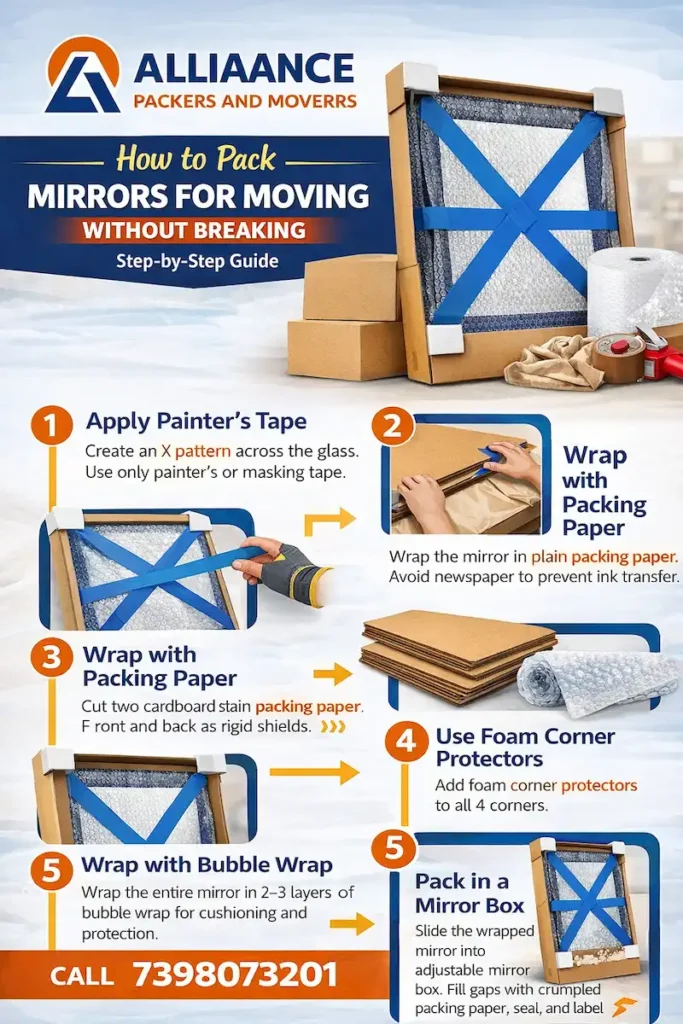
How to Pack a Mirror for Moving: Complete Step-by-Step
Step 1: Take the mirror down safely
With your helper, lift the mirror from the wall with both hands gripping the frame firmly. Stand directly in front of the mirror; your helper stands on the opposite side. Lift straight upward to disengage from wall hooks or mounting hardware. Pull 15–20 cm away from the wall and confirm no cables, wires, or brackets are still attached. Carry horizontally at waist height to the padded work surface. Place on the padded surface with the reflective side up. Wipe the glass surface clean — dust or grit trapped under wrapping will scratch the glass during transit.
Step 2: Apply painter’s tape in an X pattern across the glass face
Using painter’s tape or masking tape, apply strips across the front surface of the glass forming a large X from corner to corner. For larger mirrors, add additional horizontal and vertical strips to create a light grid across the surface.
Why: If the glass cracks or shatters during transit, the tape holds the fragments together in the original position. Without tape, a shattered mirror produces loose shards that scatter inside the box and create a safety hazard for anyone opening it at the destination.
⚠ Use ONLY painter’s tape or masking tape on the glass surface. Never use duct tape, parcel tape, or any strong adhesive tape directly on the mirror glass or frame. Strong adhesive tape damages the reflective coating on the glass and the finish on frames when removed.
Step 3: Wrap in packing paper — the first layer
Lay several large sheets of plain packing paper on the padded work surface. Place the mirror face-down on the paper. Fold and wrap the paper around the entire mirror — all four sides and both faces — as if wrapping a gift. Tape the paper down only to itself, not to the mirror frame or glass. This creates a protective paper sleeve that prevents direct contact between wrapping materials and the mirror surface.
Step 4: Apply foam or cardboard corner protectors to all 4 corners
Fit a corner protector on each of the mirror’s 4 corners over the paper wrapping. Foam L-profile corner protectors are the best option. If ready-made protectors are not available, fold thick cardboard into triangular L-shapes and tape them in place. Corners are the highest-impact point on any mirror — they take the first hit when a box is set down or bumped against a wall. Corner protectors must be applied before bubble wrap, not after.
Step 5: Cardboard sandwich — rigid shields on front and back
Cut two pieces of corrugated cardboard to the mirror’s dimensions (or slightly larger). Place one sheet on the front face of the wrapped mirror and one on the back. Tape the two sheets together along their edges to create a rigid protective sandwich around the entire mirror. This step is critical: the cardboard sandwich prevents the mirror from flexing under pressure, which is one of the primary causes of mirror cracks during transit. It also distributes any external pressure evenly across the surface rather than concentrating it at a single point.
Step 6: Wrap in bubble wrap — 2 to 3 layers
Wrap the entire sandwiched mirror in bubble wrap. Keep the bubbles facing inward (toward the mirror surface) — this positions the air cushions directly against the item for maximum shock absorption. Apply a minimum of 2 layers for small and medium mirrors; 3 layers for large mirrors. Pay particular attention to extra coverage on the corners and edges. Secure the bubble wrap with packing tape applied only to the bubble wrap itself — never to the mirror frame.
Step 7: Add a moving blanket as the outer layer
Drape a moving blanket or thick furniture pad over the fully wrapped mirror as the outermost protective layer. This absorbs impact from external bumps and prevents the corners from pressing through the bubble wrap against the box walls. Secure the blanket with stretch film or loose tie — not tape on the frame. This layer is particularly important for ornate or gilded frames where even the bubble wrap texture under pressure can mark a delicate surface.
Step 8: Pack in the mirror box
- Assemble the mirror box. Mirror boxes typically consist of 4 interlocking cardboard panels that telescope to adjust to different sizes. Seal the base with packing tape in the H-pattern.
- Line the bottom of the box with 5–7 cm of crumpled packing paper. This forms a shock-absorbing base that protects the mirror’s bottom edge from impact when the box is set down.
- Lower the wrapped mirror into the box vertically — upright on its edge. Never slide it in flat. The box should feel snug but not require forcing.
- Fill all gaps on all four sides with crumpled packing paper until the mirror cannot shift in any direction.
- Add a final layer of crumpled paper across the top before closing.
- Seal the box with heavy-duty packing tape on all seams. Perform the shake test: gently lift the sealed box and rock it. If you feel or hear any movement inside, open the box and add more padding until nothing shifts.
Step 9: Label the box on all sides
Label | Write | Where |
Content | MIRROR — GLASS | All 4 sides and top |
Fragility | FRAGILE in large letters | All 4 sides and top |
Orientation | DO NOT LAY FLAT + upward arrow | All 4 sides |
Stacking | DO NOT STACK | Top and two sides |
Handling | KEEP UPRIGHT | All 4 sides |
💡 If hiring professional movers, verbally point out the mirror box and explain that it must remain upright throughout loading, transit, and unloading. Clear labelling reduces reliance on this verbal instruction but does not replace it.
How to Pack Different Types of Mirrors and Glass
| Mirror / Glass Type | Special Considerations | Packing Adjustments |
| Frameless mirror | No frame to protect, but exposed glass edges are extremely sharp. No tape on the reflective backing — tape on the back surface damages the reflective coating. | Double bubble wrap. Cardboard sandwich extends 3–5 cm beyond the glass edges on all sides. Apply packing paper carefully without tape on the back face. Wear gloves at all times. |
| Antique mirror with ornate or gilded frame | Gilded surfaces are extremely delicate. Any adhesive tape on gilding damages the finish permanently. Signs of flaking or cracking gilding require specialist handling. | Acid-free tissue paper as the very first layer (before any packing paper) to protect delicate surfaces. Never tape anything to the frame directly. All tape applied to paper or bubble wrap only. Significant antique mirrors should be crated, not box-packed. |
| Large full-length wall mirror | Weight and size make handling dangerous without the correct equipment. Two or three people may be required. | Custom-sized mirror box or telescoping carton. Extra bubble wrap layers (3 minimum). Moving blanket on both faces before boxing. Transport between two mattresses in the truck for maximum lateral protection. |
| Mirrored wardrobe doors / cabinet doors | Hinges, handles, and locking hardware can puncture wrapping and scratch the glass surface. | Remove all hardware before packing. Store hardware in a labelled bag taped to the outside of the packed door. Pack each door separately in its own carton or mirror box. Place vertically in the truck. |
| Glass tabletop | Always separate from the table frame before packing. Glass is strongest at its edges — transport on its edge, not flat. | Clean surface thoroughly before packing. Cardboard sheets on both faces. Bubble wrap + moving blanket. Transport upright on its edge, strapped to truck wall. Never stack anything on top. |
| Decorative / baroque framed mirror | Protruding frame elements create uneven surfaces that concentrate pressure on specific points during transit. | EPE foam sheet as first contact layer (conforms to frame protrusions). Paper wrapping second. Extra corner padding. Custom crating for very large or very high-value pieces. |
How to Pack a Glass Tabletop for Moving
Glass tabletops present a different challenge from wall mirrors: they are typically heavier, they have no frame to grip, and they are often large enough that even wrapping them requires two people. The fundamental principle is the same — always transport on the edge, never flat.
Why glass must always travel upright on its edge
Glass is structurally strongest at its edges. When a glass tabletop lies flat, the glass must support its own weight distributed across the largest possible surface area. Any vibration, bump, or the weight of something placed on top creates pressure across the weakest axis of the glass. When the same piece travels upright on its edge, the structural strength is at the bottom support point and the glass can flex slightly in its own plane without cracking.
Step-by-step: packing a glass tabletop
- Clean the glass surface thoroughly to remove all dust and grit. Even fine particles trapped under wrapping will scratch the glass surface during transit.
- Separate the glass top from the table frame if it is removable. Pack the glass and the frame as separate items. This reduces the weight of each piece and allows each to be properly protected.
- Lay the glass on a moving blanket on the floor (blanket down first, then glass). Apply painter’s tape in an X pattern across the glass face.
- Cut two corrugated cardboard sheets to the tabletop dimensions. Place one on each face of the glass. Tape the sheets together along the edges to create the protective cardboard sandwich.
- Wrap in 2–3 layers of bubble wrap (bubbles inward) covering all surfaces, edges, and corners.
- Wrap in a moving blanket as the outer layer. Secure with packing tape to the blanket surface only.
- If a box is available: line the base with crumpled paper, insert the wrapped tabletop vertically on its edge, fill all gaps, seal and label.
- If no suitable box is available: the wrapped tabletop travels in the truck upright, strapped to the truck wall. Never flat on the truck floor.
⚠ Never stack anything on top of a glass tabletop, even a wrapped one. Even light items create pressure points. Any stacking weight, combined with road vibration, can crack a glass tabletop that has survived packing intact.
How to Load and Transport Mirrors and Glass in the Moving Truck
The packing sequence protects glass from pressure and scratches. The truck loading placement protects it from impact and the forces of acceleration, braking, and road vibration during transit. Both are required — correct packing with incorrect truck placement still breaks mirrors.
The non-negotiable rule: always upright
Mirrors and glass panels must always travel upright — standing on their edges, not lying flat. Glass is strongest at its edges. When laid flat, the glass must support its own weight distributed across the largest possible surface. Any vibration, bump, or item placed on top applies pressure across the weakest axis of the glass. Vertical transport eliminates this loading condition.
Best placement in the truck
- Position the mirror box against the truck wall or side panel, upright, with the flat face against the wall
- Place between two large, stable, soft items: mattresses are ideal. Two mattresses on either side of a mirror provide lateral cushioning that resists any sideways movement during cornering or sudden stops
- If a second stable item is not available, strap the mirror box to the truck’s tie-down rails using ratchet straps. The box must not be able to tip
- Large glass tabletops: strap directly to the truck side wall in vertical position, padded against the wall with a moving blanket between the glass and the truck wall
What to avoid in the truck
- Never lay a mirror or glass panel flat on the truck floor
- Never stack any box or item on top of a mirror box
- Never lean a mirror box at an angle against other boxes — the angle allows it to slip and tip during transit
- Never place glass items near the truck door — items near the door are first to be jostled during loading and unloading, and most exposed to any sudden door movement
💡 If the mirror must be transported in a passenger vehicle for a local move, keep it upright in the boot or back seat. Place a folded blanket between the glass and any hard surface. Have a second person hold it steady if the mirror is large enough to be unsteady in the vehicle.
Common Mirror and Glass Packing Mistakes to Avoid
Mistake | Why It Causes Damage | Correct Approach |
Skipping the painter’s tape X on the glass | If the glass cracks during transit, loose shards scatter inside the box and create a serious safety hazard at unpacking. | Always apply painter’s tape or masking tape in an X pattern across the glass face before any wrapping. This holds fragments in place if the glass breaks. |
Using duct tape or strong adhesive tape on the glass or frame | Strong adhesive tape damages the reflective coating on the glass when removed. On gilded or antique frames, it strips the finish. | Painter’s tape or masking tape only on the glass surface. All other tape applied to packing paper, bubble wrap, or box surfaces only. |
Skipping the cardboard sandwich | Without rigid shields on both faces, the wrapped mirror can flex under pressure. Flexing concentrates stress at the glass’s thinnest points and causes cracking. | Two pieces of corrugated cardboard cut to mirror size, one front and one back, taped together along the edges before bubble wrap is applied. |
Not protecting corners | Corners take the first impact from any bump or box set-down. Unprotected corners chip, crack, and transmit impact force into the glass. | Foam or cardboard corner protectors on all 4 corners, applied after packing paper and before bubble wrap. |
Transporting flat or at an angle | Flat transport places the full weight of the glass across its weakest axis. An angled position allows the mirror to slide, build momentum, and impact the box wall. | Always fully upright. Strapped or placed between two stable items in the truck. Never angled, leaned, or flat. |
Using a box that is too large | Excess space allows the mirror to shift inside the box during transit, building momentum and striking the box wall. | Mirror box approximately 30% larger than the mirror, with all gaps filled until nothing moves when shaken. |
Using packing peanuts around mirrors | Packing peanuts shift, lack firm support, may scratch through friction, and compress permanently rather than recovering from impact. | Crumpled packing paper, foam sheets, or bubble wrap for gap filling. Not packing peanuts. |
Not labelling all sides with DO NOT LAY FLAT | A box with a fragile label on the top only is invisible when handled sideways. Movers set boxes down on sides frequently during loading. | Label FRAGILE + DO NOT LAY FLAT + KEEP UPRIGHT on all 4 sides, not just the top. |
Stacking anything on top of the mirror box | Any weight on the mirror box transmits pressure down into the glass. Combined with road vibration, even a light box on top can crack a mirror. | DO NOT STACK label on top and two sides. Position in the truck where nothing can be placed on top. |
How Alliaance Packers And Movers Handles Mirrors and Glass
Alliaance Packers And Movers has packed and transported wall mirrors, glass tabletops, mirrored wardrobe doors, and glass shelving as part of household shifting in Lucknow since 2013. Every mirror packing job follows a defined multi-layer sequence with verified professional technique.
| What Alliaance Provides | Detail |
| Free pre-move survey | All mirrors and glass items are identified at the survey. Sizes are measured, the correct box types and materials are confirmed, and any items requiring custom crating are flagged before moving day. |
| Mirror boxes and telescoping cartons | Correctly sized mirror boxes for every household mirror. Telescoping cartons adjusted to fit each specific piece. |
| Painter’s tape application | Applied to the glass face before any wrapping on every mirror. All-team standard practice. |
| Cardboard sandwich | Two corrugated cardboard sheets cut to size for every mirror, front and back, taped into a rigid protective sandwich before bubble wrap. |
| Foam corner protectors | Applied to all 4 corners before bubble wrap on every mirror and glass panel. |
| Bubble wrap (2–3 layers) | Bubbles inward on all layers. Minimum 2 layers for standard mirrors; 3 for large pieces. |
| Moving blanket outer layer | Applied over bubble wrap on all mirrors. Especially important for ornate and gilded frames. |
| Upright loading and strapping | All mirror boxes loaded and secured upright against the truck wall or between mattresses. Ratchet straps applied. No mirror is ever transported flat. |
| Antique and specialty mirrors | Acid-free tissue paper available for gilded and antique frames. Custom wooden crating available for high-value or very large pieces. Discuss at pre-move survey. |
| Payment structure | 5% at booking · 85% at loading · 10% at delivery |
Get a Free Quote in 30 Seconds!
Tell us your move details and our team will call you back within 15 minutes — 7 days a week.
“Pay only 10% on delivery — after you are satisfied”
✅ No spam · No hidden charges · Call within 15 mins
🔒 Your information is 100% safe and never shared
⭐ 800+ families trust Alliaance Packers And Movers
📞 Prefer to call?
Frequently Asked Questions
Painter's tape (or masking tape) applied in an X pattern across the glass face does not prevent the mirror from breaking. Its purpose is to hold the glass fragments together in their original position if the mirror shatters during transit. Without tape, a broken mirror produces loose shards that scatter inside the box and create a serious safety hazard when the box is opened at the destination. Use only painter's tape or masking tape — never duct tape or strong adhesive tape, which damages the reflective coating and frame finish when removed.
Glass is structurally strongest at its edges. When a mirror lies flat during transport, its own weight is distributed across the largest possible surface — the weakest axis of the glass. Every bump and vibration applies pressure across this weak axis. When transported upright on its edge, the load is transferred to the structurally strongest point, and the glass can flex slightly in its own plane without cracking. In the moving truck, laying a mirror flat also means any other item placed on top of it will apply direct pressure to the glass, compounding the risk.
The cardboard sandwich technique involves cutting two pieces of corrugated cardboard to the mirror's dimensions and placing one on the front face and one on the back of the wrapped mirror, then taping the sheets together along the edges to form a rigid shield. This rigid cardboard shell prevents the mirror from flexing under external pressure — flexing is one of the primary causes of cracks in mirrors during transit. It also distributes any impact force evenly across the surface rather than concentrating it at a single point.
Yes, for smaller mirrors. Keep the mirror upright in the boot or back seat. Place a folded blanket between the glass and any hard surface. Do not lean it at an angle that allows it to slide. Have a second person hold larger pieces steady if the mirror cannot sit securely on its own. For large, heavy, or high-value mirrors, the truck with correct strapping and placement between mattresses typically provides more controlled and stable transport than a passenger vehicle.
Frameless mirrors are more fragile than framed ones because the glass edges are directly exposed with no frame to absorb edge impacts. Double bubble wrap is the minimum. The cardboard sandwich must extend 3–5 cm beyond the glass edges on all sides so the cardboard corners take impacts rather than the bare glass edge. Do not apply any tape to the reflective backing of a frameless mirror — tape on the back surface permanently damages the reflective coating. Handle with gloves at all times, since the exposed edges are extremely sharp.
Separate the glass top from the table frame and pack each separately. Clean the glass surface thoroughly. Apply painter's tape in an X. Create a cardboard sandwich (one sheet each side). Wrap in 2–3 layers of bubble wrap (bubbles inward). Wrap in a moving blanket as the outer layer. Transport standing upright on its edge — strapped to the truck wall or inside a correctly sized flat-pack carton if available. Never transport a glass tabletop flat. Never stack anything on top of it during transit.
Pack Your Mirrors Safely with Experts
Don’t risk costly damage during your move. Our trained professionals use proven multi-layer packing techniques to protect your mirrors and glass items from cracks and breakage. Book Alliaance Packers And Movers today for safe, secure, and stress-free shifting.