
How to Pack Crockery and Glassware for a Move: Complete Guide
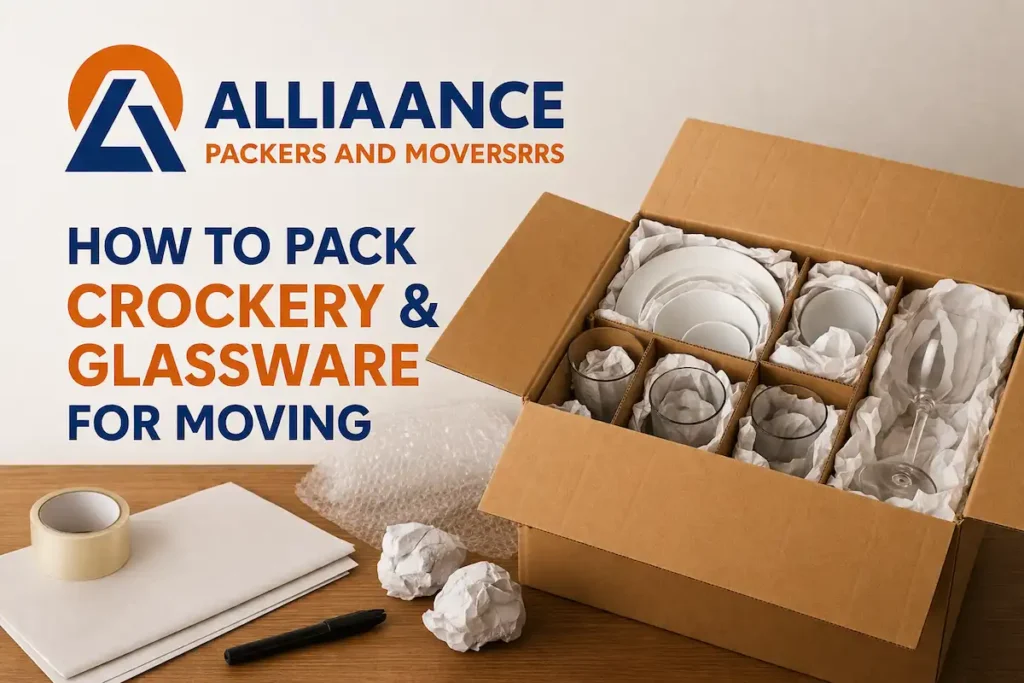
The kitchen generates the most breakage in any household move. The crockery cabinet — plates, bowls, mugs, glasses, stemware, and fine china — contains the highest concentration of fragile items in any home, and almost all damage to these items is entirely preventable. The cause is almost never a dramatic drop. It is almost always: plates packed flat instead of vertically, glasses left with empty interiors that allow inward collapse under pressure, boxes with unfilled gaps where items shift and collide on every bump. This is why experienced packers and movers in Lucknow always follow structured packing techniques to minimize damage.
This guide documents the correct technique for every category of crockery and glassware, with verified professional packing methods for each. Every step is explained with its reason, so you understand not just what to do but why.
About Alliaance Packers And Movers: We have packed crockery and kitchenware as part of household shifting in Lucknow since 2013. Our crew brings dish-specific boxes, packing paper, bubble wrap, and cardboard dividers on every job. Call +91 7398073201 for a free pre-move survey.
Table of Contents
Packing Materials You Will Need
Material | Purpose | Key Note |
Dish pack boxes (double-wall corrugated) | Rigid outer container designed for crockery and glassware. Double-wall construction rated to hold 18–22 kg without buckling. | Do not use regular single-wall boxes for crockery. Double-wall dish packs absorb impact and handle stacking weight. Use new boxes — old or used boxes have weakened walls. |
Plain packing paper (unprinted newsprint) | First wrapping layer on all crockery. Fills gaps inside glasses before wrapping. Crumpled into balls for box base and gap fill. | Never use newspaper — ink transfers onto crockery and is difficult to remove. Use plain unprinted newsprint only. |
Bubble wrap | Second protective layer for high-value or particularly fragile items (glassware, stemware, fine china). | Apply over packing paper. Secure with tape to the bubble wrap, not to the item surface. |
Acid-free tissue paper | First layer for fine china and heirloom crockery | Prevents moisture-related tarnishing and discolouration of delicate surfaces. Plain packing paper is adequate for everyday crockery. |
Cardboard dividers / cell kits | Creates individual compartments inside boxes for glasses and stemware | Most effective glassware protection available. Prevents glass-on-glass contact regardless of how the box is handled. |
Foam sheets | Padding layer between plates; lining box base and top | Provides uniform cushioning across a surface area. Useful as an alternative or supplement to crumpled packing paper. |
Packing tape (heavy-duty) | Sealing all box seams — base and top | Reinforce box base with H-tape pattern: one strip along the centre seam + one strip along each side edge. Three strips minimum. |
Permanent marker | Labelling all sides of every crockery box | Write FRAGILE + THIS SIDE UP on all four sides and the top. Boxes get rotated during handling — labelling only the top is insufficient. |
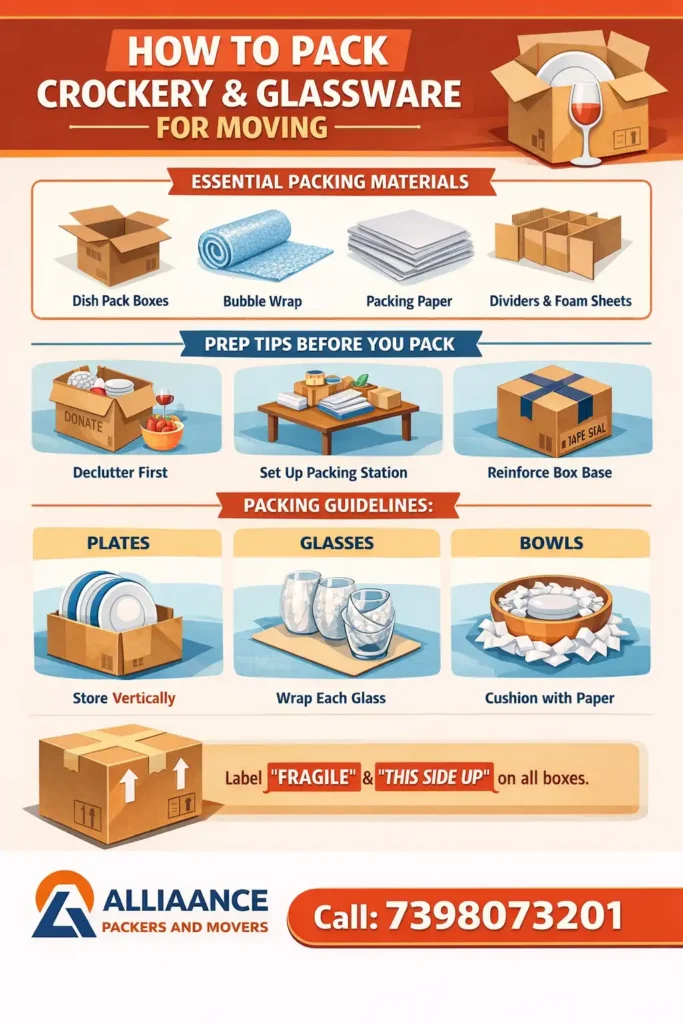
Before You Start: Preparation Steps
Step 1: Declutter before packing
Before packing a single item, go through your crockery and identify what is worth moving. Chipped glasses, cracked bowls, incomplete sets, and items you rarely use are poor candidates for careful packing. Less to pack means fewer boxes, less weight, and fewer items at risk of breakage during transit. Set aside a dedicated set of everyday dishes to use for meals until the final day of packing.
Step 2: Set up a dedicated packing station
Clear a large, flat surface — a dining table or kitchen counter is ideal. Lay out all packing materials within arm’s reach before starting. A dedicated workstation prevents you from holding a half-wrapped glass while hunting for tape. Assemble and tape the base of all dish boxes before packing begins.
Step 3: Reinforce box bases before filling
Dish boxes are heavy when full. Reinforce every box base with at least three strips of heavy-duty packing tape in the H-tape pattern: one strip down the centre seam plus one strip along each side edge. This prevents the base from failing under the combined weight of stacked crockery — one of the most common causes of breakage that has nothing to do with wrapping technique.
Step 4: Create a cushioned base layer
Before placing any item in the box, fill the bottom with a minimum of 5 cm of cushioning. Use crumpled balls of packing paper (never folded flat — crumpled balls give maximum shock absorption), foam sheets, or bubble wrap. This base layer absorbs impact from below — particularly important when boxes are set down during loading and unloading.
How to Pack Plates, Bowls, and Serving Dishes: Step-by-Step
The single most important rule: plates go vertical, not flat
This is the most consequential packing decision in any kitchen move. When plates are stacked flat, the bottom plate bears the full weight of every plate above it. Every bump and vibration during transport adds to that cumulative pressure — and all of it is focused on the flat, weakest surface of the plate. When plates are packed vertically on their edges — like vinyl records in a crate — force is distributed along the edge, which is structurally the strongest part of any plate. The difference between a broken plate and an intact one at the destination is often this single decision.
How to pack plates: step-by-step
- Lay 2–3 sheets of packing paper flat on your work surface.
- Place one plate in the centre of the paper stack.
- Fold one corner of the paper over the plate surface, then tuck in the sides. Roll the plate away from you, tucking the remaining paper around it until the plate is fully covered. Secure with a strip of tape.
- Bundle 3–4 wrapped plates of the same size together. Wrap the entire bundle in 2–3 additional sheets of paper for added protection.
- Stand the plate bundle on its edge inside the box — vertically, like records in a cabinet. Pack plates of similar sizes together; this prevents smaller plates from slipping under larger ones.
- Pack bundles tightly enough that they cannot shift, but do not force them. Fill any gaps between bundles with crumpled packing paper.
⚠ Plates packed flat in a box always have the bottom plate under the full weight of every plate above it. This is the leading cause of plate cracking during moves. Always vertical.
How to pack bowls
Bowls can be nested by size — place smaller bowls inside larger ones — with a sheet of packing paper between each bowl before nesting. Wrap the nested bundle in 2–3 sheets of packing paper and secure. Pack bowl bundles on their edges or at an angle (never fully flat). Fill all gaps around and between bowl bundles with crumpled paper.
How to pack mugs and cups
Mugs, particularly those made from porcelain, are fragile at the handle — the most commonly broken point. Wrap the handle with a separate piece of packing paper first. Then place a ball of crumpled paper inside the mug. Wrap the entire mug in packing paper, then add a layer of bubble wrap for porcelain mugs. Secure with tape. Pack mugs upright in the box; do not stack one mug inside another without padding between.
How to pack serving dishes, platters, and casseroles
Large serving dishes and platters are heavier and should go in the box first (at the bottom). Wrap each individually in at least 3–4 sheets of packing paper, with extra padding around the edges. Glass lids must be packed separately from their base dishes — never pack a lid sitting on top of a dish inside the box. Wrap each lid individually.
💡 Pack plates of similar sizes together in the same bundle and the same box. Mixing very large and very small plates in a single bundle allows the smaller plates to slip under the larger ones during transit, increasing breakage risk.
How to Pack Glassware and Stemware
Glassware is the most breakage-prone category in any kitchen move. Even a small vibration is sufficient to crack thin glass if items are in contact with each other. The fundamental rule: no glass-on-glass contact inside the box, at any point during transit.
Step-by-step: packing glasses and tumblers
- Stuff the interior of each glass with a tightly crumpled ball of packing paper before wrapping. This prevents inward collapse under pressure, which is a leading cause of glass breakage from inside.
- Place the stuffed glass on a corner of a sheet of packing paper. Roll it diagonally, tucking the paper ends into the glass top and bottom as you roll.
- Add a second layer of packing paper, or for delicate glassware, wrap in bubble wrap over the paper layer.
- Secure with tape to the outer layer of paper or bubble wrap only — never tape directly on the glass surface.
- Place glasses upright in the box, never on their side. Upright keeps pressure off the rim and bowl.
- Use cardboard cell dividers or divider inserts inside the box to create individual compartments. Each glass occupies its own compartment, with no glass-on-glass contact regardless of how the box is handled.
- Fill any remaining space inside each compartment with crumpled paper so the glass cannot move within its compartment.
Step-by-step: packing wine glasses and stemware
Stemware is the most fragile item in the kitchen. The stem is the highest breakage point and must receive specific protection.
- Stuff the glass bowl with crumpled packing paper.
- Wrap the stem first with a dedicated separate piece of packing paper. Overlap and secure with tape to the paper.
- Wrap the entire glass — bowl, stem, and base — in bubble wrap as the outer layer. Pay additional attention to the stem, applying extra bubble wrap to this area.
- Place each wrapped glass upright in a box with cardboard cell dividers. A dedicated box for stemware only is the safest approach.
- Fill all empty space inside the box with crumpled paper so nothing moves when the box is gently shaken.
- Add a final layer of crumpled paper or foam on top before sealing.
- Label: GLASSWARE — FRAGILE — THIS SIDE UP on all four sides and the top.
💡 Use cardboard dividers (cell kits) inside glassware boxes. These are the single most effective glassware protection tool available. They create separate rigid compartments that prevent glass-on-glass contact — the leading cause of glassware breakage — regardless of how the box is handled during transit.
How to Pack Fine China and Heirloom Crockery
Fine china and heirloom crockery require a higher standard of care than everyday kitchenware. These are items that cannot be replaced, and their packing should reflect that.
What is different about fine china packing
- Use acid-free tissue paper as the first contact layer rather than plain packing paper. Acid-free tissue paper prevents moisture-related tarnishing and discolouration of delicate glazed surfaces over time.
- After the tissue layer, wrap in at least 3–4 sheets of plain packing paper.
- For pieces with gold or silver trim: avoid using newspaper or any paper with printed ink. Ink transfers to metallic trim and is difficult or impossible to remove without damaging the finish.
- Add bubble wrap as the final outer wrapping layer on all fine china pieces regardless of their apparent sturdiness.
- Use double-boxing for your most valuable or irreplaceable pieces: pack completely inside a smaller box, then place that box inside a larger box with 5–7 cm of crumpled paper padding on all sides between the two boxes.
- Pack fine china in its own dedicated box, not mixed with everyday crockery.
Packing soup tureens, porcelain figurines, and decorated pieces
Items with protruding handles, lids, or decorative elements need individual wrapping of each component before the main item is wrapped. Any lid is packed separately. Any protruding handle receives extra packing paper at that specific point before the main wrapping begins. Figurines and decorative porcelain items should be individually wrapped in tissue paper then bubble wrap, and placed in their own small boxes with foam cushioning on all sides.
Box Packing Order, Filling, and Sealing
How the box is filled is as important as how individual items are wrapped. Most crockery damage during moves is caused by items shifting inside boxes — not by inadequate individual wrapping.
Correct packing order inside the box
| Layer | What Goes Here | Why |
| Bottom (5 cm cushioned base) | Crumpled packing paper balls, foam sheets | Shock-absorbing foundation. Minimum 5 cm. |
| First item layer | Heaviest items: serving dishes, platters, cast iron, dense ceramics | Heavy items at the bottom create a stable foundation and prevent top items from being crushed |
| Middle layer | Medium-weight items: dinner plates (vertical), bowls, mugs | The main body of the box. Plates always vertical. |
| Upper layer | Lighter items: side plates, cups, small bowls (nested and wrapped) | Lighter items on top. Never place heavy items above fragile light ones. |
| Top layer (5 cm cushioned) | Crumpled packing paper or foam sheet before box is sealed | Prevents downward compression from anything placed on top of the box during transit |
The shake test — mandatory before sealing
Before sealing any crockery box, perform the shake test. Gently lift the sealed box and rock it from side to side. Listen and feel for any movement inside. If anything shifts, open the box and add more crumpled packing paper to the gaps. A correctly packed crockery box makes no sound and produces no internal movement when shaken. Only seal the box when this test is passed.
Sealing and labelling
- Seal the top with packing tape using the same H-tape pattern as the base: one strip along the centre seam + one strip along each side edge.
- Write FRAGILE in large, bold letters on all four sides and on the top. Boxes are rotated, stacked, and handled by multiple people. A label on the top only is invisible when the box is on its side.
- Add THIS SIDE UP with an upward arrow on all four sides.
- Write the contents and destination room on at least two sides: e.g., ‘KITCHEN — DINNER PLATES — FRAGILE’.
- Keep boxes under 20 kg total weight. Crockery is dense. A fully packed dish box becomes very heavy quickly. Pick up the box before sealing to test its weight — if it is difficult to carry comfortably, it is too heavy and more likely to be dropped.
Common Crockery Packing Mistakes to Avoid
Mistake | Why It Causes Breakage | Correct Approach |
Packing plates flat in a stack | Bottom plate bears full weight of everything above it; every vibration adds pressure to the weakest flat surface | Pack all plates vertically on their edges — like vinyl records. Always. |
Leaving glass interiors empty before wrapping | Hollow interior collapses inward under pressure, cracking the glass from inside | Stuff every glass, cup, and mug with crumpled packing paper before wrapping |
Not using dividers for glassware | Glasses touch each other inside the box; even slight vibration causes chipping and cracking at contact points | Use cardboard cell dividers to create individual compartments. This is the single most effective glassware protection. |
Using newspaper as wrapping material | Ink transfers to crockery surfaces and is difficult to remove | Use plain unprinted packing paper only. Newspaper is never appropriate. |
Leaving empty space inside boxes | Items shift and collide on every bump; most crockery damage is caused by internal box movement, not external impact | Fill every gap with crumpled packing paper until nothing moves when the box is shaken |
Overpacking boxes beyond 20 kg | Box becomes too heavy to carry safely; more likely to be dropped; base can fail under stacking weight | Keep all crockery boxes under 20 kg. Use more boxes if needed. |
Labelling FRAGILE on the top only | Box is handled sideways, inverted, and stacked; a single top label is invisible during most of its journey | Label FRAGILE + THIS SIDE UP on all four sides and top |
Packing glass lids with their dishes | Lid and base are different shapes; any movement causes the lid to chip against the dish or shatter the rim | Always pack lids separately from their base dishes, individually wrapped |
Mixing fine china with everyday crockery | Weight differences and mismatched fragility levels increase risk | Fine china gets its own dedicated box, individually wrapped in acid-free tissue + packing paper + bubble wrap |
How Alliaance Packers And Movers Packs Your Crockery
Alliaance Packers And Movers has packed crockery, glassware, and kitchen items as part of household shifting in Lucknow since 2013. Every crockery packing job follows a defined sequence with the correct materials — no improvisation.
| What Alliaance Provides | Detail |
| Free pre-move survey | Our crew visits your Lucknow address before booking. All crockery and glassware volumes are assessed at the survey — the correct number of dish boxes, divider inserts, and wrapping materials is confirmed before moving day. |
| New double-wall dish boxes | Double-wall corrugated cartons for all crockery. New boxes for every job — never reused boxes with weakened walls. |
| Plain packing paper (not newspaper) | All crockery wrapped in plain unprinted newsprint. No ink transfer to any item surface. |
| Cardboard cell dividers | Standard on all glassware boxes. Individual compartments for every glass and stemware item. |
| Bubble wrap for fragile items | Applied as second layer on glassware, stemware, and fine china items. |
| Acid-free tissue paper | Available for fine china and heirloom crockery on request. Discuss at pre-move survey. |
| Shake-test standard | Every crockery box is shake-tested before sealing. If anything moves inside, the box is opened and re-padded. |
| Plates always packed vertically | Professional standard applied to every plate in every box on every Alliaance job. |
| Payment structure | 5% at booking · 85% at loading · 10% at delivery |
Get a Free Quote in 30 Seconds!
Tell us your move details and our team will call you back within 15 minutes — 7 days a week.
“Pay only 10% on delivery — after you are satisfied”
✅ No spam · No hidden charges · Call within 15 mins
🔒 Your information is 100% safe and never shared
⭐ 800+ families trust Alliaance Packers And Movers
📞 Prefer to call?
Frequently Asked Questions
Always vertically — on their edges, like vinyl records in a crate. When plates are stacked flat, the bottom plate bears the full weight of every plate above it. Every vibration during transport adds to that cumulative pressure across the widest, weakest surface of the plate. When packed vertically on their edges, force is distributed along the edge — the structurally strongest part of any plate — significantly reducing breakage risk. This single technique is what separates professional crockery packing from amateur approaches.
Dish pack boxes — double-wall corrugated cartons specifically designed for crockery and glassware. These boxes have walls approximately 30% thicker than standard moving boxes and are rated to hold 18–22 kg without buckling under stacking weight. Never use regular single-wall moving boxes or used boxes for crockery. Used boxes have weakened walls that may fail under the weight of plates, causing total breakage of the box contents.
An empty glass has a hollow core that can collapse inward under pressure during transit — cracking the glass from the inside without any external impact. Filling the interior with crumpled packing paper before wrapping provides internal support, preventing this type of inward collapse. This is standard professional practice for all hollow items: glasses, mugs, cups, vases, and any hollow ceramic container.
The stem is the highest breakage point. Process:
(1) stuff the glass interior with crumpled paper.
(2) wrap the stem first with a separate piece of paper and secure.
(3) wrap the entire glass in packing paper, then bubble wrap as an outer layer with extra bubble wrap at the stem.
(4) place upright in a box with cardboard cell dividers — one glass per compartment.
(5) fill all compartment space with crumpled paper so nothing moves.
(6) final top cushioning layer.
(7) seal and label all sides GLASSWARE — FRAGILE — THIS SIDE UP.
No. Newspaper ink transfers onto crockery, particularly on porous ceramic surfaces and glazed finishes — and is difficult to remove without damaging the glaze. Use plain, unprinted packing paper (also called newsprint) instead. It is inexpensive, available from any packing supply shop, and leaves no ink residue on any surface. For fine china or items with gold or silver trim, acid-free tissue paper provides the cleanest first contact layer.
Keep all crockery boxes under 20 kg. Crockery and glassware are dense, and a fully packed dish box becomes very heavy quickly. Before sealing any box, pick it up. If it is difficult to carry comfortably at arm's length, it is too heavy and more likely to be dropped. Use an additional box rather than overloading one. A dropped overloaded box is a guaranteed total loss of its contents regardless of how well each item was wrapped inside.
Safe Crockery Packing Starts Here
Protect your valuable crockery and glassware with expert packing techniques trusted by professionals. Alliaance Packers and Movers ensures zero-damage shifting using high-quality materials and proven methods. Book your move today for a safe, hassle-free relocation experience. Call now and secure your items with experts you can trust.