
How to Pack Clothes for Shifting: Wardrobe Box vs Carton Box Guide

Clothes are one of the easiest items to underestimate when planning a move. Unlike furniture or crockery, they do not break. Unlike electronics, they do not need anti-static protection. And because they are soft and flexible, it is tempting to throw them into any available bag or box at the last minute. However, experienced packers and movers in Lucknow always recommend a more structured approach to avoid common mistakes.
That approach creates two real problems. First, loosely packed clothes waste enormous truck space — professional movers note that poorly packed wardrobes often take up twice the volume they need to. Second, without the right packing method, formal wear and structured garments arrive at the new home creased and wrinkled, requiring professional pressing or steaming before they are wearable again.
The central decision in clothes packing is choosing the right container for each garment type. A wardrobe box keeps hanging clothes on their hangers and delivers them wrinkle-free. A standard carton box is more economical and space-efficient for folded everyday clothes. This guide explains both methods, when to use each, and how to combine them for an efficient, organised wardrobe move.
About Alliaance Packers And Movers: We have packed and shifted wardrobes as part of household moves in Lucknow since 2013. Our crew brings the correct boxes and materials for every garment category. Call +91 7398073201 for a free pre-move survey.
Table of Contents
- Step 1: Declutter Your Wardrobe Before Packing
- Step 2: Packing Materials for Clothes
- The Wardrobe Box: What It Is, When to Use It, and How
- The Carton Box: How to Pack Folded Clothes the Right Way
- Wardrobe Box vs Carton Box: Side-by-Side Comparison
- Other Smart Packing Methods for Clothes
- How to Pack Special and Delicate Garments
- Labelling Clothes Boxes: What to Write and Where
- How Alliaance Packers And Movers Handles Your Wardrobe
- FAQs
Step 1: Declutter Your Wardrobe Before Packing
Every item you choose not to move is one fewer item to pack, transport, and unpack. Wardrobes accumulate unused clothing faster than almost any other category in a household. Moving is the most effective opportunity to reduce the wardrobe to what is genuinely worn and needed.
The three-pile method
- Keep: clothes you wear regularly, that fit, and that are in good condition
- Donate: clothes in wearable condition you no longer wear or need
- Discard: damaged, stained, or unwearable items
What to do with clothes you are not moving
| Option | Best For |
| Donate to a local charity or NGO | Wearable clothes in good condition |
| Donate to a school or community centre | Children’s clothes, uniforms, sports kits |
| Sell online | Branded or high-value items in good condition |
| Pass to friends, family, or neighbours | Quick, no packaging needed |
💡 Declutter by season: start with out-of-season clothes (winter in summer, summer in winter). These are the easiest to evaluate objectively because you are not wearing them and can see them more clearly. Pack the decluttered out-of-season items first — they are the lowest-urgency clothes and can be boxed weeks before the move.
Step 2: Packing Materials for Clothes
The material you choose determines whether your clothes arrive wrinkle-free and organised or creased and jumbled. Clothes are uniquely flexible in their packing requirements — they can go into wardrobe boxes, carton boxes, suitcases, vacuum-seal bags, or dresser drawers depending on the garment type and move distance.
| Material | Best Used For | Key Notes |
| Wardrobe box with metal hanging bar | Formal wear, suits, dresses, sarees, sherwanis, expensive garments on hangers | Tall box with built-in metal bar. Clothes stay on hangers throughout the move. Double-wall construction. Standard size: approximately 60 cm × 55 cm × 120 cm tall. |
| Medium carton box | Folded everyday clothes: t-shirts, jeans, casual shirts, knitwear, trousers | Use medium-sized boxes, not large. Large boxes filled with clothes become bulky and hard to stack efficiently. |
| Wheeled suitcase | Heaviest clothes (jeans, jackets, winter wear) + Day 1 essentials bag | Rigid, rollable, and no wasted space. Ideal for jeans, jackets, shoes, and the clothes you need immediately after the move. |
| Vacuum-seal compression bags | Bulky off-season items: winter coats, heavy woollens, duvets, comforters | Reduces bulk by 50–70%. Requires a vacuum or pump. Not suitable for delicate fabrics that compress badly. |
| Packing paper / tissue paper | Lining the base of carton boxes; wrapping delicate or embroidered garments | White, unprinted paper only. Provides a clean surface and some moisture protection. |
| Stretch film / plastic wrap | Wrapping dresser drawers with clothes still inside | Keeps drawer contents in place so the drawer can be transported as-is, without emptying. |
| Dryer sheets or lavender sachets | Inside carton boxes and wardrobe boxes to prevent musty odours | Clothes sealed in boxes during transit can develop a stale smell. Dryer sheets absorb humidity and keep fabrics smelling fresh. |
| Large new garbage bags (sturdy) | Emergency alternative for hanging clothes if wardrobe boxes are unavailable | Poke hanger hooks through the closed bottom of the bag. Pull down around grouped clothes. Adequate for short local moves only. |
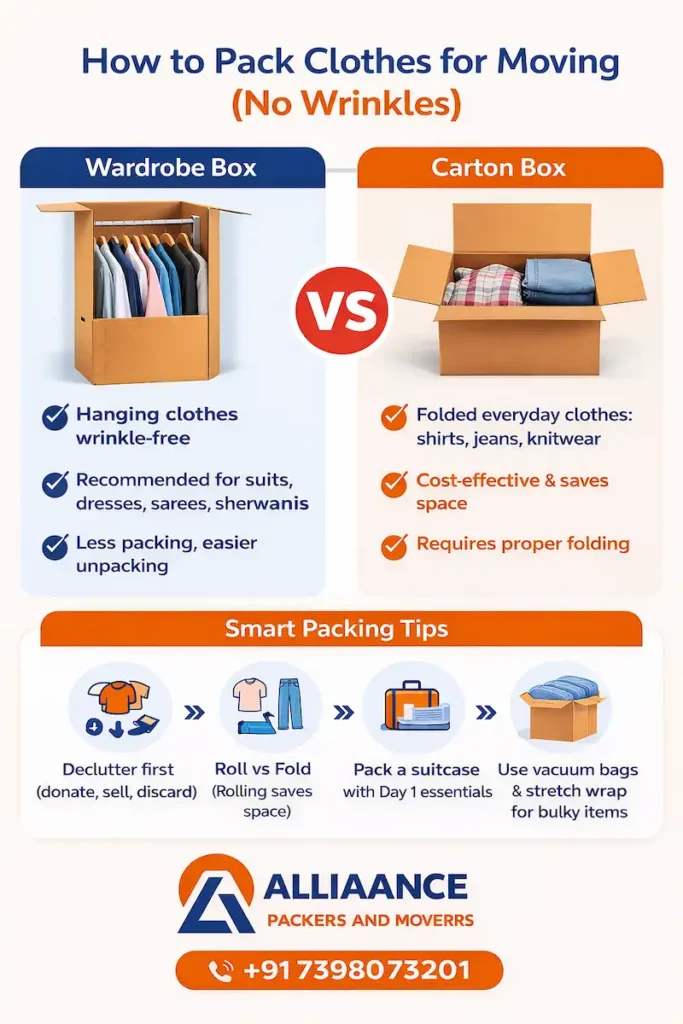
The Wardrobe Box: What It Is, When to Use It, and How
A wardrobe box is a tall, heavy-duty cardboard carton with a metal hanging bar fitted across the top interior. Clothes transfer directly from the closet rod onto the wardrobe box bar — still on their hangers — and travel that way to the new home. No folding, no ironing on the other end.
Wardrobe box specifications
Specification | Standard Details |
Typical dimensions | Approximately 60 cm × 55 cm × 120 cm tall (24″ × 21″ × 48″) |
Hanging capacity per box | Approximately 2 feet (60 cm) of closet rod space; 20–30 hangers depending on garment bulk |
Weight limit | Up to 45 kg (100 lbs) total box weight |
Construction | Double-wall corrugated cardboard |
Rule of thumb | 1 wardrobe box per 2 feet (60 cm) of hanging closet rod |
Bottom section | Can be used for folded clothes, shoes, or accessories below the hanging garments |
What to put in a wardrobe box
- Formal wear: suits, blazers, sherwanis, kurtas, achkans
- Dresses and gowns: wedding wear, sarees on hangers, anarkali suits
- Dress shirts and formal trousers that crease easily
- Winter coats and heavy jackets on hangers
- Any garment that would need professional pressing if folded for transit
What NOT to put in a wardrobe box
- Casual t-shirts, jeans, knitwear — these should go in carton boxes to save wardrobe box space
- Very heavy items that would push the box past its weight limit when combined with hanging clothes
- Items not on hangers — wrap and place in carton boxes instead
How to pack a wardrobe box: step-by-step
- Assemble and tape the base before starting. Reinforce the base seam with a double layer of packing tape.
- Fit the metal hanging bar across the top of the box at the provided notches.
- Sort garments by type and length: long dresses and coats together; shirts and jackets together. Replace any broken or flimsy hangers before packing.
- Transfer clothes directly from your closet rod to the wardrobe box bar, still on their hangers. Do not remove clothes from hangers.
- Do not overfill the bar. Leave a small gap between garments so they are not compressed against each other.
- Place shoes, folded accessories, or lightweight folded items at the bottom of the box below the hanging clothes.
- Place a dryer sheet inside to prevent musty odour during transit.
- Close and tape the top securely. Label: WARDROBE — HANGING CLOTHES — [BEDROOM] — KEEP UPRIGHT on all sides.
⚠ Wardrobe boxes must always be transported upright. Never lay a wardrobe box on its side — this compresses and creases all the hanging garments, defeating the purpose of using a wardrobe box. Secure upright in the truck against the truck wall.
How to calculate how many wardrobe boxes you need
Measure the total width of your hanging closet rod in feet (or in 30 cm increments). Divide by 2. That is the number of wardrobe boxes required. For example: an 8-foot closet rod needs 4 wardrobe boxes.
💡 Before using wardrobe boxes on moving day, do your own quick test: measure out 60 cm (2 feet) on your closet rod and count how many garments hang in that space. That is the capacity of one wardrobe box for your specific wardrobe.
The Carton Box: How to Pack Folded Clothes the Right Way
Standard medium carton boxes are the right choice for everyday folded clothes — t-shirts, jeans, casual shirts, knitwear, undergarments, socks, children’s clothes, and any garment that does not need to stay on a hanger. Carton boxes are more economical than wardrobe boxes, stack efficiently in the truck, and are ideal for India’s intercity moves where clothes spend multiple days in transit.
Box preparation
- Use medium-sized boxes — not large. A large box filled with clothes becomes unnecessarily bulky and difficult to stack neatly in the truck. Medium boxes keep loads manageable.
- Reinforce the base seam with double-layer packing tape before filling.
- Line the bottom of the box with 1–2 sheets of clean, white packing paper. This provides a clean surface and light moisture protection.
Rolling vs. folding: which method to use and when
| Technique | Best For | How To Do It | Key Benefit |
| Rolling (military roll) | T-shirts, leggings, casual shirts, soft fabrics | Lay the item flat. Smooth out any wrinkles. Fold in any sleeves. Roll tightly from bottom to top like a cylinder. Tuck the roll snugly into the box. | Saves significant space. Rolled items pack into corners and gaps. Fewer wrinkles than flat folding for soft fabrics. |
| Flat folding | Blazers, dress shirts, structured trousers, knitwear | Fold along natural seams. Smooth as you fold. Stack face-to-face to avoid imprint marks. | Preserves the garment’s shape. Better for structured items that lose shape if rolled. |
| Bundle wrapping | Mixed garments in one bundle | Place a structured item (shirt, trousers) in the centre. Layer softer items around it, wrapping each outer layer tightly around the bundle. | Reduces wrinkles by wrapping items around a core, which distributes tension. |
Packing order inside the carton box
- Heavy items at the bottom: jeans, sweaters, jackets, denim, knitwear
- Medium items in the middle: casual shirts, trousers, loungewear
- Lightest items on top: t-shirts, socks, undergarments, light fabrics
Filling gaps and sealing
Once all clothes are packed, fill any remaining gaps with crumpled packing paper, rolled socks, or small soft items. The clothes should not shift when you gently rock the sealed box. Seal the top with packing tape. Label every box on at least two sides: contents type + destination room.
💡 Place a dryer sheet or two inside every carton box of clothes before sealing. Clothes sealed in boxes during a multi-day intercity move can develop a stale or musty smell. A dryer sheet absorbs humidity and keeps fabrics smelling clean.
Wardrobe Box vs Carton Box: Side-by-Side Comparison
Factor | Wardrobe Box | Carton Box |
Primary purpose | Hanging clothes transported on hangers, wrinkle-free | Folded everyday clothes, seasonal wear, casual garments |
Best garment types | Formal wear, suits, dresses, sarees on hangers, coats, blazers | T-shirts, jeans, knitwear, casual shirts, undergarments, socks, children’s wear |
Cost | Higher — specialised tall box with metal bar | Lower — standard corrugated carton |
Truck space occupied | More — tall box cannot be fully stacked | Less — stacks efficiently with other carton boxes |
Unpacking speed | Fastest — clothes already on hangers, go directly to wardrobe rail | Standard — requires folding out and organising on shelves |
Wrinkle protection | Excellent — no folding, no compression | Moderate — rolling reduces wrinkles; folded garments may need light ironing |
Ideal move distance | Any distance — local or intercity | Any distance — particularly practical for intercity where truck space matters |
Weight limit | ~45 kg total (100 lbs) | Standard weight per box; keep under 20–25 kg for safe handling |
Alternative if unavailable | Trash bag technique or garment bags for short local moves | Suitcases, vacuum bags, or dresser drawers with stretch film |
Other Smart Packing Methods for Clothes
Beyond wardrobe boxes and carton boxes, three additional methods are used by professional movers for specific categories of clothing. Each solves a particular problem: bulk, accessibility, or garment value.
Method 1: The dresser drawer method (for local moves)
Leave folded clothes exactly where they are in dresser or chest of drawer drawers. Wrap each individual drawer with stretch film or plastic wrap — this locks the contents in place and keeps dust out. The wrapped drawer can then be transported inside the dresser (if the dresser is being moved with drawers in) or stacked separately.
Important caveat: This method works well for local moves and short-distance shifting. For intercity moves or long-distance travel over multiple days, remove clothes from drawers and pack in carton boxes. Drawers in furniture can shift, open, and spill during long-distance transit even when wrapped.
⚠ Many professional movers will not move drawers with contents inside for intercity moves — the additional weight inside furniture increases the risk of structural damage to the piece. Always confirm your mover’s policy at the pre-move survey.
Method 2: Vacuum-seal compression bags for bulky items
Vacuum-seal bags (also called compression bags) are ideal for bulky off-season items that would otherwise occupy enormous box space. Fill the bag with the items — winter coats, heavy woollens, duvets, comforters, puffy jackets — seal the zip, and use a vacuum or pump to remove the air. The contents compress to a fraction of their original volume.
- Best for: heavy winter coats, puffer jackets, thick woollens, duvets, blankets, sweaters
- Not suitable for: delicate fabrics, embroidered garments, structured formal wear, or anything that loses shape when tightly compressed
- Practical benefit: a pile of winter coats that would have filled an entire wardrobe box can compress down to a bundle that fits in a suitcase or a small carton box
Method 3: The suitcase and luggage method
Every suitcase, duffel bag, backpack, and travel bag must be moved anyway. There is no reason to move these empty. Fill them with clothes.
- Wheeled suitcases: ideal for the heaviest clothes — jeans, jackets, heavy knitwear, shoes. The wheels mean the weight is rolled, not carried.
- Day 1 suitcase: pack 2–3 days of essential clothes for each family member — what you need on moving day and for the first night and morning at the new home. Keep this bag accessible throughout the move.
- Smaller bags and backpacks: ideal for accessories, undergarments, socks, and toiletries that would otherwise clutter a carton box
Method 4: The trash bag technique (emergency only)
When wardrobe boxes are not available and the move is a short local distance, the trash bag technique is an acceptable short-term solution for hanging clothes. Group 5–10 garments on their hangers together. Tie the hangers at the top with a rubber band or cable tie. Make a small hole in the closed bottom of a large, sturdy new garbage bag. Insert the hanger hooks through the hole. Pull the bag down around the full length of the clothes. Secure the bottom of the bag with tape.
⚠ The trash bag technique is only adequate for very short local moves where clothes will be out of bags within hours. For intercity moves or any move lasting more than one day, use a proper wardrobe box. Loose bags do not stack well in trucks and many professional moving crews will not transport loose bags of clothes.
How to Pack Special and Delicate Garments
Garment Type | Packing Method | Notes |
Wedding lehenga / bridal saree / heavy embroidered garments | Wardrobe box individually (one per box if very heavy). Use garment bag inside the wardrobe box for maximum protection. | Never fold heavy embroidered garments — the embroidery compresses and distorts. Keep on hangers. |
Silk sarees and dupattas | Wrap individually in clean white tissue paper before packing. Place in a dedicated medium carton box. | Silk snags easily. Never pack silk in contact with rough cardboard surfaces. Always tissue paper as the first layer. |
Designer or expensive garments | Wardrobe box for hanging items. For folded items: tissue paper first, then packing paper wrap. Carry personally if extremely valuable. | Consider carrying very high-value garments in your personal vehicle rather than the truck. |
Children’s clothes | Roll and pack in small–medium carton boxes by size group and season. Label by child’s name. | Children’s clothes are small and roll very efficiently. One medium box can hold a large volume. |
Shoes | Bottom layer of wardrobe box, or a dedicated small carton box. Stuff shoe interior with paper to preserve shape. | Never pack shoes loose in a clothing box — the hard soles compress and damage soft garments. |
Seasonal / off-season clothes | Vacuum-seal bags for bulky items. Carton boxes for lighter off-season clothes. Label clearly with season. | Pack these first — they will not be needed until after the move. The lowest priority for unpacking. |
Labelling Clothes Boxes: What to Write and Where
Clothes boxes are not fragile, but they need specific labelling to make unpacking fast and to tell movers which room each box belongs in. Without clear labels, every clothes box looks identical — and sorting them out on the other end takes hours.
| Label Element | What to Write | Where to Put It |
| Contents | ‘CLOTHES — CASUAL’, ‘CLOTHES — FORMAL’, ‘CLOTHES — WINTER WEAR’ | Two sides of the box |
| Owner/Person | ‘CLOTHES — [PERSON’S NAME]’ for household moves with multiple people | Two sides |
| Destination room | ‘Master Bedroom’, ‘Children’s Room’, ‘Guest Room’ | Two sides |
| Handling instruction for wardrobe boxes | ‘KEEP UPRIGHT’ with an arrow indicating the vertical orientation | All four sides of wardrobe boxes |
| Priority | ‘OPEN FIRST’ for Day 1 suitcase or the clothes box you need immediately | Top + two sides |
💡 For multi-person households, use a different coloured marker for each family member’s boxes. This means movers can place each person’s boxes in the correct room without reading every label individually — and unpacking is faster because each person knows immediately which boxes are theirs.
How Alliaance Packers And Movers Handles Your Wardrobe
Alliaance Packers And Movers has packed and shifted wardrobes as part of household moves in Lucknow since 2013. Our crew uses the correct packing method for each garment category — wardrobe boxes for hanging formal wear, carton boxes for folded everyday clothes, and the right wrapping for delicate and ethnic garments.
What Alliaance Provides | Detail |
Free pre-move survey | We visit your address before booking. Closet space is measured, garment categories are assessed, and the number of wardrobe boxes and carton boxes is confirmed. No guesswork on moving day. |
Wardrobe boxes with metal bars | Available for all household shifting moves. Discuss at survey whether wardrobe boxes are required and for which garments. |
Medium carton boxes for folded clothes | All everyday folded clothes packed in medium-sized cartons. Heavy at bottom, light on top. Dryer sheets placed inside to prevent musty odour. |
Packing paper lining | Bottom and sides of all clothing cartons lined with clean packing paper before filling. |
Stretch film for dresser drawers | For local Lucknow moves: drawer contents can be left in place and wrapped with stretch film. Confirmed at survey whether this is appropriate for your move distance. |
Wardrobe box upright loading | All wardrobe boxes loaded and secured upright in the truck against the truck wall. Never laid flat. |
Delicate garment handling | Silk sarees, heavy lehengas, and bridal wear handled individually. Discussed at pre-move survey. |
Payment structure | 5% at booking · 85% at loading · 10% at delivery |
Get a Free Quote in 30 Seconds!
Tell us your move details and our team will call you back within 15 minutes — 7 days a week.
“Pay only 10% on delivery — after you are satisfied”
✅ No spam · No hidden charges · Call within 15 mins
🔒 Your information is 100% safe and never shared
⭐ 800+ families trust Alliaance Packers And Movers
📞 Prefer to call?
Frequently Asked Questions
Use a wardrobe box for any clothes that need to stay on hangers — formal wear, suits, dresses, sarees, coats, blazers, and expensive garments that would need professional pressing if folded. Use regular medium carton boxes for everyday folded clothes: t-shirts, jeans, casual shirts, knitwear, undergarments, and children's clothes. Most household moves need a combination of both: wardrobe boxes for the formal section of the wardrobe and carton boxes for the casual section.
Use 1 wardrobe box per 2 feet (approximately 60 cm) of hanging closet rod. Measure the total hanging length of your closet rod and divide by 2. For example: a 6-foot closet rod needs 3 wardrobe boxes. Each standard wardrobe box accommodates approximately 20–30 hangers depending on the bulk of the garments. Heavier items like thick winter coats take more bar space than light shirts.
For local moves (same city), yes — wrap each drawer individually with stretch film or plastic wrap to keep the contents in place. For intercity moves, it is generally better to remove clothes from drawers and pack them in carton boxes. Drawers with contents inside add significant weight to furniture and can shift or open during long-distance transit. Always confirm your mover's policy on drawer contents at the pre-move survey.
For hanging garments: use a wardrobe box, which keeps clothes on their hangers throughout the move with no folding and no wrinkles. For folded clothes: rolling soft fabrics (t-shirts, leggings, casual shirts) causes fewer wrinkles than flat folding and saves more space. For structured garments (blazers, dress shirts): fold along natural seams and wrap in tissue paper. The key principle is to avoid over-compression — clothes packed too tightly in any container will crease regardless of the packing method.
Yes, for bulky off-season items. Vacuum-seal compression bags dramatically reduce the volume of heavy winter coats, woollens, duvets, comforters, and puffy jackets — items that would otherwise occupy an entire wardrobe box can compress down to fit in a single small carton. They are not suitable for delicate fabrics, embroidered garments, structured items, or anything that loses shape under compression.
Pack a dedicated Day 1 bag — a suitcase or duffel bag with 2–3 days of clothes for every family member: outfits for moving day, the first morning at the new home, and one change. Include undergarments, nightwear, and any medications. Keep this bag separate from the truck load or ensure it is loaded last so it is first off the truck. This means if unpacking takes longer than expected, everyone has what they need immediately.
Moving Soon? Pack Your Clothes the Right Way!
Avoid wrinkles, save space, and make unpacking effortless with expert packing methods used by professionals. Whether you choose wardrobe boxes or carton boxes, the right technique makes all the difference. Get stress-free shifting with Alliaance Packers and Movers. Call now at 7398073201 for a smooth move!