
How to Pack Books for Moving: Tips to Save Space and Avoid Damage
Books look simple to pack. They are flat, they do not shatter, and they stack neatly. But books are one of the most frequently damaged and most injury-causing items in any household move — for two reasons that most people do not anticipate: weight and positioning.
A single shelf of hardcover books can fill a box to its structural limit in minutes. An overfilled book box is one of the most common causes of back injury on moving day, and a box that fails at the base while being carried down stairs is a guaranteed loss of its contents. At the same time, a book packed at the wrong angle — spine down, paper edges bearing pressure, or at odd angles — arrives at the destination warped, bent, or with a damaged binding that will never return to its original shape.
This step-by-step guide covers everything from choosing the right box and preparing it correctly, to the verified professional packing positions for hardcovers, paperbacks, and rare editions, to how book boxes should be placed in the moving truck. Every step includes the reason behind it.
About Alliaance Packers And Movers: We have packed and moved household libraries in Lucknow since 2013. As one of the reliable packers and movers in Lucknow, our crew brings book-appropriate boxes, packing paper, and verified packing techniques on every job. Call +91 7398073201 for a free pre-move survey.
Table of Contents
- Step 1: Declutter Before You Pack
- Step 2: Gather the Right Materials
- Step 3: Prepare Your Boxes Correctly
- Step 4: How to Pack Books — Position, Order, and Weight
- Step 5: How to Pack Rare, Collectible, and Valuable Books
- Step 6: Sealing and Labelling Book Boxes
- Common Book Packing Mistakes to Avoid
- Where to Place Book Boxes in the Moving Truck
- How Alliaance Packers And Movers Handles Your Books
- FAQs
Step 1: Declutter Before You Pack
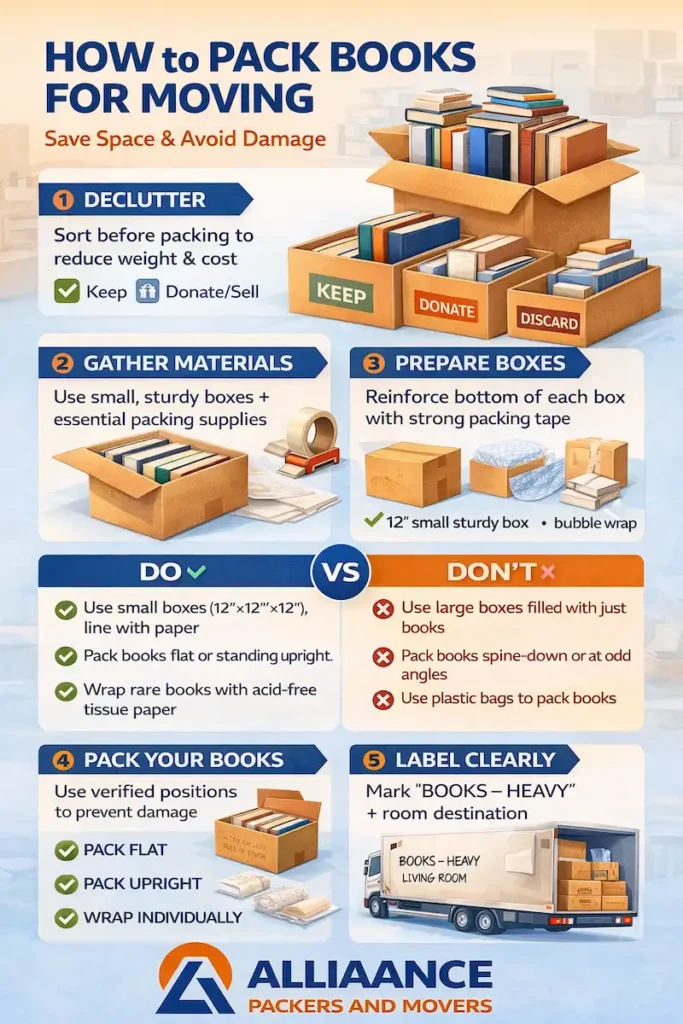
Before packing a single box, go through your collection and decide what is genuinely worth moving. Books are heavier per box than almost any other household item. Every book you choose not to move means less weight to carry, fewer boxes to pack and unpack, and a lower overall move cost if your mover charges by weight or volume.
Sort into three piles
- Keep — books you will read, reference, or display in the new home
- Donate or sell — books in good condition you no longer need
- Discard — damaged, mouldy, or incomplete books not worth moving
What to do with books you are not moving
Option | Notes |
Donate to a school or library | Accepted in good, clean condition. Extends the life of books in your community. |
Donate to a charity | Many charitable organisations accept books for resale or redistribution. |
Sell online or to a used bookstore | A good option for collectible or academic books in good condition. |
Pass to friends, family, or neighbours | Fastest option, no packaging required. |
💡 Get your decluttering done before packing begins — not during. Decision-making slows packing and increases the risk of items being packed by mistake. Set aside one session for decluttering and a separate session for packing.
Step 2: Gather the Right Materials
The materials you use determine how well your books are protected and how safely the boxes can be handled. Using the wrong boxes — particularly large boxes or structurally weak recycled boxes — is the leading cause of both book damage and moving-day injuries.
| Material | Purpose | Key Notes |
| Small sturdy boxes (12″×12″×12″ / 1.5 cu ft) | Primary container for all books | This size is specifically recommended by professional movers for books. It limits total box weight to a safe 16–18 kg. Never use large boxes filled entirely with books — they become dangerously heavy. |
| Heavy-duty packing tape | Sealing and reinforcing box base and top | Use double layer on the base seam. Tape the inside seam extending at least halfway up the box walls. If using a recycled box, add a third layer of tape. |
| Plain packing paper / newsprint (unprinted) | Lining box interior; filling gaps; wrapping individual books | Line the bottom and sides of the box before placing any books. Crumple into balls to fill gaps — never use folded flat paper, which provides much less cushioning. |
| Bubble wrap | Additional protection for rare, collectible, or fragile editions | Secondary wrapping layer for valuable books over packing paper. |
| Acid-free tissue paper | First wrapping layer for rare, collectible, or antique books | Prevents pages from yellowing over time. Standard packing paper is adequate for everyday books. |
| Cardboard pieces | Placing between books to protect dust jackets from creasing | A slip of cardboard between hardcover books protects the dust jacket from rubbing and tearing. |
| Permanent marker | Labelling all sides of every book box | Write contents, destination room, and BOOKS – HEAVY on top and two sides minimum. |
| Wheeled suitcase | Transporting the heaviest hardcovers | A suitcase with wheels is an excellent way to manage the densest books. Use interior straps to secure them if available. |
⚠ Do not use very large boxes filled exclusively with books. A large box of books can exceed 40–50 kg — far beyond safe lifting weight. It is more likely to be dropped, more likely to fail at the base, and guarantees injury risk on stairs or loading ramps. Always use small boxes for books.
Step 3: Prepare Your Boxes Correctly
Box preparation is not optional. The base of a book box carries enormous cumulative weight. A box that fails at the seam while being carried is a total loss — books fall, pages bend, spines crack, and the carrier risks injury from the sudden shift in weight.
Reinforcing the base
- Apply the first strip of packing tape along the centre seam on the outside of the box base.
- Apply a second strip along the centre seam for a double layer of tape.
- Extend the tape from the base seam at least halfway up the sides of the box on all four sides — not just across the flat bottom. This is the critical step most people skip: the tape strengthens the fold point where the base meets the walls, which is where boxes fail under load.
- For recycled boxes: add a third layer of tape. Used cardboard has already been compressed and weakened — it does not have the same structural integrity as new boxes.
Lining the interior
Line the bottom and all four sides of the box with sheets of packing paper or newsprint. This gives an extra layer of protection to book covers during the move, cushions the impact when the box is set down, and provides a moisture barrier at the base.
💡 Test your base by placing the assembled empty box on the floor and pressing down firmly on the centre of the base with both hands. If the base flexes significantly, add another layer of tape before packing.
Step 4: How to Pack Books — Position, Order, and Weight
This is where most people make the decisions that determine whether their books arrive in good condition or damaged. Three factors matter: packing position (how the book sits in the box), packing order (what goes in first), and weight management (how much goes in one box).
The most important rule: the spine is the strongest part of any book
The spine is where the pages are bound together. It is structurally the strongest part of any book. When packing, position each book so that if any pressure or weight is applied during transit, the spine bears it — not the unbound paper edges, not the flat cover surface under a stack. This single principle explains every correct packing position.
Correct packing positions by book type
| Book Type | Correct Packing Position | What to Avoid |
| Hardcover books (standard) | Pack upright on their edges with the spine against the side wall of the box — exactly as they sit on a bookshelf. Alternate bound edges up and down when packing multiple books together. | Never pack with the paper edges facing down. Paper edges bearing the weight of the book compress and bend permanently. |
| Hardcover books (heavy / large) | Lay flat at the bottom of the box, stacking heaviest first. Do not stack more than 3–4 flat hardcovers in one layer. | Never place lighter books underneath heavy flat-packed hardcovers — they will be crushed. |
| Paperback books | Lay flat in stacks, or stand upright spine-first (spine toward the box wall) so the paper edges face upward. A combination of both methods in one box is acceptable. | Never pack spine-down (spine bearing pressure against the box base). Never pack at odd angles — this causes warping. Never pack paper edges down. |
| Oversized / coffee table books | Lay flat at the base of the box, largest and heaviest first, no more than 3–4 stacked. These are too wide to pack upright. | Do not mix oversized flat-packed books with upright-packed books in the same box — the height mismatch creates pressure points. |
| Rare / collectible editions | Pack upright, individually wrapped, with cardboard between each book. Do not pack too tightly. | Do not mix with ordinary books. Do not let covers rub against each other. |
Packing order within the box
- Start with the heaviest books — large hardcovers, textbooks, coffee table books. These go at the base.
- Medium-weight books in the middle layer.
- Lightest books — slim paperbacks, pocket editions — on top.
This order matters both for book protection and for the stability of the box. Heavy books at the bottom create a stable foundation. Lighter books on top are protected from being crushed. The overall weight is distributed closer to the ground level, making the box easier and safer to carry.
Sort by size for efficient, safe packing
Group books of similar sizes together in the same box. Packing large and small books together in the same layer creates uneven surfaces where books press against each other at different points. Small books slipping under large ones causes bending and warping. Size-sorted books pack together tightly and evenly, providing mutual support with less risk of movement.
Fill all gaps before sealing
Once all books are positioned, fill every remaining gap in the box with crumpled balls of packing paper, folded towels, soft clothing, or similar items. The books should not be able to shift when you gently rock the box. Movement inside a book box is the primary cause of bent corners, creased pages, and damaged spines during transit — not external impact.
⚠ Never leave empty space in a book box. A half-full box allows books to shift, slide, and collide on every bump. If you have run out of books but the box is not full, fill the remaining space with crumpled paper, towels, or clothing before sealing.
Step 5: How to Pack Rare, Collectible, and Valuable Books
Rare, first-edition, signed, or antique books require a higher standard of care than everyday reading copies. These are items whose value — financial or sentimental — makes damage irreversible. Their packing reflects that.
Individual wrapping for rare editions
- Wrap each rare book individually in acid-free tissue paper as the first contact layer. Acid-free tissue paper prevents the acid in regular paper from transferring to the book’s pages and causing yellowing over time.
- Add a layer of bubble wrap over the tissue paper for physical impact protection during transit.
- To protect the dust jacket specifically: place a piece of cardboard between each hardcover book. The cardboard prevents the dust jacket of one book from rubbing against and creasing the cover or dust jacket of its neighbour.
- Pack all rare books in their own dedicated box — never mixed with everyday books.
- Label the box: ‘RARE BOOKS — FRAGILE — HANDLE WITH CARE’ on all sides.
Transporting rare books personally
The safest approach for any truly rare or high-sentimental-value book is to carry it yourself in your personal vehicle rather than placing it in the moving truck. Moving trucks carry dozens or hundreds of boxes. No matter how well packed, rare books in a truck are subject to the cumulative vibration and handling of a multi-stop commercial move. A book in your personal vehicle is under your direct control throughout.
The suitcase method for heavy hardcovers
A wheeled suitcase is an excellent alternative transport method for the heaviest hardcover books in your collection. The suitcase’s rigid shell protects the books, its wheels eliminate the need to carry the weight, and interior straps (if present) secure the books in place. Use this method for art books, atlases, encyclopaedias, and other oversized volumes that make standard book boxes unwieldy.
Step 6: Sealing and Labelling Book Boxes
Sealing the top
- Add a final layer of crumpled packing paper across the top of the books before closing the box flaps. This fills the headspace above the books and prevents downward compression if anything is placed on top of the box.
- Seal with multiple layers of packing tape using the same method as the base: one strip along the centre seam extended halfway down the sides on all four sides.
- Press firmly on the top of the sealed box. If you feel any movement inside, open the box and add more fill before resealing.
Labelling — what to write and where
Book boxes are among the heaviest boxes in any move. Correct labelling protects both the books and the people handling them.
| Label | What to Write | Where to Put It |
| Contents | Brief description: ‘BOOKS — Fiction’, ‘BOOKS — Textbooks’, ‘BOOKS — Cookbooks’ | Two or more sides of the box |
| Weight warning | ‘BOOKS — HEAVY’ | Top of box AND two sides |
| Destination room | ‘Study’, ‘Living Room’, ‘Children’s Room’ | Two sides |
| Handling instruction | ‘THIS SIDE UP’ with an upward arrow | Two sides |
| Special handling (rare books only) | ‘FRAGILE — RARE BOOKS — HANDLE WITH CARE’ | All four sides and top |
💡 Label book boxes in the order you want to unpack them. Books organised by room and genre at the packing stage means they go straight to the correct shelf at the destination — no hunting through every box for a specific title on day one.
Common Book Packing Mistakes to Avoid
Mistake | What Happens | Correct Approach |
Using large boxes filled with books | Box exceeds safe lifting weight (18+ kg). Injury risk escalates. Box base more likely to fail mid-carry. | Small boxes (12″×12″×12″) only. Keep weight under 16–18 kg per box. |
Packing books with paper edges facing down | Pages compress and bend permanently under the book’s own weight. Damage is irreversible. | Hardcovers: spine against box wall, upright. Paperbacks: flat or spine-first, paper edges up or sideways. |
Leaving empty space in the box | Books shift and slide on every bump, bending corners and creasing pages. | Fill every gap with crumpled packing paper, towels, or soft items until nothing moves. |
Not reinforcing the box base | Box fails at seam under the weight of books, causing total loss of contents during carry. | Double tape on base seam. Tape extending halfway up all four sides from the base. |
Mixing heavy and light books in the same layer | Heavy books crush lighter books placed underneath or beside them. | Heavy at bottom, medium in middle, light on top. Every layer. |
Using newspaper to wrap books | Ink transfers to book covers and pages. Newspaper contains acid that accelerates yellowing. | Use plain unprinted packing paper. Acid-free tissue for rare editions. |
Packing books at odd angles | Books warp when stored at angles — a shape they may never recover from. | All books packed either fully upright or fully flat. No angled positioning. |
Not separating rare books from ordinary books | Rare editions get compressed against heavier everyday books and sustain damage. | Rare books in their own dedicated box, individually wrapped. |
Where to Place Book Boxes in the Moving Truck
How book boxes are loaded in the truck determines their condition at the destination. Two rules apply: book boxes go at the bottom, and they are stacked no more than three high directly on the floor.
- Book boxes are among the heaviest in any move. They should always be placed on the truck floor — never on top of furniture or other boxes.
- Stack book boxes no more than three high directly on the floor. Stacking higher risks toppling, which can cause boxes to fail and books to scatter.
- Place book boxes against the truck’s front or side walls to create a stable wall. Use moving straps or rope to secure each row before adding lighter household items on top.
- Do not place light, fragile boxes on top of book box stacks — the weight of even an average box placed on a book box stack increases compressive load on the lowest boxes.
💡 Book boxes are the ideal foundation layer for the truck because of their uniformity, density, and structural stability. Position them first along the truck walls. Lighter household goods build on top of and around them — not the other way around.
How Alliaance Packers And Movers Handles Your Books
Alliaance Packers And Movers has packed household libraries as part of shifting services in Lucknow since 2013. Book packing follows the same professional standards on every job — no improvisation.
What Alliaance Provides | Detail |
Free pre-move survey | Our crew visits your Lucknow address before booking. All books are assessed at the survey — the correct number of small book boxes and packing materials is confirmed before moving day. |
Small sturdy book boxes | Double-walled, correctly sized book boxes for every job. Weight kept under 16–18 kg per box on all Alliaance packs. |
Correct packing positions | Hardcovers upright (spine to wall) or flat. Paperbacks flat or spine-first. Paper edges never facing down. Applied consistently by trained crew. |
Plain packing paper (not newspaper) | All gap-filling and lining done with plain, unprinted newsprint. No ink transfer to any book surface. |
Rare book handling | Available on request: acid-free tissue wrapping, individual bubble wrap, dedicated labelled carton. Discuss at pre-move survey. |
Reinforced box bases | Double-layer tape on all base seams, extended halfway up box walls, on every book box. |
Truck loading placement | Book boxes placed on the truck floor in the first loading layer, stacked maximum 3 high, secured against truck walls. |
Payment structure | 5% at booking · 85% at loading · 10% at delivery |
Get a Free Quote in 30 Seconds!
Tell us your move details and our team will call you back within 15 minutes — 7 days a week.
“Pay only 10% on delivery — after you are satisfied”
✅ No spam · No hidden charges · Call within 15 mins
🔒 Your information is 100% safe and never shared
⭐ 800+ families trust Alliaance Packers And Movers
📞 Prefer to call?
Frequently Asked Questions
Use small boxes approximately 12"×12"×12" (around 1.5 cubic feet). This size limits total box weight to 16–18 kg — the safe maximum for a book box. Most professional movers specifically recommend this box size for books because larger boxes filled with books become dangerously heavy, are more likely to be dropped, and are more likely to fail at the base under the combined weight.
It depends on the book type. Hardcovers are generally best packed upright on their edges with the spine against the box wall — the same position as on a bookshelf. This keeps the spine (the structurally strongest part) bearing any pressure rather than the flat cover surface or the paper edges. Paperbacks can be packed flat in stacks or standing upright spine-first. The one position to always avoid: paper edges facing down, which bends and damages pages under the book's own weight.
Keep every book box under 16–18 kg. Books are denser than almost anything else in a household move. A small box filled with hardcovers reaches this limit faster than you expect. Before sealing, pick up the box and assess whether you can carry it comfortably at arm's length down a flight of stairs. If not, remove some books and start a new box. A dropped book box due to excessive weight guarantees damage to contents and injury risk to the carrier.
Wrap each rare book individually in acid-free tissue paper first — this prevents acid transfer and yellowing. Add a layer of bubble wrap for physical protection. Place a piece of cardboard between each book to protect dust jackets. Pack all rare books in their own dedicated box, never mixed with ordinary books. Label the box on all sides: RARE BOOKS — FRAGILE — HANDLE WITH CARE. For books of very high value or sentimental significance, carry them in your personal vehicle rather than in the moving truck.
Yes — for the heaviest hardcover volumes, a wheeled suitcase is an excellent option. The rigid shell protects the books, the wheels eliminate the need to carry the weight, and the suitcase can be rolled directly to the truck without lifting. If the suitcase has interior straps, use them to secure the books and prevent shifting. This method works particularly well for large art books, atlases, and encyclopaedias that would otherwise make a standard book box excessively heavy.
Book boxes should go on the truck floor in the first loading layer — never on top of furniture or other boxes. Stack book boxes no more than three high directly on the floor, positioned against the truck walls to create a stable foundation. Secure each row with moving straps before adding lighter goods on top. Book boxes are one of the heaviest and most structurally uniform items in a move, which makes them ideal as the base layer that lighter goods build around.
Ready to Move Without Stress?
Make your relocation simple, safe, and damage-free with Alliaance Packers and Movers. From expert packing to secure transportation, our trained team handles everything with care.