
Peak Season vs Off-Season Moving: How Season Affects Your Bill

Same flat, same crew size, same route—and two very different bills. For people booking packers and movers Lucknow, the difference may depend on the month they choose to relocate. This guide explores how peak and off-season moving periods can affect shifting costs, mover availability, weather conditions, and the overall relocation experience in India.
What the India-specific sources say about peak and off-season moving: how big the price gap is, which months sit on which side, how availability and weather change the experience, and where the sources contradict each other. Where they disagree, we say so.
Table of Contents
- Verdict First
- Peak vs Off-Season Moving Costs
- Cost Differences and Financial Impact
- Availability, Scheduling, and Booking
- Weather, Logistics, and Seasonal Trade-Offs
- Quick Comparison
- FAQs
Verdict First
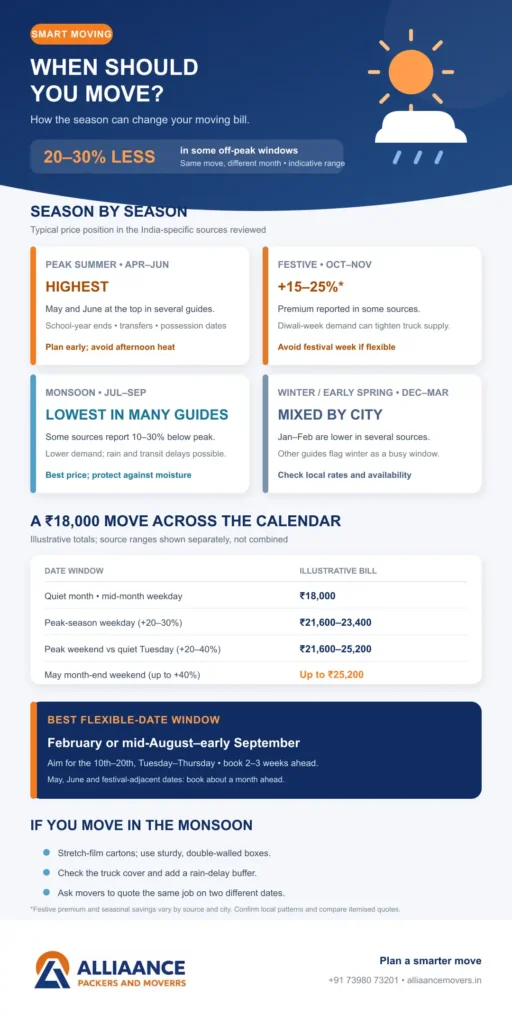
Yes, the season you choose changes your bill. In the India-specific sources we reviewed, the same job costs roughly 20 to 30 per cent less in an off-peak window than in a peak one, and the gap between a peak-season weekend and a quiet mid-month Tuesday can reach 20 to 40 per cent.
Most expensive: April to June, with May and June at the top, and the October–November festive weeks.
Cheapest: the monsoon months of July to September — one month-by-month guide marks August as the lowest-priced month of the year — and January–February in several sources.
Where sources disagree: winter. One industry directory reports that October to February carries about 40 per cent of the year’s moves, and another guide lists November to January as a premium window, while others describe December to February as calm and cheap. Demand also differs by city. Treat the winter months as ‘check locally’, not ‘automatically cheap’.
Window | Months | Price position | Main driver | Verdict |
Peak summer | April–June (May and June highest) | Highest | School-year endings, job changes and possession dates | Pay it only if your date is fixed |
Festive | October–November | High; 20–30% above off-peak in some cities | Festival-season moves | Avoid Diwali week if you can |
Monsoon | July–September | Lowest | Demand dips, movers negotiate | Best price; plan for moisture and delays |
Winter and early spring | December–March | Mixed: January–February low in several sources; March starts climbing | Pleasant weather; wedding and festival dates | Best comfort; confirm locally |
What we would do. If your date is flexible, aim for February or a mid-August to early-September window, on a Tuesday to Thursday in the middle of the month, with an early-morning start, booked two to three weeks ahead. If your date is fixed by a school admission, transfer order or possession date, book a full month ahead for May, June and festival-adjacent dates, take an early-morning slot , and ask for the same job quoted on two different dates.
Is There a Cost Difference for Moving During Peak Seasons?
There is, and the sources agree on that even where they disagree on which months count as peak. This section covers what ‘peak’ means in India and why prices move; the next section puts numbers on it.
Short answer: yes, and it is large enough to matter
Movers price by demand. When many households want the same crews and trucks in the same weeks, quotes rise. The size of the effect depends on the source and the city, but the range that keeps appearing is 20 to 30 per cent between peak and off-peak for the same job, widening toward 40 per cent when a peak month also contains a weekend or month-end date .
India has three overlapping peaks, not one
- March to June: school-year endings, job changes and possession dates, plus students and tenants moving into new rentals. A survey-based piece lists Bangalore, Mumbai, Hyderabad and Chennai as markets where moves cluster from March to June.
- October to November: the festive stretch, which several sources treat as a second peak.
- The weekly and monthly layers: more than half of India’s moves fall on Friday, Saturday or Monday, and rental cycles push demand toward month-end . These sit on top of whichever season you are in.
Why movers charge more when everyone moves at once
The reason is plain supply and demand. A mover has a limited number of trucks and trained crews. In busy weeks the experienced crews are booked first, and what is left is thinner. Quotes in those weeks reflect that scarcity. In quiet weeks the reverse holds: movers negotiate more readily and give each move more attention .
The winter disagreement: what each source says
Sources contradict each other on the winter months. Here is the full picture, so you can see the disagreement for yourself.
Source type | What it says about the winter window |
Industry directory press release, September 2026 | Reports October to February as the peak moving season, about 40% of annual moves (the directory’s own figure) |
Lists November to January as a peak window, with charges 15–20% higher | |
Moving-timing guide | Calls October–March the easiest transition for weather, but notes that higher demand raises winter booking rates; marks December as moderate |
Timing guide from a storage provider | Calls November–February the best season for comfort; says December is quiet and cheap; notes a wedding-season squeeze on trucks in some cities |
Cost-saving guide covering Hyderabad, Bengaluru and Pune | Lists January as off-peak (20–30% below peak) and October–November as premium |
Moving-cost forum answer | Puts January–February among the lower-rate months and October–November among the most expensive |
Mumbai price guide | Lists January, February, October and November together as off-peak, 15–20% cheaper than peak |
One reading fits most of this: winter demand is real, because people like moving in cool, dry weather and festival and wedding dates cluster there, but it is spread more evenly than the April–June crush, so prices soften in January and February. That is our interpretation, not a figure any single source states. October–November is where the sources split the most, so quote that window on its own dates.
Does every city see the same pattern?
No. The Hyderabad, Bengaluru and Pune guide puts April–June and October–November as the premium windows, while the Mumbai guide lists October and November as off-peak . Monsoon pricing also varies: movers in Surat report 10 to 20 per cent below peak-summer rates in July and August. Lucknow moves are shaped by the March–June transfer season. Ask your mover what the local pattern is rather than assuming a national one.
Is a peak-season premium ever fair?
It can be. A premium that reflects real scarcity, disclosed in an itemised written quote, is a market price. What is not fair is a premium that appears on moving day after your goods are loaded. The protection is the same in every season: a written, itemised, all-inclusive quote issued after a physical or video survey.
Cost Differences and Financial Impact: What Each Season Adds to Your Bill
This section turns the seasonal pattern into rupees. All figures come from the sources noted, are shown as quoted, and are ranges, not guarantees.
The headline numbers from the sources
Comparison | Figure | Source |
Same job, peak vs off-peak (Hyderabad, Bengaluru, Pune) | Off-peak is 20–30% less (mid-July, August, January) | |
Peak weekend vs quiet mid-month Tuesday | Gap of 20–40% for the identical job | |
May month-end weekend vs a quiet date | Can cost about 40% more | |
Monsoon vs peak summer (Surat movers) | 10–20% lower | |
Mumbai off-peak vs peak | 15–20% cheaper in January, February, October, November | |
Festive-season premium | 15–25% above regular months | |
Weekend premium on its own | 10–20% | |
Heat surcharge, May–June (some cities) | 10–15% |
A worked example: one ₹18,000 job across the calendar
The table below applies the ranges above to a job that costs ₹18,000 on a mid-month weekday in a quiet month. It is an illustration, not a quote. The sources give these ranges separately and do not say how they combine, so each row is shown as quoted.
Date type | Adjustment (as quoted) | Illustrative bill |
Quiet month, mid-month Tuesday–Thursday (baseline) | None | ₹18,000 |
Peak season, mid-month weekday | +20–30% | ₹21,600 – ₹23,400 |
Peak-season weekend vs quiet mid-month Tuesday | +20–40% | ₹21,600 – ₹25,200 |
May month-end weekend | Up to +40% | Up to ₹25,200 |
Flipped around: if a peak-season quote for the same job is ₹20,000, the 20 to 30 per cent off-peak difference means roughly ₹14,000 to ₹16,000 in a quieter window. The saving is real money, but only if the cheaper date also works for your possession and school dates.
Season-specific line items to watch for
- Heat surcharge: some operators add 10–15% in May–June. Ask whether it is already in your quote.
- Monsoon waterproofing: Mumbai guidance lists a waterproof add-on of roughly ₹800–2,000. In a monsoon move, this is money well spent, not a trick.
- Last-minute booking: a mover hired at the last minute can charge more. Book early in every season.
Quote spread can outweigh the season effect
One source reports that quotes for the same move routinely differ by more than 30 per cent ; another puts the gap between the cheapest and costliest quote at 40 to 60 per cent . These figures come from movers and property sites, not independent surveys, so treat them as indicative. The point stands: two itemised written quotes can differ by more than the season does. Get at least three, and compare on the all-in total.
Cost levers that work in any season
- Declutter first. A source reports that cutting a 3BHK’s volume by 25 to 30 per cent through decluttering reduces the quote in proportion.
- Pack the easy items yourself. Households that pack books, clothes, utensils and decor reportedly lower the quote by 15 to 25 per cent. Leave fragile and oversized items to professionals.
- Choose a weekday. Weekday moves cost less than weekends, with sources citing 10 to 20 per cent.
- Choose mid-month (10th–20th) over the 25th–5th window. One source puts the combined saving of mid-month, mid-week and low-demand season at 15 to 30 per cent.
When paying the peak premium is the cheaper choice overall
Sometimes the date is not yours to move. School admissions, transfer orders and possession dates fix it. In that case the useful question is not ‘how do I avoid the premium’ but ‘what else can I control’: booking lead time, the time of day, the volume you move, and the quote you accept. A related case is the possession gap. One source notes that paying double rent across a gap can cost more than a few weeks of temporary storage. Alliaance Packers And Movers offers secure storage at its Bijnor Road warehouse in Lucknow from ₹3,000 per month, which can bridge a gap without forcing a bad date.
How to compare a peak quote and an off-peak quote fairly
A fair comparison needs the same scope in both: the same inventory, the same packing materials named, the same floor and lift details, the same insurance option, and GST stated on both. If an off-peak quote is cheaper because it left out materials or insurance, it is not cheaper. Ask each mover to price the same job on two dates and to show what is included.
Availability and Scheduling: How Early to Book, Which Dates Fill First, and What Each Season Does to Crew Quality
Price is only half of the seasonal effect. The other half is whether you get the crew and slot you want.
How far ahead to book in each season
Situation | Suggested lead time | Source |
Normal months | Two to three weeks | |
May, June or any festival-adjacent date | A full month ahead | |
Peak transfer season (March–June), Lucknow and similar markets | Three to four weeks | |
Fixed-date moves in any busy window | As early as possible; confirm the slot in writing |
Crew quality in a crunch versus a quiet week
In busy weeks the good crews are booked first, and the remaining slots can go to less experienced teams. In quiet weeks you can choose your mover instead of accepting whoever answers, and the crew is not rushing to the next job . Off-season is therefore a quality advantage as well as a price advantage.
Which weekday and which dates fill first inside any season
Within every season the same dates get crowded. One moving-cost guide reports that about 55 per cent of India’s relocations happen on a Friday, Saturday or Monday. Month-end and the first days of the next month are the monthly rush, as rental agreements end and start. Tuesday to Thursday and the 10th to the 20th are the quietest slots.
Early-morning slots: the scheduling lever that works in every season
A 6 to 8 AM start beats peak city traffic, avoids midday heat and gives cooler loading . An 8 AM start is the professional default, and it usually means finishing in daylight, with dinner in the new home instead of unloading at midnight. Ask for the earliest slot your building allows.
When your date is fixed by a transfer order, school admission or possession date
Families moving for school admissions often cannot avoid summer. If that is you, book two to three weeks early, insist on an early-morning slot, keep the move itself small by decluttering, and get the quote itemised so the peak premium is visible and not buried.
Building lifts and society slots in busy weeks
Weekday moves tend to find the service lift free, while weekend and busy-week moves can queue behind two or three other moves. In premium societies the freight lift and gate pass often need booking 24 to 48 hours ahead. Confirm both before moving day, in every season.
How Alliaance Packers And Movers Handles Season-Sensitive Bookings
Alliaance Packers And Movers has operated from Lucknow since 2013. For every booking we carry out a free physical or video pre-move survey and issue a written fixed quote after it. Payment follows a staged structure: 5% at booking, 85% at loading and 10% at delivery after safe arrival. Intercity moves use GPS-tracked own vehicles, and transit insurance is available as basic (about 1.5% of declared value) or all-inclusive (up to 3%), with the original certificate issued before the truck departs.
When you request a quote, tell us your date range. We recommend asking any mover, including us, to price the same job on two dates so the seasonal difference is visible in writing before you pay an advance.
Weather, Logistics, and Trade-Offs: What Heat, Rain and Festivals Do to Your Move
Every season trades something. Summer gives you clear roads and costs the most. Monsoon gives you the lowest price and asks more of your packing. Winter gives you comfort and, in some cities, a squeeze on trucks.
Summer heat: loading, goods and crew
Afternoon loading in 40-degree heat is hard on crews and on heat-sensitive items such as candles, cosmetics and electronics left in a parked truck. On the plus side, summer offers dry roads and fast, time-bound highway transit for city-to-city moves. If summer cannot be avoided, take an early-morning slot and keep sensitive items with you.
Monsoon moisture: the packing upgrade that matters
Moisture is the quiet enemy of mattresses, sofas and cartons. A guide from Surat movers recommends double-walled corrugated cartons with plastic stretch film around every carton, and heavy polythene covers on mattresses and sofas. It also says to ask to see the truck beforehand, because a torn tarpaulin is a common cause of water damage. These practices are the same ones we apply on any long-distance move: stretch film on all cartons and a properly covered truck.
Waterlogged roads and delayed intercity transit
Monsoon can slow or reroute trucks. Waterlogged roads and delayed intercity transit are the main risks. During the July 2025 Gurugram waterlogging, movers on Sohna Road were reportedly stuck for about six hours with water above the axles. In Surat, the guide advises building a buffer and not scheduling utility disconnection at the old address on the same day as the move. Mid-week mornings are the safest window because rainfall is lightest early in the day, according to that Surat guide; afternoon downpour timing is city-specific.
Winter: reliable roads, early sunsets and the wedding-season truck squeeze
Cool, dry weather makes loading easier, protects electronics and furniture, and keeps intercity transit predictable. The caveats are early sunsets, so morning moves must start on time, and a wedding-season rush in some cities that can tighten truck availability. The same source reports that its December-to-February slots fill earliest with planned, unhurried moves, so book ahead even in winter.
Festival weeks: demand up, trucks scarce
October and November are treated as a peak by several sources. One source adds that during Diwali week many trucks are pulled into goods transport, so availability for household moves drops. If your move is near a major festival, book earlier than usual and expect a premium in the 15 to 25 per cent range.
Possession-date gaps: when timing and storage meet
Timing can create a gap: a cheap monsoon slot may arrive before the new home is ready, or a possession date may slip. Temporary storage separates the moving date from the possession date. Alliaance offers short-term storage at its Bijnor Road warehouse in Lucknow from ₹3,000 per month, and the gap cost is usually smaller than paying twice for housing or taking an expensive date.
The trade-off matrix: cost, comfort and availability
Season | Cost | Comfort and weather | Availability | Biggest trade-off |
Peak summer (Apr–Jun) | Highest | Hot afternoons; dry roads | Crews stretched; book early | You pay most and work in the heat |
Festive (Oct–Nov) | High in many cities | Post-monsoon roads | Trucks diverted around Diwali | Premium plus tight slots |
Monsoon (Jul–Sep) | Lowest | Rain, moisture, delays | Movers negotiate; easy to get a slot | You must pack and plan for water |
Winter and early spring (Dec–Mar) | Mixed; Jan–Feb low in several sources | Cool and dry | Fills with planned moves; wedding squeeze in some cities | Check local pattern; book ahead |
Quick Comparison
Season-by-season snapshot
Peak summer | Festive | Monsoon | Winter / early spring | |
Months | Apr–Jun (May, Jun highest) | Oct–Nov | Jul–Sep | Dec–Mar |
Demand | Highest | High | Lowest | Mixed; city-dependent |
Price vs off-peak | 20–30% higher in some cities | 15–25% higher | Lowest; 10–30% below peak | Jan–Feb low in several sources |
Crew availability | Stretched | Tight around Diwali | Good; movers negotiate | Fills early; wedding squeeze in places |
Weather | Hot; dry roads | Post-monsoon | Rain, waterlogging | Cool, dry |
Best for | Fixed-date moves | Auspicious-date moves, booked early | Budget-first, flexible dates | Comfort, planned moves |
Month-by-month snapshot
Month | What the sources say |
January | Low in several sources ; part of the early-year sweet spot |
February | Called the single best month in one guide ; low rates |
March | Prices begin climbing ; peak season starts |
April | Peak window |
May | Very high; highest prices of the year |
June | Very high; highest prices of the year |
July | Rates dip ; mid-July 20–30% below peak in some cities |
August | Lowest rates of the year in one guide ; off-peak |
September | Bargain territory; rains retreating in many regions |
October | Festive premium in several sources ; off-peak in Mumbai guide |
November | Festive premium ; Diwali-week truck shortage ; sources split on winter demand |
December | Quiet and cheap in some sources ; moderate in another ; peak in another |
Best and worst date combinations
Best combination | Worst combination | |
Season | Mid-July to early September, or February | May–June, or Diwali week |
Time of month | 10th–20th | 25th–5th |
Day of week | Tuesday–Thursday | Friday–Saturday |
Time of day | 6–8 AM start | Afternoon loading in heat |
Booking | Two to three weeks ahead | Last minute |
Your season-and-date checklist
Before you pick a date
- Decide whether your date is flexible or fixed by a school, transfer order or possession date
- If flexible, shortlist February or mid-July to early September
- Avoid May–June and Diwali week unless the date is fixed
- Aim for the 10th–20th of the month and a Tuesday–Thursday
- Ask what the local seasonal pattern is in your city
When you get quotes
- Get at least three written, itemised quotes after a physical or video survey
- Ask each mover to price the same job on two dates
- Confirm packing materials, GST, insurance, floor charges and any heat or waterproofing add-on are named
- Compare the all-in total, not the headline number
When you book
- Book two to three weeks ahead; a full month for May, June or festival-adjacent dates
- Get the moving date, loading window and vehicle details confirmed in writing
- Pay only the booking advance; keep the main balance for loading and the final part for delivery
- Confirm the society gate pass and freight lift slot 24–48 hours ahead where required
If you move in summer
- Take the earliest slot your building allows
- Keep heat-sensitive items (candles, cosmetics, electronics) with you
If you move in the monsoon
- Insist on stretch film on every carton and sturdy cartons for heavy items
- Ask to see the truck and tarpaulin before moving day
- Build a rain-date buffer and do not cancel old-address utilities on the same day
- Choose a mid-week morning
If your dates do not line up
- Consider short-term storage instead of an expensive date or double rent
Get a Free Quote in 30 Seconds!
Tell us your move details and our team will call you back within 15 minutes — 7 days a week.
“Pay only 10% on delivery — after you are satisfied”
✅ No spam · No hidden charges · Call within 15 mins
🔒 Your information is 100% safe and never shared
⭐ 800+ families trust Alliaance Packers And Movers
📞 Prefer to call?
Frequently Asked Questions
For cost, the monsoon months of July to September are the cheapest in most sources, with August the lowest in one guide. For comfort at a reasonable price, February is called the single best month in one guide, and January is off-peak in several sources. For a balance of both, mid-month weekdays in February or early September are the strongest picks, booked two to three weeks ahead.
April to June is the main peak, with May and June the highest-priced months. October and November are a second peak because of the festival season. Month-end weekends in any season add to the bill.
One cost guide covering Hyderabad, Bengaluru and Pune reports that the same job costs 20 to 30 per cent less in mid-July, August or January than in peak windows. Another puts the gap between a peak weekend and a quiet mid-month Tuesday at 20 to 40 per cent. These are indicative ranges from movers and property sites, not independent surveys.
Generally yes. Rates dip because demand dips, and movers negotiate more readily. Surat movers report 10 to 20 per cent below peak-summer rates; the Hyderabad, Bengaluru and Pune guide says 20 to 30 per cent in mid-July and August. The trade-off is moisture and delayed transit, so use stretch film on every carton, check the truck’s tarpaulin and build a rain-date buffer.
It depends on the source and the city. One directory reports October to February as the peak, with about 40 per cent of annual moves, and another lists November to January as a premium window. Others describe December to February as calm and cheap, and a Mumbai guide lists January, February, October and November as off-peak. Ask local movers to quote your winter dates directly.
Two to three weeks ahead in normal months, and a full month ahead for May, June or any festival-adjacent date. For Lucknow’s March–June transfer season, three to four weeks is a safer lead time. Last-minute bookings can attract higher charges.
Yes, when your date is fixed by a school admission, transfer order or possession date, or when waiting would mean paying double rent across a gap. In those cases, control what you can: book early, take an early-morning slot, reduce volume by decluttering, and insist on an itemised quote. If a gap remains, compare the premium against short-term storage.